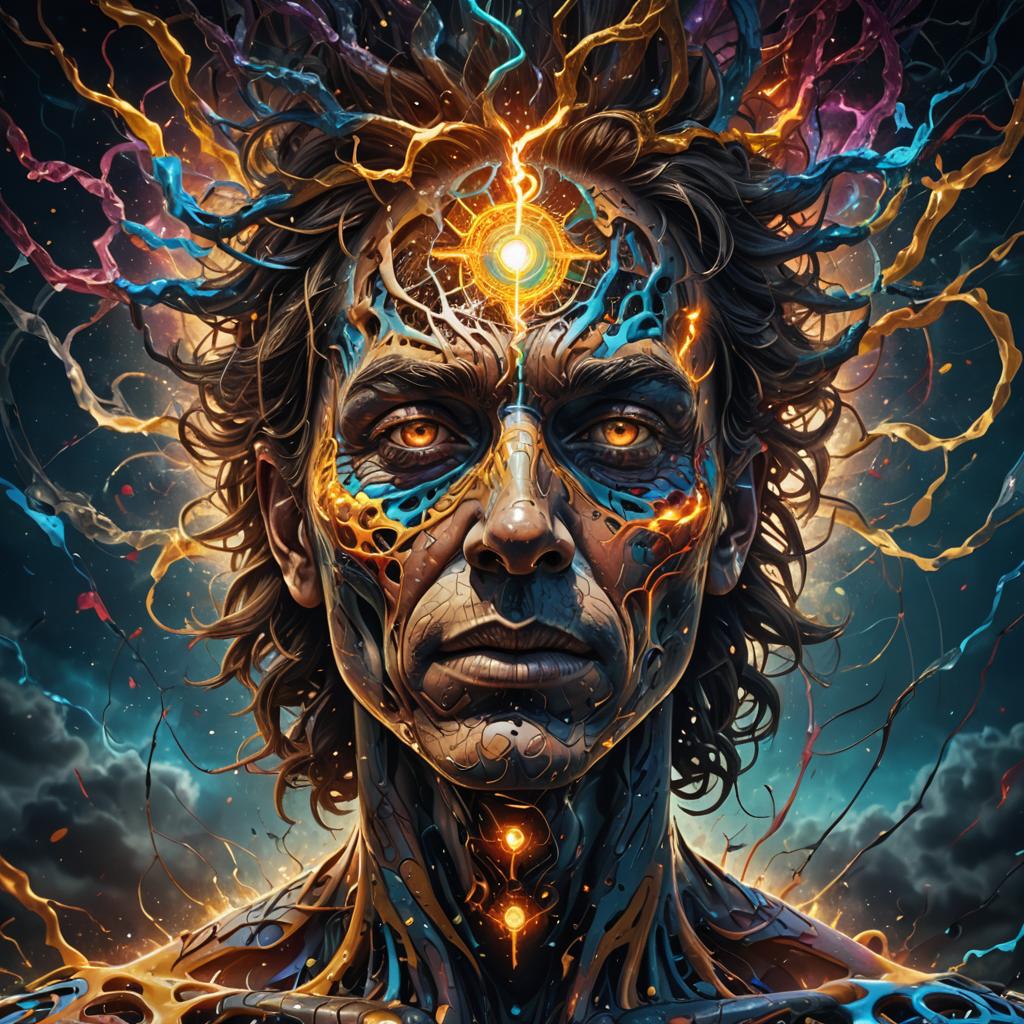
Physical phenomena are manifestations of quantum processes. Since quantum mechanics describes the behavior of particles at the smallest scales, it provides the framework for understanding the nature of reality.
Quantum physics
Quantum mechanics, the science of the very small, provides a profound framework for understanding the nature of reality. At its core, quantum mechanics reveals a universe governed by principles that defy classical intuition. Central to this framework is the concept of superposition, where particles exist in multiple states simultaneously until measured. This is mathematically described by the wave function, which encapsulates all possible states of a system and evolves according to the Schrödinger equation. The act of measurement collapses the wave function to a single outcome, introducing an inherent uncertainty and probabilistic nature to the behavior of particles. Additionally, quantum entanglement shows that particles can become interconnected, with the state of one particle instantaneously affecting the state of another, regardless of distance. This phenomenon challenges our conventional understanding of space and time, suggesting a deeply interconnected universe.
The implications of quantum mechanics extend beyond theoretical physics, influencing modern technologies and our philosophical outlook on reality. It underpins the development of quantum computing, which leverages superposition and entanglement to perform complex calculations far beyond the capabilities of classical computers. Quantum cryptography promises unbreakable security based on the principles of quantum entanglement.
Moreover, quantum philosophy challenges deterministic views of the universe, presenting a reality that is fundamentally probabilistic and interconnected. This perspective compels us to rethink the nature of existence and the role of observation, bridging the gap between the macroscopic world we experience and the microscopic world described by quantum mechanics.
Consciousness
Consciousness, from this viewpoint, might also be a phenomenon that occurs at the quantum level. There are theories that propose consciousness arises from quantum processes within the brain, such as the orchestrated objective reduction (Orch-OR) theory put forward by Roger Penrose and Stuart Hameroff. According to this theory, quantum processes in the microtubules of neurons could be the basis of consciousness.
Panpsychism
The idea of panpsychism, which posits that consciousness is a fundamental aspect of all matter, aligns well with the notion of quantum consciousness. If consciousness arises from quantum processes, and if quantum processes are ubiquitous in the universe, then it follows that some form of consciousness or proto-consciousness could be present at all levels of physical reality.
Panpsychism suggests that consciousness is not limited to complex organisms like humans but is a basic feature of the universe, present even in simple particles. This perspective challenges the traditional view that consciousness emerges only in highly organized and complex systems. Instead, it proposes that consciousness is a universal property, arising naturally from the quantum level of existence.
Concluding reflections
If everything is a manifestation of the quantum level and consciousness arises from quantum processes, then panpsychism, the idea that consciousness is inherent in all matter, makes coherent sense within this framework. This perspective bridges the gap between physical and conscious phenomena, suggesting a fundamental interconnectedness at the quantum level.





Leave a Reply