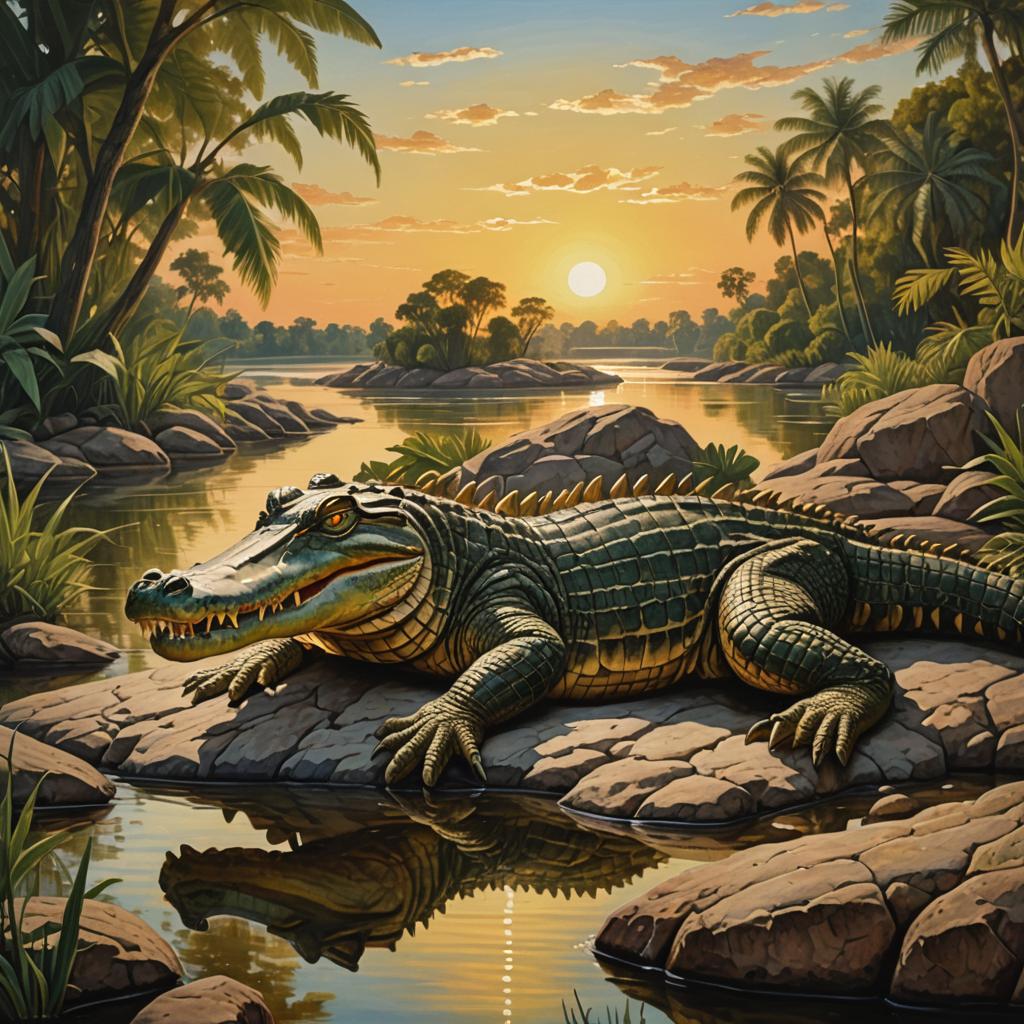
Crocodiles held a significant and complex place in ancient Egyptian religion and mythology, symbolizing both danger and protection. The Nile crocodile, prevalent in Egypt, was both feared and revered, influencing various aspects of religious life.
Sobek
The primary deity associated with crocodiles in Egyptian religion was Sobek, a god depicted as either a crocodile or a man with the head of a crocodile. Sobek was originally a god of the Nile, linked to the life-giving and destructive power of the river. He represented fertility, military prowess, and the might of the pharaohs.
Sobek’s most significant religious center was in the Faiyum region, particularly in the city of Crocodilopolis (also known as Shedet), where crocodiles were worshipped and mummified after death. These sacred crocodiles were believed to be incarnations of Sobek. The god’s cult spread throughout Egypt, and he was often associated with other deities, such as Ra, forming Sobek-Ra, a solar and creator deity.
Symbolism
In Egyptian mythology, crocodiles symbolized the chaos that threatened the order (Maat) of the world, making them both a force of destruction and a powerful protector. As the Nile’s waters could bring both life and death, so too could Sobek bring both blessings and curses.
These reptiles were also believed to protect against evil spirits, and their images were used in amulets for this purpose. The dual nature of the crocodile—dangerous and protective—mirrored the duality in Egyptian beliefs about life and the afterlife.
Crocodiles in the afterlife
Fearful crocodiles played a role in the Egyptian concept of the afterlife. The demon Ammit, known as the “Devourer of the Dead,” had the head of a crocodile, the forequarters of a lion, and the hindquarters of a hippopotamus. Ammit would devour the hearts of those deemed unworthy during the judgment in the Hall of Maat, ensuring that they would not proceed to the afterlife.
Artistic depictions
Crocodiles were frequently depicted in Egyptian art, either in their natural form or as part of Sobek’s iconography. Temples dedicated to Sobek often featured pools or lakes where live crocodiles were kept and fed, further emphasizing their sacred status. Priests cared for these animals, believing them to be manifestations of the god.






Leave a Reply