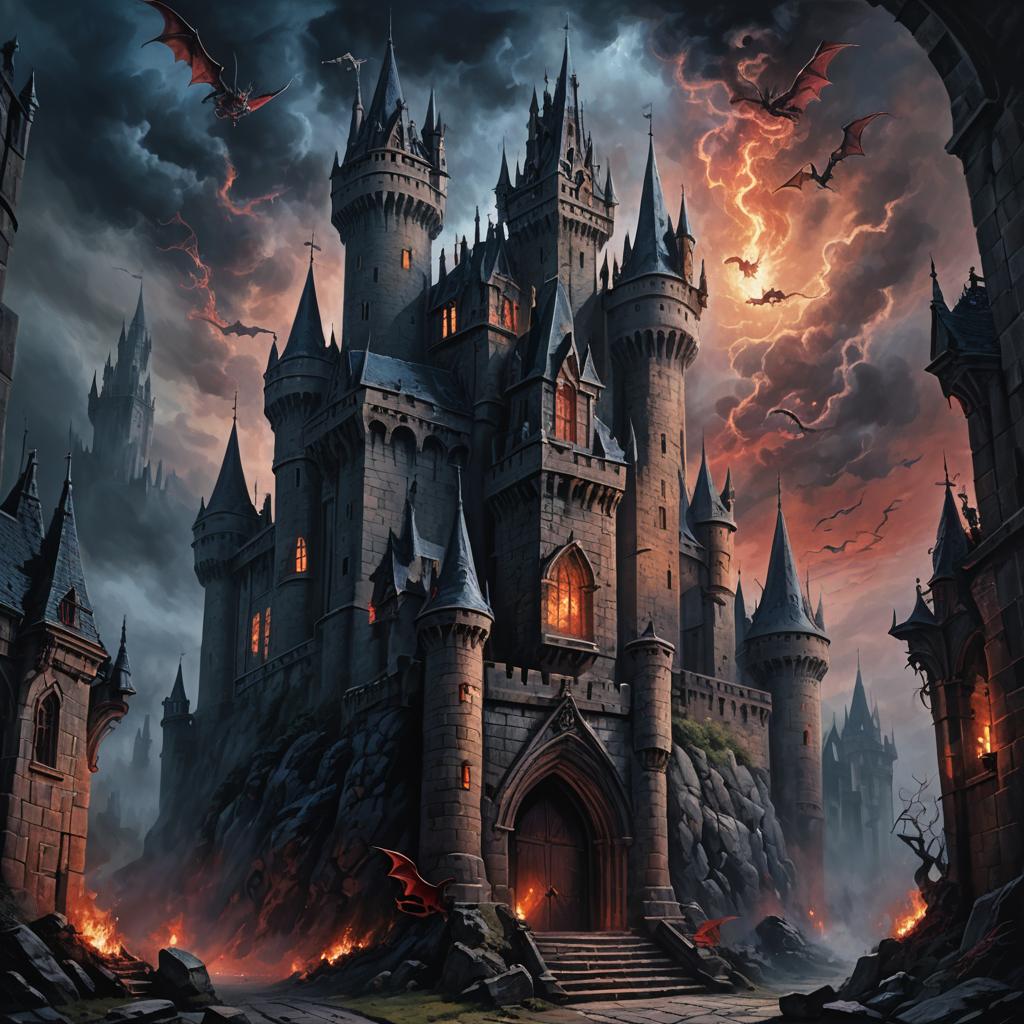
Gothicism plays an important role in modern culture, as it taps into our psychological and emotional undercurrents, often revealing the darker aspects of existence. Its influence impacts on literature, architecture, fashion, and popular media. What draws people to it is not just a fascination with the macabre or the supernatural, but a deeper exploration of fear, mortality, and the unknown, which resonate with many in a society that tends to sanitize or repress these realities.
In literature
In literature, for instance, Gothicism exposes the tension between rationality and emotion, often portraying protagonists who grapple with internal conflicts, haunted by their own subconscious fears or desires. The eerie and mysterious settings commonly associated with Gothic fiction—dark castles, abandoned ruins, stormy landscapes—serve as metaphors for the human mind’s hidden recesses. In this way, Gothicism reflects the psychological depths that we might otherwise ignore in everyday life. These stories act as allegories for our inner struggles, forcing readers to confront aspects of themselves and society that would otherwise remain hidden.
In architecture
In architecture and design, the Gothic revival that resurged in the 19th century still leaves an imprint today. Tall spires, pointed arches, and intricate detailing provoke an overwhelming sense of awe and dread simultaneously. This style mirrors the paradox of beauty intertwined with a hue of darkness, an idea that resonates with human emotions—how beauty often coexists with darkness or sorrow. This duality speaks to the human condition, where joy and fear are never too far apart.
In fashion
In fashion and subcultures, Gothicism offers an alternative to mainstream values, expressing alienation, individuality, and non-conformity. The resurgence of Goth fashion in the late 20th century, which continues today, communicates a rejection of superficial societal norms in favor of a more introspective, melancholic worldview. People who identify with Gothic culture often gravitate toward its expression of emotional depth, mystery, and even spiritual longing—traits that mainstream society may overlook or trivialize.
In popular media
In popular media, Gothicism appeals to audiences through its ability to externalize internal anxieties and provide a symbolic landscape where repressed feelings—fear, guilt, alienation—can be expressed without the constraints of reality. Think of the popularity of Gothic horror films or TV shows, which bring forth archetypal fears about life, death, and the unknown, often forcing viewers to question the line between the real and the imagined.
More broadly, Gothicism represents a cultural pushback against modernity’s insistence on progress, rationality, and order. In a world that prizes logic and productivity, Gothic themes remind us of the chaotic, irrational, and tragic aspects of existence that cannot be fully tamed. In a society that often focuses on exterior realities and productivity, Gothicism turns our attention back to the internal and the metaphysical, emphasizing that beneath the veneer of control and progress lies a vast, mysterious, and often disturbing realm of human experience.
Comparison with other movements
Gothicism, when compared with movements like Surrealism, Romanticism, and Dark Fantasy, shares a preoccupation with the subconscious, emotional depth, and the confrontation of unsettling or irrational aspects of existence. These movements, although distinct, all wrestle with the boundaries of reality, often rejecting conventional approaches to human experience in favor of exploring inner states, fantasy, and the mysteries of existence.
Surrealism and Gothicism
Gothicism, with its emphasis on darkness, fear, and the supernatural, shares Surrealism’s interest in the irrational and the subconscious, yet approaches these themes from different angles. Surrealism often seeks to disrupt reality through dream-like scenarios, absurd juxtapositions, and abstract representations, attempting to break free from societal norms by emphasizing the fluidity of the human mind. Gothicism, while also delving into the irrational, tends to be more grounded in the eerie and terrifying, focusing on how fear and mystery shape the psyche.
Where Surrealism is playful and disorienting, Gothicism is brooding and ominous, though both explore what lies beneath the surface of consciousness. Both are concerned with the boundaries of the known and the unknown, and they reject the rationalistic frameworks that govern daily life, preferring to probe the unknown.
Romanticism and Gothicism
Romanticism, like Gothicism, arose as a reaction to the Enlightenment and industrialization, movements that prioritized reason, progress, and order. Both Romanticism and Gothicism emphasize emotional intensity, nature, and individualism, but where Romanticism idealizes nature and portrays it as sublime, Gothicism finds horror and darkness within that sublimity.
Often Romanticism sees beauty in nature’s wildness, while Gothicism can interpret that same wildness as a symbol of unknown. The emotional depth they share is clear, as both engage with the complexities of human feelings, particularly melancholy, longing, and the sublime terror of confronting forces beyond human control. Yet Romanticism tends to express these emotions in more idealized or heroic terms, while Gothicism embraces tragedy and darker human emotions.
Dark Fantasy and Gothicism
Dark Fantasy, as a more modern genre, blends elements of both Gothicism and other fantastical traditions, creating narratives where magic and the supernatural exist entwined with horror or existential dread. Much like Gothicism, Dark Fantasy evokes feelings of unease, often presenting bleak worlds where human characters face malevolent forces beyond their comprehension.
Unlike Gothicism, however, which is often rooted in a specific, shadowy past or ancient settings, Dark Fantasy broadens the temporal and spatial scope, blending medieval, futuristic, or mythological elements. Both, however, share an affinity for exploring human vulnerability in the face of chaos and unknown forces, allowing the supernatural to serve as a mirror for internal conflicts and fears.
The complementary of these movements
What unites all these movements is their rejection of the purely rational or the optimistic view of humanity’s potential to control its environment. Each in its way suggests that there are forces—whether emotional, subconscious, supernatural, or irrational—that are integral to the human experience and cannot be fully understood, controlled, or dismissed.
They all embrace the complexities of existence, acknowledging that fear, desire, and mystery play essential roles in shaping who we are and how we see the world. By confronting the limits of reason and exploring the hidden dimensions of reality, Gothicism, Surrealism, Romanticism, and Dark Fantasy all question the neat, orderly structures that society often imposes, offering instead a glimpse into the chaotic aspects of life.







Leave a Reply