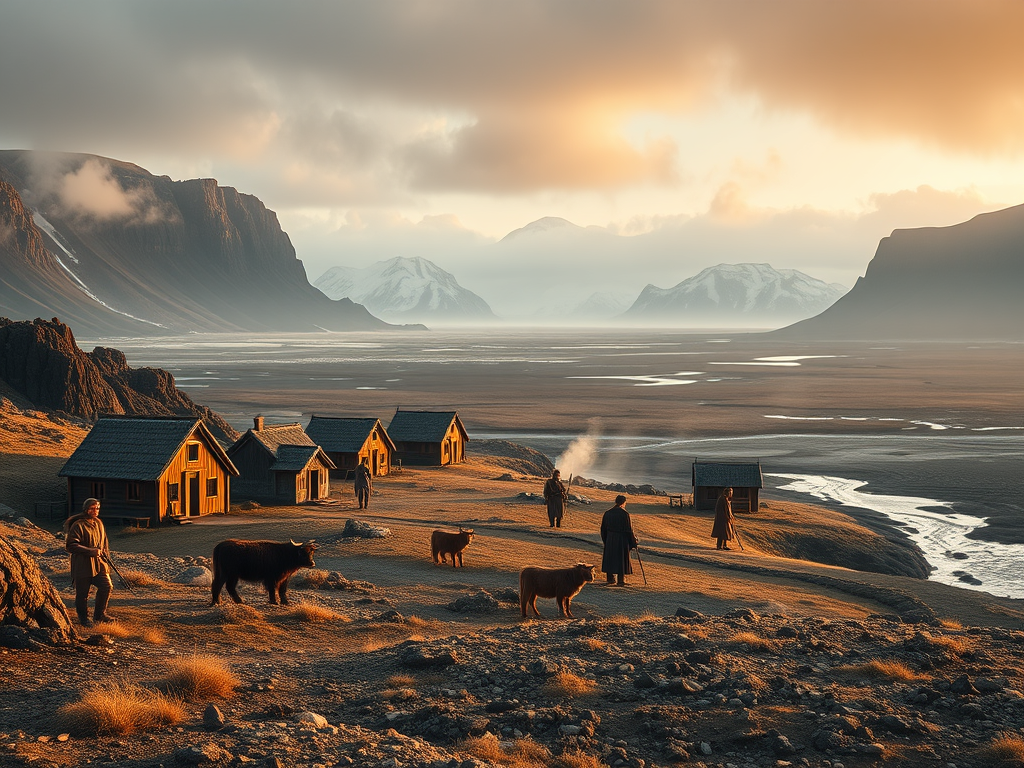
Iceland’s history reveal a story of resilience and adaptation. This land of fire and ice holds evidence of early human activity. This article was inspired by watching the fifth season of Vikings, where the character Floki colonizes Iceland, adding a narrative twist to the historical events that have shaped the island’s rich past.
The earliest settlement: reaching Iceland
Iceland remained uninhabited for most of human history due to its isolation and harsh conditions. The first settlers arrived around 870 AD, according to the medieval Icelandic sagas. Norse Vikings from Norway are believed to have been the first to set foot on the island. These settlers were likely looking for new land to farm and raise livestock. The first arrivals faced a daunting challenge: an unpredictable climate, volcanic activity, and limited resources. Despite these challenges, they established permanent settlements along Iceland’s coast. Archaeological excavations reveal early Viking farms and structures, showcasing how these settlers adapted to their new environment.
The environment and early challenges
Iceland’s environment played a key role in shaping the early lives of its settlers. The volcanic landscape, with its geothermal hot springs and ash-covered plains, provided both opportunities and challenges. The settlers relied heavily on livestock, fishing, and farming to sustain themselves. However, Iceland’s climate proved to be difficult, with long, harsh winters and unpredictable volcanic eruptions. The early Icelandic settlers learned to manage their environment, utilizing the geothermal energy for warmth and cooking. The island’s rugged terrain forced the settlers to live in tight-knit communities, often relying on each other for survival.
The Althing
By the 10th century, Iceland had established a thriving society. The islanders created a unique political system called the Althing, which is considered one of the world’s oldest parliaments. The Althing met annually, bringing together representatives from various districts to discuss laws and resolve disputes. Iceland’s early society had no centralized government but operated on a system of local chieftains and laws. This decentralized system allowed for a relatively democratic form of governance, where free men could participate in decision-making.
If the sagas bring us closer to the hearts and minds of Iceland’s early people, they also reveal the complex political fabric that held the island together. Central to this was the Althing, the assembly where laws were made, disputes settled, and justice administered. But the Althing wasn’t just a place for discussion—it was a living drama, a stage where human lives could be irrevocably altered.
In Laxdæla Saga, we witness how the decisions made at the Althing ripple through families, changing fates and sometimes leading to bloody consequences. The Althing wasn’t just a forum for law; it was a forum for identity and survival. The sagas show us that for many, the Althing was the last opportunity to find justice or to avenge a wrong. It was here that the very concept of what it meant to be Icelandic was debated and defined.
The Viking Age
Iceland’s role during the Viking Age (8th to 11th century) is crucial to understanding its ancient history. While Icelanders are best known for their seafaring raids, they were also traders, explorers, and settlers. Iceland served as a key stopover point for Vikings traveling between Scandinavia and the North Atlantic. The islanders traded goods like timber, fish, and wool. They also sailed westward, establishing colonies in Greenland and even reaching North America. The most famous Viking explorer from Iceland was Leif Erikson, who might have landed in North America around the year 1000. This journey marked one of the first European arrivals on the continent, centuries before Columbus.
Religion
The early Icelanders held strong beliefs in Norse gods and myths. They worshipped deities like Odin, Thor, and Freyja, and rituals often involved sacrifices to ensure good harvests or protection in battle. Icelanders built temples and held festivals to honor these gods, with sacrifices taking place in sacred groves or at high-altitude sites.
From Norse gods to Christianity
The transformation of Icelandic society from its Norse pagan roots to Christianity is another poignant theme in the sagas. The Saga of the Conversion of Iceland brings to life the struggle between those who held fast to the old beliefs and those who embraced the new faith.
In these moments of transition, the sagas reveal the conflict between tradition and the demands of a changing world. The fear of losing one’s identity, of severing ties to the gods who had guided their ancestors, resonates deeply in the text. Yet, the sagas also show the resilience of the Icelandic people, their ability to adapt and find new ways of being that didn’t completely erase the past. Through the stories of the men and women at the forefront of the Christianization process, we see how Iceland navigated this monumental change.
Iceland’s sagas
Iceland’s ancient history left a lasting legacy, particularly through its sagas. These epic tales, written in the 13th century but based on oral traditions, tell the stories of Viking explorers, settlers, and their families. They offer valuable insight into the lives of early Icelanders, their social structures, and their beliefs.
The sagas also provide insights into the social structure of early Icelandic society. Family ties were crucial, with complex kinship systems governing relationships. The importance of honor, reputation, and personal achievements played a central role in interactions between characters.
Law and justice were key elements in the sagas, often explored through disputes over land, inheritance, and vengeance. Iceland’s unique legal system, the Althing, featured prominently in these narratives. The Althing, one of the world’s oldest parliaments, allowed for the resolution of conflicts through assemblies and the guidance of laws, serving as a backdrop for many saga events.
At the heart of many sagas is the theme of exploration. Vikings weren’t only warriors—they were pioneers, venturing out to unknown lands across the sea. Figures such as Erik the Red, the founder of Greenland, and his son Leif Erikson, who sailed to North America long before Columbus, are central to these epic tales. Their journeys were not simply adventures; they were battles with nature, survival in extreme conditions, and the pursuit of a future carved out on foreign soil. The sagas portray these explorers as complex characters, driven not only by ambition but by the realities of their time—a fierce need for land, resources, and survival.
Family and feuds
The sagas also delve into the intricate dynamics of early Icelandic society. They are, in many ways, family chronicles. The relationships between kin, friends, and enemies were central to the social structure of the time. The Njáls Saga, one of the most famous, explores themes of loyalty, revenge, and the harsh price of honor. Blood feuds were a recurring motif—conflicts passed down through generations, as the past loomed over the present. These feuds often revealed the societal balance between personal honor and the communal need for peace.
Njál’s Saga
No saga reflects the blood and fire of Viking life more than Njál’s Saga, a story that stands as a powerful symbol of Iceland’s deeply entrenched concept of honor and revenge. Imagine the burning rage of a man whose honor is tarnished by an insult. In Iceland, such an offense could set off a chain of destruction that would echo through generations.
Njál, a wise and revered man, finds himself caught in the turbulent currents of family feuds. His story is one of deep wisdom, but also of tragic consequence. His saga unfolds as Njál’s family engages into a deadly conflict with the sons of another man, over a series of insults and perceived wrongs. The escalating violence that follows is not just a matter of physical confrontation; it is a psychological battle, one that pits personal honor against the survival of the community. As Njál’s own sons die, the saga takes us through the bitter realization that the very values that once defined Icelandic society—loyalty, respect, and honor—can destroy everything in their path.
Through Njál’s story, we see the stark reality of Viking society—its ruthless cycles of vengeance, its often destructive loyalty, and the deep consequences of living by a code that demands absolute retribution. The final, tragic moments of the saga reveal that the price of honor was sometimes too high to bear.
The lasting legacy of the sagas
Today, the sagas remain one of the most important contributions to world literature. They offer not only historical narratives but also rich insight into the human experience. The sagas of Iceland continue to be studied, appreciated, and admired for their deep exploration of human nature and society. Icelanders remain deeply connected to their sagas, and these ancient texts continue to inspire modern works of literature, film, and art.






Leave a Reply