Disclaimer: This text contains serious spoilers.
Every ten years, I return to Ubik by Philip K. Dick, and each time, it astonishes me in ways I didn’t expect. No matter how familiar I think I am with its world, it refuses to settle into a single interpretation. It doesn’t just make me question its themes—it makes me question myself, my assumptions, my entire perception of what is real. There’s something both exhilarating and deeply unsettling about that.
What is real?
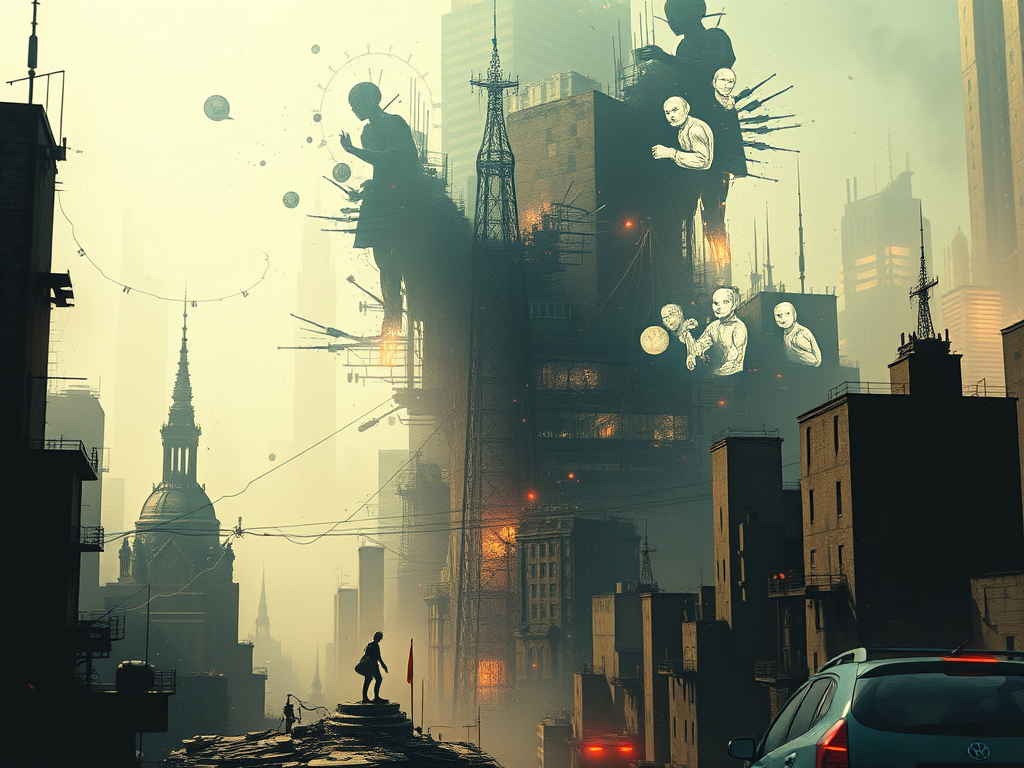
Reality in Ubik is an unstable, flickering construct. The story follows Joe Chip, a man who thinks he understands the rules of his world—until those rules begin to collapse. Time regresses, objects revert to outdated forms, and people disintegrate before his eyes. It’s not just his environment that’s falling apart; his certainty about reality itself erodes with each passing moment.
This taps into the same existential terror found in The Matrix and, centuries earlier, in Plato’s allegory of the cave. In both cases, what people take for reality is nothing but a projection, a shadow cast by forces they cannot see.
But Ubik goes further. It suggests that reality isn’t just manipulated—it’s inherently fragile, breaking down like an old film reel burning away in the projector’s heat.
The half life
And then there’s half-life, that eerie middle state between existence and oblivion. In this world, the dead don’t truly die—they linger, communicating in fragmented, dreamlike interactions.
This brings Maya to mind, the Buddhist concept of illusion. Just as Maya suggests that life itself is deceptive, Ubik forces us to wonder: are the protagonists actually alive, or are they merely remnants of consciousness clinging to a dissolving reality? And if reality can degrade, if time itself can unravel, then what was it in the first place? A construct, a dream, a fleeting moment before the inevitable void?
The dynamics of power in a psychic world
Yet, Ubik isn’t just about metaphysical horror—it’s about power, control, and the unsettling idea that perception itself is a battleground. The novel’s world is ruled by corporations, psychic espionage, and forces that shape reality without anyone’s consent.
This isn’t far from The Matrix, where reality is engineered to keep people docile, their illusions maintained by an unseen authority. In Ubik, this authority isn’t an AI but something even more elusive—perhaps commercial, perhaps divine, perhaps an accident of entropy.
Ubik and Gnosticism
The novel doesn’t just depict reality as unstable—it presents it as a battleground where two unseen, opposing entities struggle for control. This recalls the dualistic themes found in Gnostic texts, where the material world is shaped by conflicting divine and corrupt influences. In Ubik, this manifests through the conflict between Jory, who consumes the life essence of others trapped in half-life, and the mysterious, benevolent Runciter, who tries to guide Joe Chip toward stability. These two forces dictate whether reality crumbles or holds together, much like the Gnostic notion of a false demiurge crafting an illusionary world while hidden knowledge offers escape.
The manifestations of reality’s breakdown in Ubik are more than just eerie regressions in time. They are symptoms of an ongoing war over perception itself. Objects revert to older versions of themselves, people rot and decay as though time itself rejects them, and messages from Runciter appear in the most unexpected places—coins, graffiti, product labels—as if reality is desperately trying to send Joe Chip a lifeline. These manifestations feel almost religious, resembling divine revelations or cryptic warnings, reinforcing the idea that the characters exist within a controlled illusion.
What is Ubik?
The titular Ubik product appears as salvation, a miracle in an aerosol can. But is it really? Is it truth, or just another illusion, a desperate attempt to stabilize a world already beyond saving?
And yet, despite all its existential dread, Ubik resists absolute despair. Even in a crumbling reality, something fights back. Whether it’s human will, some unknown force, or the mind’s refusal to surrender to chaos, there’s a suggestion—just a whisper—that maybe, just maybe, something real exists beyond the illusion.
Ubik and the Blade runner
Both Ubik and Blade Runner (the 1982 film based on Philip K. Dick’s Do Androids Dream of Electric Sheep?) explore the fragility of reality, the instability of identity, and the struggle against forces that manipulate perception. However, while Blade Runner maintains a noir-infused, grounded approach to these themes, Ubik plunges headfirst into metaphysical horror, making its exploration of reality far more chaotic and unsettling.
At the core of both narratives is a protagonist grappling with the shifting nature of existence. The film toys with memory implants and false histories, echoing the way Ubik challenges the very structure of reality itself. In Ubik, Joe Chip doesn’t just question whether someone is real—he questions whether reality itself is disintegrating around him.
Time and entropy play crucial roles in both. Blade Runner presents replicants with limited lifespans, creating a sense of urgency as they try to extend their existence. Roy Batty’s desperate search for more life mirrors the way Ubik’s characters struggle against a deteriorating reality where time regresses unpredictably.
Corporate control
Corporate control looms over both narratives, but in distinct ways. Blade Runner presents Tyrell Corporation as the architect of artificial life, commodifying and controlling existence itself. In Ubik, corporate power operates in a less direct but even more insidious way—through psychic espionage.
Tyrell’s motto, “More human than human,” encapsulates the dilemma of artificiality versus authenticity, whereas Ubik suggests an even darker notion: what if everything we take for real is just another layer of deception?
Where Blade Runner remains noir, melancholic, and visually hypnotic, Ubik is hallucinatory, unsettling, and unpredictable. Blade Runner contemplates what it means to be human, while Ubik asks whether anything—humanity, time, existence—is even real in the first place. Both leave their protagonists with unanswered questions, lingering doubts, and a reality that refuses to be pinned down.
Philip K Dick’s legacy
Philip K. Dick’s works—hallucinatory, unsettling, and deeply philosophical—explore the fragility of reality, the instability of identity, and the unseen forces shaping both, making his vision eerily prophetic in an era of deepfakes, virtual realities, and algorithmic manipulation.
His narratives suggest that what we take as real is always subject to hidden influences, whether corporate, technological, or even metaphysical. He fused Gnostic themes with pulp storytelling, blending speculative fiction with philosophical depth, creating worlds where perception itself is unreliable and where salvation—if it exists—lies in the act of questioning.
If a fan of him you would know that his ideas have transcended literature, shaping films like Blade Runner, Total Recall, and A Scanner Darkly, influencing everything from cyberpunk to postmodern philosophy, and proving that his vision of reality as a layered, shifting construct was not just fiction but a reflection of the world we live in today.





Leave a Reply