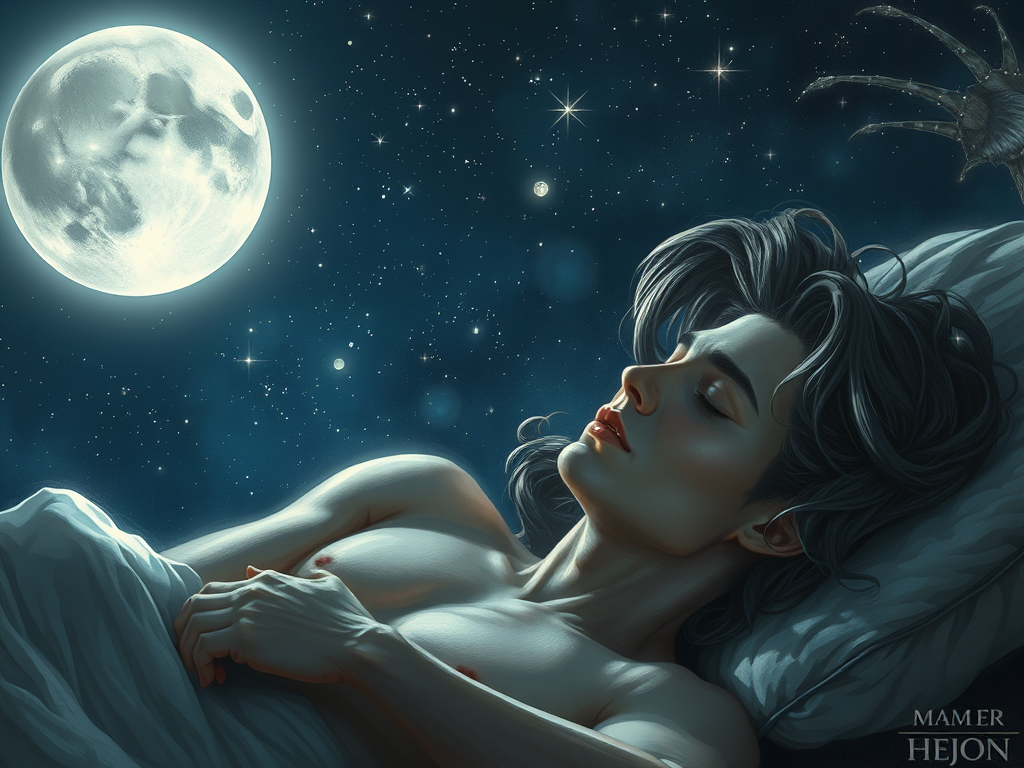
Greek mythology holds many stories of love, fate, and divine intervention. Among them, the tale of Endymion stands out as one of the most mysterious and poetic. Ancient texts offer different versions of his life, but all agree on one thing—his fate was unlike any other. Whether he was a shepherd, a hunter, or a king, Endymion’s beauty caught the attention of a goddess, and his eternal sleep became the stuff of legend.
The love of Selene and Endymion
Selene, the goddess of the moon, saw Endymion as he rested beneath the night sky. His radiant beauty enchanted her, and she fell deeply in love. Every night, she rode her silver chariot across the heavens and gazed down at him, unable to resist his charm. Some say she descended to Earth, embracing him in secret, bathing him in her pale light. Theirs was a love that defied mortal limits, bound to the cycles of the moon and the stillness of the night.
A gift or a curse?
Zeus, ruler of the gods, played a crucial role in Endymion’s fate. Some versions of the myth say that Selene asked Zeus to grant Endymion eternal youth so she could love him forever. Others claim Zeus himself cast Endymion into an everlasting sleep as a punishment or as a way to preserve his beauty. In either case, Endymion remained untouched by time, neither aging nor waking. He lay in a cave on Mount Latmus, his features forever serene, as if lost in an eternal dream.
Endymion’s slumber became more than just a physical state. It symbolized a life caught between existence and oblivion, between love and longing. Selene’s visits to his resting place transformed his sleep into something more profound. Did he dream of her? Did he hear her voice as she whispered through the night? His dreams became a realm of their own, where love endured beyond time and space. In this way, Endymion lived on, not in waking life but in the realm of dreams and myth.
The symbol of longing
The myth of Endymion has fascinated poets, artists, and philosophers for centuries. His eternal sleep represents more than divine love—it speaks to human longing, the desire to preserve beauty, and the struggle against the passage of time. His story asks whether immortality is a gift or a burden. If frozen in time, does love truly last, or does it become a shadow of what it once was? These questions keep Endymion’s legend alive, ensuring that his name, like Selene’s love, never fades.
A Jungian perspective on Endymion
The myth of Endymion reflects the depths of the unconscious. His eternal sleep mirrors the hidden world beneath waking awareness. Jung saw myths as expressions of the psyche, revealing universal patterns within the collective unconscious. Endymion’s story speaks to the mysteries of the inner self.
Selene, the moon goddess, might represent the anima, the feminine aspect within the male psyche. She watches over Endymion, drawn to his beauty and stillness. Her descent to him symbolizes the connection between consciousness and the unconscious, guiding him toward deeper self-awareness. The anima serves as both a muse and a bridge to hidden knowledge.
The cave as the place of transformation
Endymion sleeps in a cave, a sacred place in mythology and Jungian psychology. Caves symbolize the descent into the unconscious, the realm of dreams and introspection. His sleep is not death but a process of inner transformation. The cave shelters him, allowing him to exist outside of time.
Jung valued dreams as a gateway to self-discovery. Endymion’s eternal sleep places him in a state of perpetual dreaming. His dreams become a means of connection with Selene, the anima, and the archetypal forces that shape his existence. His story reminds us that the unconscious holds wisdom beyond waking thought.
The myth as a journey of individuation
Endymion’s fate reflects the path of individuation, the process of integrating the unconscious with the conscious self. His sleep is not mere stillness but an inward journey. Through his connection with Selene, he moves toward wholeness, embracing the depths of his soul. His story teaches that self-knowledge requires surrender to the mysteries within.






Leave a Reply