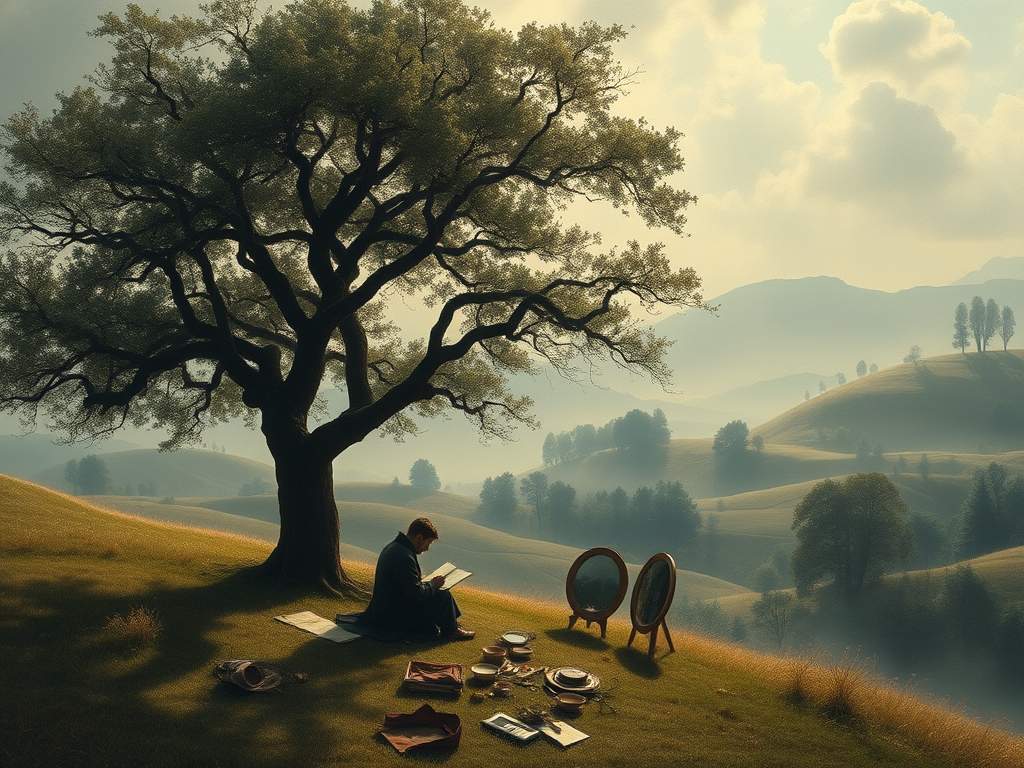
Romanticism rose in the late eighteenth century as a response to the cold rationality of the Enlightenment. In the shadows of revolutions and industrial upheaval, poets and painters sought refuge in the spiritual, the emotional, and the sublime. The step forward in culture, the Romantic vision of the soul that resisted mechanistic thought, insisting that nature, emotion, and imagination held truths inaccessible to logic.
Embraced mainly by intellectuals of the ninetieth century Romanticism was a spiritual yearning dressed in poetry, landscape, and flame. It offered a vision of the soul that resisted mechanistic thought, insisting that nature, emotion, and imagination held truths inaccessible to logic. Symbolism, emerging decades later, did not replace that vision—it inherited its aching spirit and carried it further inward. Where the Romantics turned toward sublime mountains and tragic heroes, the Symbolists peered through veils and mirrors, following the echoes that Romanticism had awakened but not resolved.
A different kind of escapism
There was escapism in both movements, but of a different nature. The Romantic poet often wandered the earth, lost in memory and melancholic awe, searching for a home in the vastness of the world or in love. The Symbolist withdrew not geographically, but psychologically—into the self, into dreams, into the murky silence beneath language. Yet both were driven by the same desire: to reclaim a sense of mystery in a world that increasingly denied it. In that sense, Symbolism did not simply follow Romanticism—it deepened its questions and altered their direction.
The sacred veil of language
Words, for the Romantics, carried passion, but for the Symbolists, they carried shadows. But in both, language was a ritual. Poets no longer used verse as mere ornament or didactic tool—they saw it as invocation. Mallarmé’s elliptical phrases owe as much to Keats’ sensual reveries as they do to Baudelaire’s decay-laced stanzas. From Keats, Mallarmé inherited the desire to give language a texture so rich it becomes almost palpable—a music of sensation, where words evoke moods beyond their literal meaning. Keats’ lush imagery opened poetic space where absence and longing could shimmer in soft ambiguity. From Baudelaire, he drew the impulse to reveal the uncanny behind the ordinary, to let beauty and rot coexist, and to turn inner disintegration into a new form of art. The Symbolists took Romantic lushness and wove into it the estrangement of the modern psyche.
Myths as a shared pulse
The Romantics rediscovered myth; the Symbolists re-enchanted metaphor. Yet myth was not merely a source of stories—it was a vessel of symbolic truth, a shared code that both movements used to reach toward the sacred.
The Romantics returned to Greek gods, Nordic legends, and Christian mysticism, not to recreate past beliefs but to resurrect forgotten dimensions of the soul. Myth was the language of the eternal—used not for spectacle, but for spiritual recovery. Romanticism embraced the mythic archetype as a figure of reflection: Prometheus became the emblem of creative suffering, Orpheus the soul’s descent for beauty. Symbolists did not abandon those myths; they buried them deeper, threading their symbolism with Orphic tones, Dionysian patterns, and Hermetic allegories.
Myths became bridges across the two eras. The mythic journey transformed from external quest to internal rite. In that mutual obsession with the ineffable, they stood not in opposition but in dialogue across the threshold of a century.
Symbols as spiritual allegories
Long before the Symbolists, Romantic poets were already treating symbols as sacred tools for inner exploration. They mined nature and myth for images that served as allegories—vehicles for lessons that reached beyond the rational mind. The nightingale, the ruined abbey, the storm-tossed sea—each became a mirror of the soul, a metaphor layered with spiritual resonance. Wordsworth’s solitary reaper and Blake’s tyger were not merely lyrical subjects but revelations clothed in metaphor. Their use of symbol was not decoration—it was initiation, intended to awaken dormant awareness. The Symbolists inherited that approach, not by imitation but by turning symbols inward, making them less transparent, more dreamlike, more elusive.
Rebellion with reverence
Despite their different temperaments, neither movement existed to destroy what came before. Romanticism, for all its intensity, revered antiquity and the inner divine. Symbolism, no less radical in its withdrawal, paid homage to Romantic subjectivity even as it dissolved the ego into archetype and dream. The Symbolist gaze did not reject Romantic vision; it dissolved it into a more intimate opacity. The torch was passed not by proclamation, but by shared silence.
The echo that reshapes the voice
What began as Romantic awe became Symbolist ambiguity. But awe and ambiguity are siblings. One looks outward, the other inward—but both are gestures of reverence. And so the conversation between Romanticism and Symbolism remains unfinished, looping across generations, alive in the works of those who still believe the visible conceals the real. The inheritance was not linear. It was ritualistic, psychological, like memory itself. Romanticism gave Symbolism its soul, and Symbolism answered by giving it a second, more haunted voice.







Leave a Reply