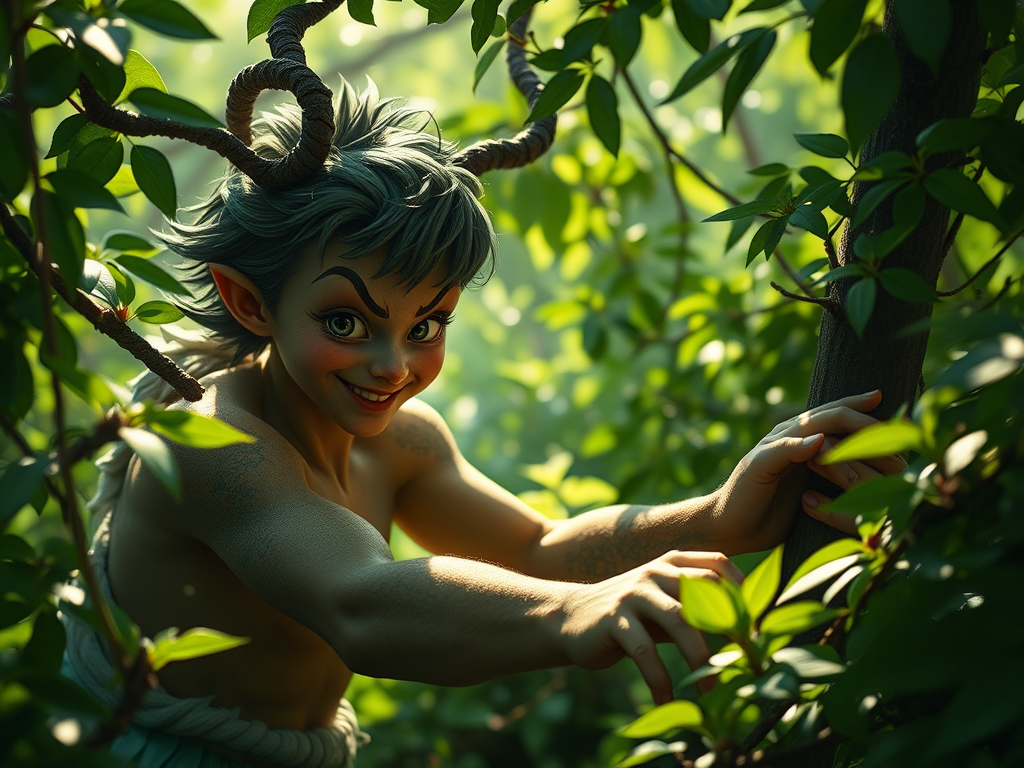
Puck, the Green Man, and Robin Hood emerge from a shared ancient tradition rooted in humanity’s relationship with the forest, nature’s power, and defiance of social order. They represent different expressions of the same primal archetype connected to wildness, freedom, and the forest’s mysterious influence. Understanding their subtle differences reveals how they together embody the complexity of the forest spirit in human culture.
Puck as the active forest spirit
Puck acts as the living, breathing manifestation of the forest’s unpredictable energy. He moves through human and natural realms with agility and mischief, disrupting order and breaking boundaries. Puck’s presence injects chaos and playfulness into the world, making him a dynamic force that stirs change and challenges authority. As the forest spirit incarnate, he expresses nature’s restless intelligence and constant motion, embodying the untamed, sometimes unsettling vitality of the wild.
The Green Man’s symbolic and dramatic force
Unlike Puck’s constant movement, the Green Man stands as a more passive, symbolic figure rooted in the cycles of growth, decay, and renewal. His image in carvings and legends connects humans to nature’s eternal rhythm. Though often silent and still, the Green Man can manifest dramatic power, especially in Arthurian legends where he takes on roles that influence fate and transformation. His presence reflects nature’s deep, sometimes violent forces beneath its calm surface—ancient, enduring, and capable of sudden, profound action.
Robin Hood as the rebel
Robin Hood channels the forest spirit’s defiance into human resistance. He lives outside the law, operating within the forest as both refuge and weapon against corrupt power. Robin Hood embodies practical rebellion grounded in a moral code shaped by the forest’s freedom and justice. His guerrilla tactics and protection of the oppressed reveal how the forest tradition can take concrete social form, transforming wildness into purposeful challenge against authority.
Myths vs legends with forest spirits
The forest serves as the common ground linking these figures, representing a place where human society’s structures weaken and nature’s raw forces prevail. It offers shelter and power to those living beyond or against social norms. Each figure draws strength from the forest’s mystery and danger, shaping their roles as disruptor, symbol, or rebel within the same timeless tradition.
Myths serve as expressions of archetypes—universal symbols that emerge from the collective unconscious. In this framework, the Green Man functions as an archetype representing nature’s cycles, regeneration, and the wild spirit of the forest. Myths communicate this archetype in symbolic, timeless, and often abstract ways, emphasizing fundamental truths about life, death, and renewal.
Legends, in contrast, transform archetypes into human narratives. They give recognizable form to the archetype by connecting it to figures who share the archetype’s traits but exist within specific social or historical contexts. These stories humanize the archetype, providing motives, actions, and relationships that allow people to engage with the archetype’s power on a personal level.
Robin Hood exemplifies this process as a legend grounded in the same archetypal tradition as the Green Man or Puck. While the Green Man and Puck remain symbolic representations of the forest spirit, Robin Hood appears as a human figure who embodies the archetype’s qualities—rebellion, justice, connection to the wild, and resistance to oppressive authority. His story personalizes the archetype, turning abstract qualities into concrete actions and ethical choices within a narrative that resonates culturally.
A nuanced tradition of wildness and power
Together, Puck, the Green Man, and Robin Hood express a tradition that honors nature’s intelligence, cycles, and resistance. Puck embodies the forest’s restless spirit; the Green Man symbolizes nature’s deep, often hidden force; and Robin Hood represents active rebellion born from these energies. Their interplay reveals how humans have understood and reimagined the forest spirit as both playful and serious, passive and dramatic, mystical and practical—an enduring source of freedom and transformation.






Leave a Reply