
Jack London’s life reads like a novel of the redemptive power of reflection. Born in 1876 into poverty and instability, he grew up in a fractured household where neglect and deprivation were the norm. His father abandoned him, and his mother’s erratic behavior left him largely to his own devices.
Born into poverty, with an unstable mother and an uncertain father, he grew up with a sense of being unanchored — a child who had to invent himself from scratch. That early insecurity became the engine of his personality. He threw himself into the world with ferocity, as if each new ordeal might reveal something essential about who he was.
As a boy, he was forced into grueling labor, working in factories and on the waterfront, and by adolescence he had already slipped into a life of poor self restrain. He stole oysters to survive, drank heavily, and drifted into petty crime. His choices were impulsive, driven by hunger and restlessness rather than foresight, and they eventually landed him in jail for vagrancy.
As a teenager he was jailed for vagrancy during his tramp travels, and he wrote a first hand account of the experience in “My Life in the Underworld”). In that narrative, he describes being arrested at Niagara Falls, processed, and confined, giving a detailed picture of the routines, slang, and psychology of life “on the road” and inside a cell. The episode taught him how swiftly minor, impulsive choices could collapse into legal trouble, and how the machinery of policing and incarceration weighed especially hard on the poor and itinerant.
The jail experience sharpened his sense of class and social injustice: he saw how vagrancy laws criminalized destitution and how confinement stripped people of dignity and agency. That exposure contributed to a lifelong interest in the criminal justice system’s effects on the marginalized, a theme that later surfaced in his reporting and fiction, and set the stage for his more explicit engagement with prison reform in the 1910s.
London’s later novel The Star Rover (published as The Jacket in England) directly challenges public assumptions about crime and punishment, drawing on testimony from ex convict Edward Morrell and London’s own observations to criticize brutality and solitary confinement. The work reflects what he took from his early incarceration: that prisons can deform rather than rehabilitate, and that humane reform is necessary to protect both individual potential and social wellbeing.
It was in that moment of confinement that London began to reflect, realising that if he continued to live recklessly, his life would collapse into nothing. Reflection set his change in motion, shaping the decisions that followed. He turned to books, teaching himself through voracious reading, and began to see that discipline could open doors to a different kind of life. His adventures—sailing across the Pacific, prospecting in the Klondike, wandering through foreign lands became opportunities to observe, to learn, and to transform his experiences into stories.
Jack London grew up in Oakland in a family that struggled to make ends meet. From an early age he worked long hours in factories and on the waterfront, learning more about exhaustion and survival than about books. His early years were shaped by physical labor, unstable circumstances, and the sense that life demanded constant effort. He carried these experiences with him when he sailed to Japan as a young seaman and later when he travelled the country as a hobo. Each chapter left him with impressions of hardship, resilience, and the ways people respond when choices are limited.
He began writing in his late teens, first as a way to record what he had seen and later as a deliberate attempt to shape those experiences into stories. A short story he submitted to a contest won first prize, and that small success showed him that the life he had lived so far contained material worth examining. He continued to write, sending out pieces to newspapers and magazines, learning the craft through persistence rather than formal training. Writing became a place where he could look back at the events that had shaped him and understand them with more clarity than he had at the time.
When he began to write about the Yukon, the stories that emerged were grounded in what he had lived: the struggle against nature, the pressure of survival, and the thin line between endurance and collapse. Writing allowed him to revisit those moments and make sense of them in a way that daily life had not allowed.
As he continued, writing gradually gave him direction after years of drifting from one job to another. His keen understanding of human nature allowed him to look closely at his own choices and the forces that had shaped them. Through the act of shaping narrative, he began to see patterns in his own life—his sympathy for the marginalized, his interest in social justice, his fascination with strength and vulnerability. These themes appeared in his work because they were the questions he returned to whenever he wrote.
Writing allowed him to take the raw material of his past and turn it into something coherent. Experiences that might have remained only as private burdens became stories that others could read and understand. The process helped him understand himself more fully and gave him a sense of purpose that had been missing in his early years.
He imposed strict routines on his days, often producing a thousand words before noon, treating literature as both craft and mission. This discipline was a profound shift from the chaos of his youth, and it reflected a conscious effort to shape his own expression. The consistency of his output suggests an ongoing attempt to refine how he organized thought and directed intention, an implicit form of optimization through which he sought to bring his inner drive into clearer form.
His books reached a wide audience, but the more important transformation happened in the quiet work of turning lived experience into narrative. Reflection guided him toward writing, and writing helped him see his own life with greater honesty and depth. That steady practice of looking back and shaping what he found influenced the way he wrote and the way he lived.
London’s inner narrative
London believed that the proper function of man was “to live, not to exist.” He rejected the idea of merely surviving day to day and instead embraced life as an arena for adventure, risk, and self-assertion. This philosophy shaped his resilience: difficulties were not obstacles to be avoided but tests of vitality.
Hs inner narrative was built around the idea of struggle as a creative force. Seeing life as a game where one might not always hold the best cards, his take on resilience meant playing a poor hand well. This perspective allowed him to reinterpret failure as opportunity. When his manuscripts were rejected, he did not see it as defeat but as part of the process of proving himself. The way he responded to these setbacks suggests a deliberate effort to shape his own trajectory, using each challenge as material for further refinement.
Influenced by William James and American pragmatism, he saw himself as someone who valued practical outcomes and action over abstract theory. For him the purpose of life was to live fully, not merely to exist, and he measured himself by his ability to embrace risk, adventure, and intensity.
Taking pride in his working class origins, Jack London—like his fictional counterpart Martin Eden—saw himself as someone who had clawed his way out of poverty through sheer effort and discipline. His rise was fuelled by the belief that the hardships of labor and deprivation could be transformed into strength. In this way, his personal struggle became inseparable from his art, allowing him to speak for countless others striving to transcend the weight of circumstance.
Strongly identifying himself with socialism, London saw himself as a voice for the working class and someone who could use literature to expose inequality. However, he recognized tensions within himself—between intellectual pursuits and working-class identity, between materialism and a yearning for meaning—often dramatized in his stories like South of the Slot.
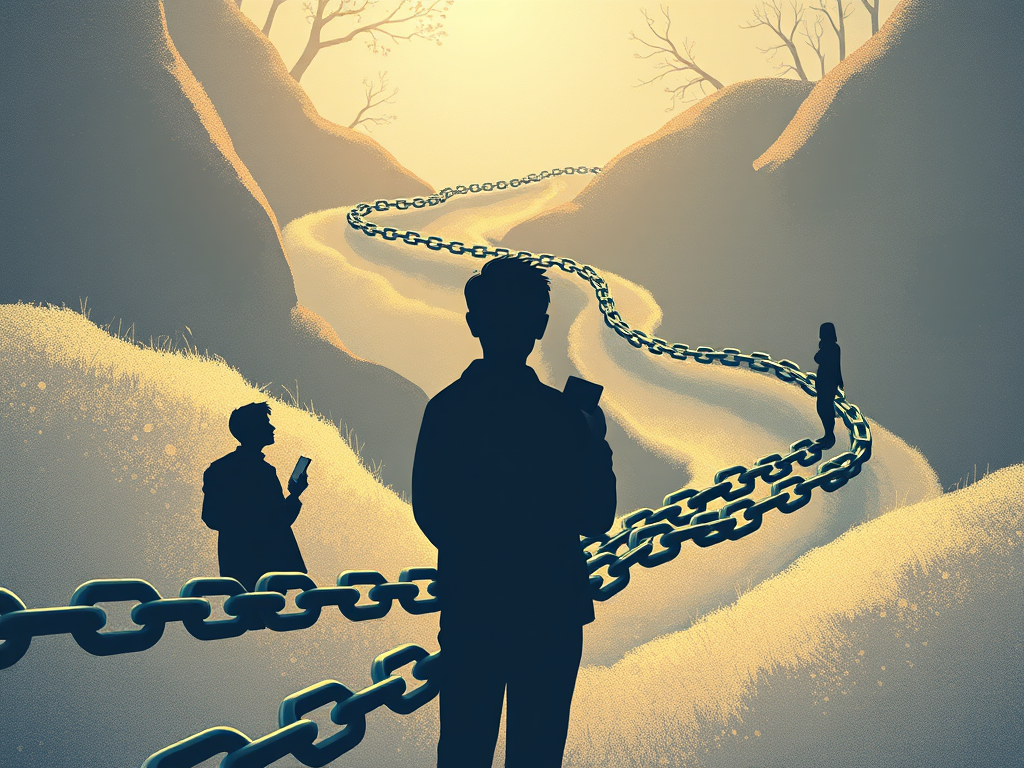
As London’s fame grew, he constructed a powerful persona: the rugged adventurer author, the self educated philosopher, the socialist firebrand. It was a mask that dazzled the public but weighed heavily on him. The more he succeeded, the more he felt trapped by the image he had created. The persona became a kind of prison — admired, lucrative, but increasingly disconnected from the vulnerable, searching man behind it. Jung would say that the persona had become overdeveloped, overshadowing the deeper Self that London was trying to reach.
Life, in London’s view, was rooted in matter rather than spirit, shaped by Darwinian ideas of struggle and natural selection. Yet his stories, though grounded in materialism, resonate with spiritual themes that reveal a deeper search for significance beyond mere survival.
London avoids supernatural explanations, but he does not deny transcendence. Instead, he locates it in experiences that expand the self beyond immediate needs: loyalty, sacrifice, awe, and the felt connection to nature and others.
Often London’s values reflect a kind of pagan vitality. He celebrated the body, nature, and the raw instincts of survival. In The Call of the Wild, Buck’s journey is not only about adapting to the brutal environment of the Yukon but also about awakening to a primal destiny—a return to the deep instincts of his ancestors that transforms him from a domesticated pet into a creature of legend. This is a form of rediscovery of an elemental truth about existence, echoing Thoreau’s conviction that life stripped to its essentials reveals a more authentic reality. Similarly, in White Fang, the narrative explores redemption and the possibility of moral growth, suggesting that even in a world governed by instinct and violence, there is room for compassion and transcendence. This outlook gave him a narrative in which resilience was not about stoic endurance alone but about embracing the full intensity of life.
Most of his stories often carry a sense of awe toward nature, portraying it as both indifferent and sublime. This duality creates a spiritual dimension where human beings confront forces larger than themselves, finding meaning in struggle and connection. His characters frequently embody resilience not only in the sense of physical endurance but as a kind of spiritual awakening—discovering courage, loyalty, and purpose in the face of adversity.
The characters in London’s major works are direct reflections of him, each one shaped by the same forces that shaped his own life. Through them, he explored how hardship forms identity, how ambition drives transformation, and how instinct and discipline interact in the making of a self. They embody the tensions he lived with—strength and vulnerability, aspiration and doubt, raw impulse and deliberate effort. In giving these figures their struggles, he was also giving form to his own.
London’s self representation in Martin Eden is most forceful in the way he turns the novel into a demonstration of his own ideological convictions. The book is not simply a portrait of a struggling writer; it is London staging his worldview through a character who embodies both his aspirations and his disillusionment. Martin’s rise from working class obscurity mirrors London’s own trajectory, and the novel becomes a way for London to assert control over how that trajectory is understood. By shaping Martin’s intellectual development, his encounters with class prejudice, and his eventual rejection of the society that once rejected him, London presents a version of himself that is sharper, more tragic, and more uncompromising than any straightforward autobiography could offer.
Martin’s final disillusionment functions as London’s critique of the very success he had achieved, allowing him to claim a moral distance from the literary marketplace even as he thrived within it. In this sense, Martin Eden becomes a deliberate act of self fashioning: London uses fiction to fix his image as both insider and outsider, a writer who understands the system intimately yet refuses to be fully claimed by it.
London’s self representation in White Fang works differently from Martin Eden, but it is just as deliberate. Instead of projecting himself through a human protagonist, he channels his identity into the novel’s moral and philosophical framework. The book becomes a way for him to assert how he understands nature, struggle, and the forces that shape character. White Fang’s journey from brutality to domestication mirrors London’s own belief that environment is the decisive sculptor of any life, including his. By dramatizing this idea through an animal, he removes the distractions of social nuance and presents his worldview in its purest form.
The novel also lets London position himself as an interpreter of the natural world. He writes with the authority of someone who has lived close to hardship and wilderness, and the story becomes a statement about that authority. White Fang’s survival, his adaptation, and his eventual trust in humans all reflect London’s conviction that strength and sensitivity are not opposites but products of circumstance. In shaping this arc, London shapes his own image: a writer who understands both the harshness of instinct and the possibility of transformation. Through the wolf dog, London asserts a vision of himself as someone who has earned insight through experience, not abstraction, and who can translate that experience into a narrative that feels elemental rather than constructed.
Buck, the dog at the heart of The Call of the Wild, becomes another vehicle for London to shape his own image. He begins as a sheltered animal living on a California estate, taken from that comfort and thrown into the brutal world of the Yukon. In that new environment he learns to fight, to endure, and to rely on instincts that had been dormant.
By tracing that transformation, London builds a figure who embodies the idea that identity is forged under pressure. Buck’s movement from domestication to a more primal existence allows London to project a version of himself shaped by hardship and sharpened by contact with the elemental. The dog’s story becomes a way for London to claim a personal origin myth grounded in struggle rather than ease.
Jack London’s individuation reads almost like one of his own adventure novels — turbulent, hungry, driven by forces he only half understood, and ultimately unfinished. When you look at his life through a Jungian lens, it becomes a story of a man wrestling with the deepest parts of himself, trying to forge a coherent identity out of chaos, instinct, ambition, and longing.
The opposites he carried — nature and culture, instinct and morality, individual and society — never fully reconciled. Instead, they pulled him apart. His later years were marked by exhaustion, illness, and a growing sense of disillusionment. The heroic persona began to crack, and the shadow he had spent his life confronting surged back in the form of alcoholism, despair, and physical decline. His death at forty feels, in Jungian terms, like the abrupt end of an individuation process that had burned too intensely to sustain itself.
Jack London’s life, viewed this way, becomes the narrative of a man who sought the Self with extraordinary courage but never found a stable center. He lived as if the only way to understand himself was to push every limit — physical, intellectual, emotional — until something essential revealed itself. What he discovered was profound, but the integration of those discoveries remained out of reach. His individuation was heroic, dramatic, and deeply human, but ultimately unfinished.






Leave a Reply