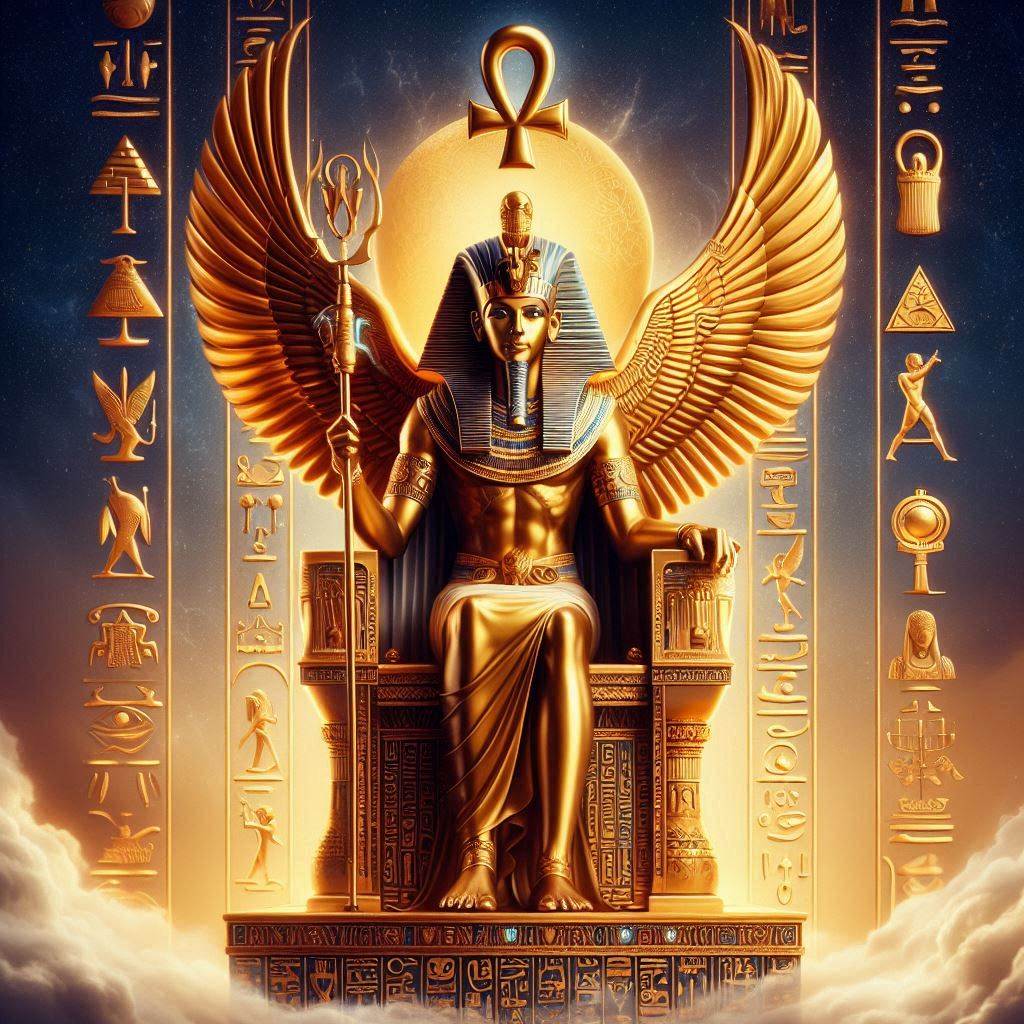
The ancient Egyptians possessed a profoundly detailed and intricate conception of the afterlife, central to their religious and cultural practices. Their belief system revolved around the idea that life continued eternally after death, not merely as a continuation but in a divine and perfected form that mirrored earthly existence. This belief was reflected in their elaborate burial practices and the rich mythology surrounding the journey to the afterlife.
The role of Ka, ba, and ankh in afterlife
Central to Egyptian thought was the idea that the soul was comprised of multiple elements.
The ka, or vital essence, was believed to be created at birth and required sustenance even after death.
The ba represented an individual’s personality and was depicted as a bird with a human head, capable of traveling between the world of the living and the afterlife.
The akh, on the other hand, was the transformed spirit, a glorified and eternal aspect of the deceased that could join the gods in the afterlife.
The preparation
Preparation for the afterlife was a meticulous process, reflecting the Egyptians’ belief in the necessity of preserving the body and providing for the soul’s needs. Mummification was a central practice, involving the removal of internal organs, which were stored in canopic jars, and the treatment of the body with natron, a type of salt, to desiccate it. The body was then wrapped in linen bandages. This preservation was crucial as the ka would need the physical vessel of the body in the afterlife.
Graves were filled with various goods, including furniture, clothing, jewelry, amulets, and food offerings, to ensure that the deceased would have comfort and sustenance in the next world. Funerary texts such as the Pyramid Texts, Coffin Texts, and the Book of the Dead were also included in the tombs. These texts contained spells, prayers, and incantations designed to protect the deceased and guide them through the trials they would face.
The Duat
The journey to the afterlife was fraught with challenges. The Duat, or underworld, was a realm filled with dangers and trials that the deceased had to navigate. This journey involved various obstacles and demons, and successful navigation required the use of protective spells and divine assistance.
A central part of this journey was the weighing of the heart ceremony, overseen by Osiris, the god of the afterlife, and Anubis, the god of mummification. During this ritual, the heart of the deceased was weighed against the feather of Ma’at, symbolizing truth and justice. If the heart was lighter than the feather, it indicated a life lived in accordance with Ma’at, and the deceased was deemed worthy of entering the Field of Reeds. If the heart was heavier, it was consumed by Ammit, a fearsome deity, resulting in the soul’s destruction.
Aaru
The Field of Reeds, or Aaru, represented the ultimate reward for the virtuous soul. It was envisioned as an idealized version of Egypt, with fertile fields, abundant water, and a peaceful existence. Here, the deceased would be reunited with loved ones, continue activities enjoyed in life, and live in eternal harmony under the gaze of the gods.
In summary, the ancient Egyptian view of the afterlife was a deeply complex and central aspect of their culture. Through their elaborate burial practices, the meticulous preparation for the journey through the Duat, and the promise of an eternal, blissful existence in the Field of Reeds, the Egyptians sought to ensure that death was not an end but a transition to a divine and perfected continuation of life.






Leave a Reply