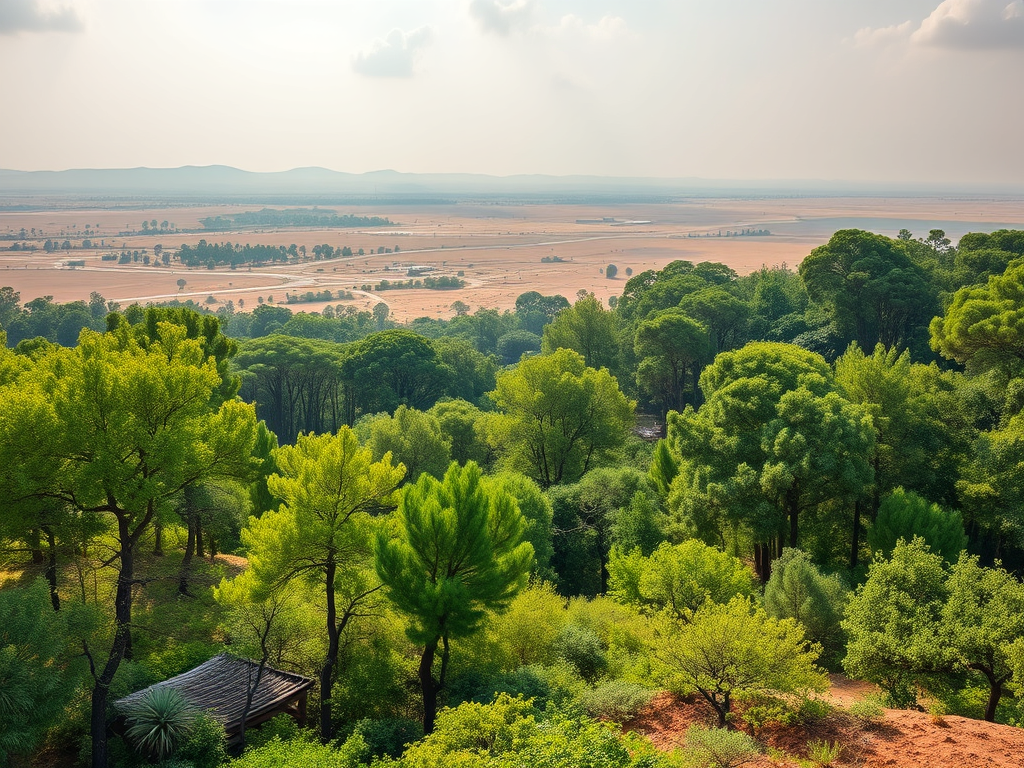
The Three‑North Shelterbelt Program rests on a set of ecological engineering techniques whose effectiveness depends on how they alter wind dynamics, soil stability, moisture retention, and vegetation succession. Although the project is often described in broad strokes, each technique has a specific operational logic that determines whether it succeeds or fails in arid and semi‑arid environments.
Shelterbelts
Shelterbelts are the foundational element. Their purpose is not simply to add trees to the landscape but to reshape the movement of air across open terrain. When wind encounters a line of trees, it slows, rises, and disperses. This reduction in velocity diminishes the wind’s capacity to lift and transport soil particles. Behind a well‑designed shelterbelt, a zone of reduced turbulence forms, extending several times the height of the trees. Within this protected zone, soil moisture evaporates more slowly, crops experience less mechanical stress, and organic matter accumulates more readily. The belts also trap airborne sand, gradually building small depositional mounds that further stabilize the surface. Their effectiveness depends on porosity: a belt that is too dense creates turbulence, while one that is too sparse fails to slow the wind. The intended design is a semi‑permeable barrier that modifies airflow rather than blocking it outright.
In regions where dunes are mobile, shelterbelts cannot be established until the substrate is stabilized. This is where the checkerboard sand‑fixation technique comes into play. Workers lay straw or brushwood in square grids across dune surfaces. Each square disrupts the wind at ground level, reducing its ability to scour sand from the surface. The grid creates thousands of micro‑environments where wind speed is low enough for seeds to germinate and for moisture to persist slightly longer after rare rainfall events. Over time, these micro‑habitats accumulate organic matter and allow hardy pioneer shrubs to take root. Once shrubs establish themselves, their root systems bind the sand, and their canopies further reduce surface wind speeds. The checkerboard is therefore not an end in itself but a temporary scaffold that enables the first stage of ecological succession in an otherwise hostile environment.
Reforestation
In semi‑arid zones, the goal is to create a vegetative cover that can survive on limited rainfall while gradually improving soil structure. Trees and shrubs intercept rainfall, reduce runoff, and contribute leaf litter that decomposes into humus. Their roots penetrate compacted soils, increasing porosity and water infiltration. Over years or decades, this process transforms degraded land into a more resilient ecosystem capable of supporting a wider range of species. The intended mechanism is cumulative: each generation of vegetation improves the substrate for the next. Early reliance on fast‑growing monocultures was meant to accelerate this process, but experience showed that ecological speed comes at the cost of vulnerability. Mixed‑species plantings now aim to mimic natural community structure, distributing risk and creating more stable microclimates.
Water‑management
Water‑management interventions are designed to compensate for the fundamental constraint of the region: insufficient and irregular precipitation. Micro‑catchments concentrate runoff around individual seedlings, ensuring that even light rains are captured rather than lost to evaporation. In some zones, shallow crescent‑shaped pits are dug upslope of each plant to funnel water toward the root zone. Drip irrigation, where used, delivers minimal but precisely targeted moisture, reducing losses and allowing young trees to survive their most vulnerable years. The underlying logic is to maximize the ecological return on every unit of water, since large‑scale afforestation in drylands is impossible without careful hydrological accounting.
Grassland restoration
Grassland restoration and grazing management complement the arboreal techniques. In many areas, desertification was driven less by climate than by chronic overgrazing. When grasses are allowed to recover, their dense root mats anchor the soil far more effectively than trees can in the early stages. The intended mechanism is to rebuild the herbaceous layer that historically stabilized these landscapes. Rotational grazing, seasonal closures, and the establishment of protected zones allow grasses to complete their growth cycles, replenish root biomass, and outcompete invasive species. Once the grass layer is restored, it acts as a living buffer that reduces the pressure on newly planted trees and shrubs.
A holistic approach
Across all these techniques, the program’s logic is cumulative and interdependent. Shelterbelts cannot function without stable soils; dunes cannot be stabilized without pioneer shrubs; shrubs cannot survive without micro‑catchments or reduced grazing pressure; and none of these interventions endure without local participation and long‑term maintenance. The Green Wall is therefore not a single technique but a sequence of ecological transitions, each designed to create the conditions for the next. Its success depends on whether these transitions occur in the right order, at the right scale, and with species and designs suited to the specific micro‑climates of northern China.






Leave a Reply