Intention is the mind’s capacity to direct itself toward a goal, whether that goal is an action, a thought, or an emotional stance. In our consciousness it is the organising force that turns our aspirations into a directed movement of the mind. In this sense, intention is the commitment of attention and effort toward something that has been selected as meaningful. What distinguishes intention from simple desire is this element of directedness: intention carries an orientation, a sense of “aboutness,” that gives shape to our behaviour and inner life.
Many philosophers describe intention as one of the clearest expressions of conscious agency, because it reveals the mind’s ability to choose among possibilities and commit to one of them. Practically, intention is the mechanism by which one possibility is elevated above the others and becomes the organising principle of our behaviour. To form an intention, one must be aware not only of the external situation but also of one’s own internal landscape—desires, beliefs, memories, and priorities. The act of choosing among possibilities requires a reflective stance, a capacity to survey one’s mental contents and decide which of them should guide action. In this sense, intention is both outward‑facing and inward‑facing: it responds to the world while simultaneously shaping the self.
Intention carries a temporal dimension by linking the present moment to a future state that does not yet exist. During the process of clarifying our intentions we project ourselves forward, imagining a possible outcome and aligning our present actions with that imagined future. The anticipatory structure is one of the reasons intention is so closely tied to the idea of autonomous decision making and agency.
Even though our mental life is full of competing impulses and fragmented thoughts, intention gathers these scattered elements into a coherent direction. It is the point at which the mind asserts a kind of order over its own complexity, choosing one course and allowing others to fall away. This unifying function is part of what makes intention feel so intimately connected to our sense of self.
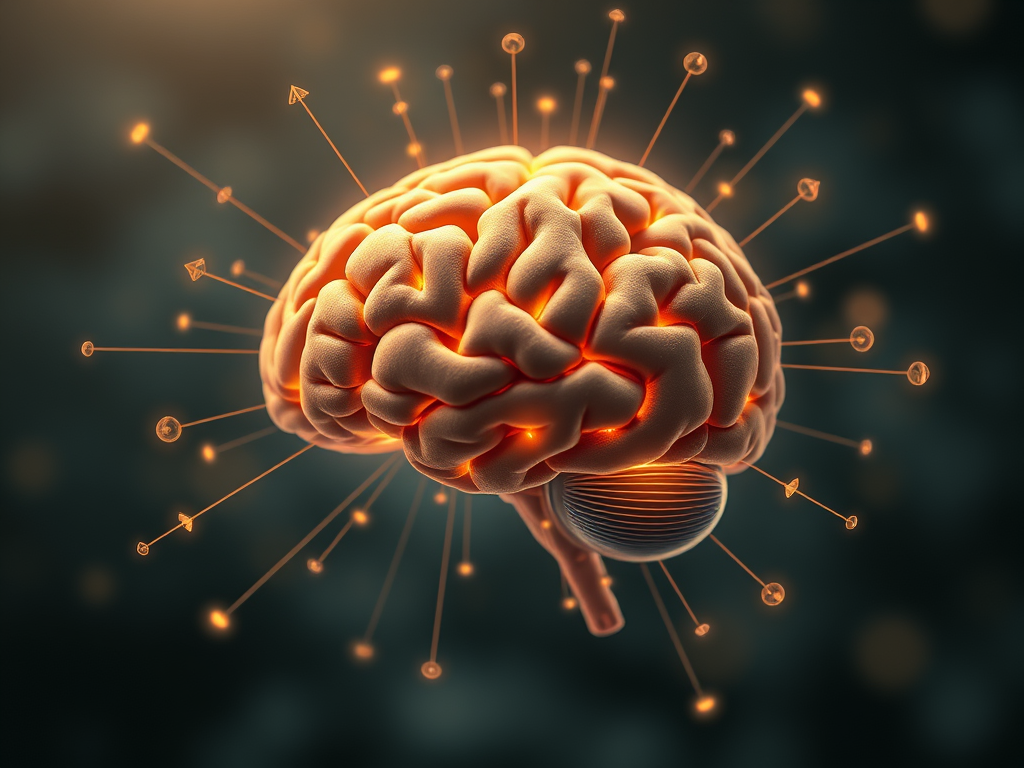
The formation of intention draws on several interconnected neural systems. The prefrontal cortex plays a central role, as it supports planning, decision-making, and the ability to hold goals in mind. Within this region, the dorsolateral prefrontal cortex helps us weigh options and maintain focus, while the ventromedial areas integrate emotional and motivational signals that influence what we choose to pursue. The anterior cingulate cortex contributes by monitoring conflicts between competing impulses and helping to select the most appropriate course of action.
A group of deep brain structures, the basal ganglia, participate in translating intentions into actions by shaping patterns of movement and behavioural initiation. Contributing to the process of learning, the basal ganglia mediates between the substrate of learned behaviours and intention. With other words the brain cannot generate intentions without relying on already learned behaviours.
Even the parietal regions, which help represent the body in space, are involved in preparing the mind to act toward a chosen goal. The parietal lobes contribute to visualisation by integrating sensory information—especially spatial, visual, and bodily signals—into coherent internal representations of the world. They assemble what we see, where things are, and where we are in relation to them, creating the spatial framework that makes mental imagery possible. This integrative function allows us to manipulate objects in the mind’s eye, imagine movements, and construct scenes that are not currently present to perception.
This same capacity is closely tied to the formation of intention. Research shows that regions within the parietal lobe participate in selecting targets for action, prioritising sensory information, and linking attention to goal‑directed behaviour. In other words, the parietal lobe helps transform imagined or perceived possibilities into actionable plans by representing where an intended action should be directed and how it relates to the surrounding environment. This makes the parietal lobe a bridge between visualisation and intention: the ability to picture an action internally is supported by the same neural systems that prepare the body to carry it out.
These systems do not operate in isolation: intention emerges from their cooperation: emotional centres signal what matters, memory systems provide context, and executive regions shape these influences into a coherent plan. Such a complex interplay explains why intention can feel both deliberate and spontaneous, a dynamic process that links thought, emotion, and action.




Leave a Reply