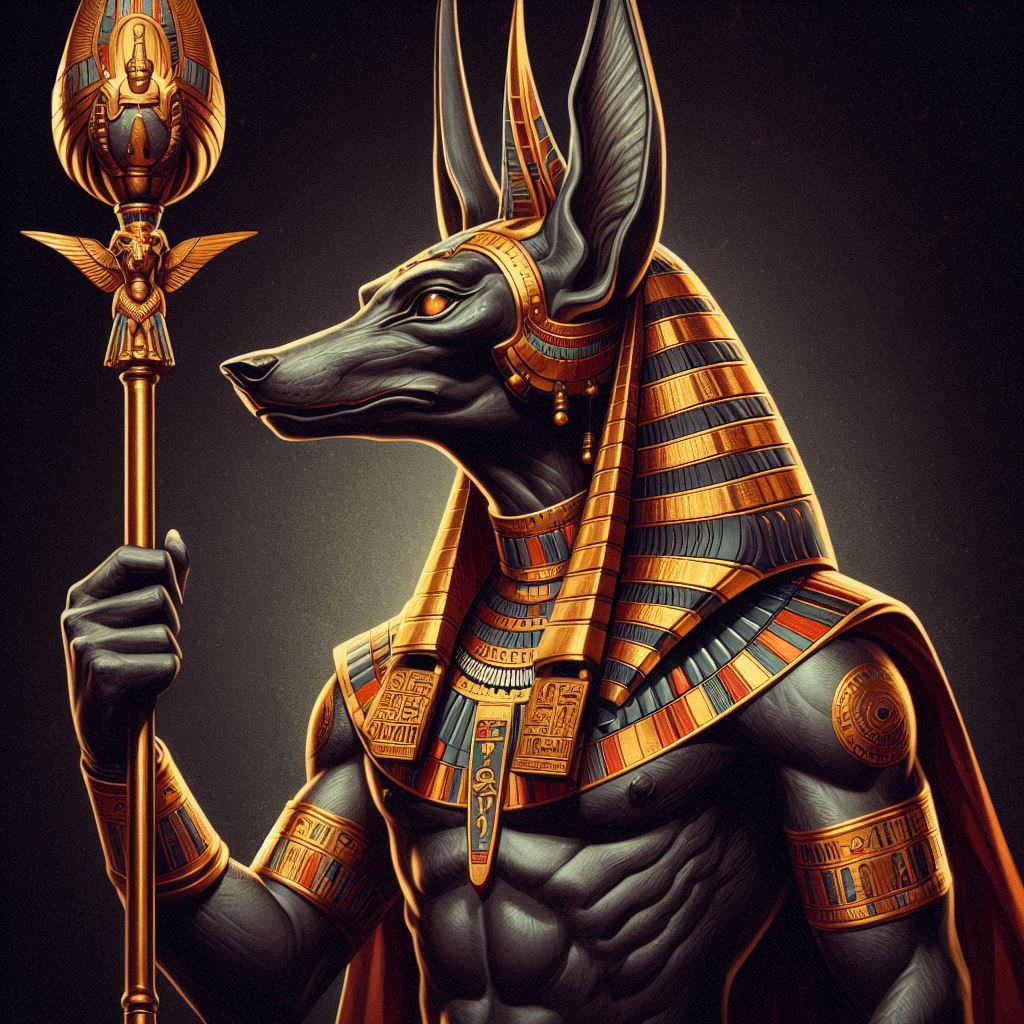
Anubis was an ancient Egyptian deity, patron of the funerary practices and the afterlife. Often depicted as a man with the head of a jackal or a jackal itself, Anubis played a crucial role in guiding souls to the afterlife and overseeing the process of mummification. He was the protector of graves.
The redeemer
One of the key myths involving Anubis is the story of Osiris. According to this myth, Osiris, the god of the underworld, was murdered by his brother Set, due to envy. Then, his body was dismembered and scattered. Anubis, along with his sister Nephthys, searched for the pieces of Osiris’s body. Anubis then played a pivotal role in reassembling, embalming the resurrecting Osiris. This act of preserving and reviving Osiris established Anubis’s role as the protector of the dead and the guide for souls in the afterlife.
Anubis was weighing the heart, which was a crucial part of the judgment of the deceased. In this ritual, the heart of the deceased was weighed against the feather of Ma’at, the goddess of truth and justice. Anubis was responsible for overseeing this process to determine whether the deceased had lived a just life. If the heart was lighter than the feather, the soul was worthy of entering the afterlife. If not, it was devoured by Ammit, a fearsome creature part lion, hippopotamus, and crocodile.
The afterlife
In Ancient Egyptian mythology, the “Field of Reeds,” or Aaru, was a heavenly realm of lush, fertile landscape, reminiscent of the rich, green plains of the Nile Delta. It was a place where the deceased could experience an idealized version of life on Earth, free from suffering and full of abundance.
In the Field of Reeds, the land was eternally fertile, and the crops flourished effortlessly. The deceased engaged in activities similar to those they enjoyed in life, particularly farming, but without the burdens that came with earthly toil. Life in this paradise was peaceful, prosperous, and happy. One could dwell forever in a state of eternal youth and vitality. The Field of Reeds was a place where the soul could find ultimate fulfillment, living in harmony with nature and the divine, surrounded by the familiar comforts of the earthly world, yet perfected in every way.
Ammit
Ammit, in Ancient Egyptian mythology, was a formidable and fearsome goddess associated with the afterlife, specifically with the judgment of souls. He was a chimera-like creature with the head of a crocodile, the front half of a lion or leopard, and the hindquarters of a hippopotamus. These animals were all among the most dangerous and feared in Ancient Egypt, making Ammit a terrifying symbol of destruction and doom.
If during the judgement the heart of the deceased was heavier than the feather—indicating that the person had led a life filled with sin and wrongdoing—Ammit would devour the heart, condemning the soul to eternal restlessness and oblivion. This was a fate worse than death, as it meant that the individual would be denied entry into the afterlife and the chance for eternal peace.
Socrates and Anubis
In Plato’s dialogues, Socrates swears “by the dog” (Greek: kai me ton kuna) – a reference to Anubis. The mention of this god by Socrates may reflect a recognition of Anubis as a powerful and impartial figure of judgment and truth.
Psychological interpretation and symbolism
Interpreting the myth of Anubis and Ma’at through a psychological lens offers a fascinating perspective on the dynamics of the psyche. In this view, Ma’at represents the conscience and moral integrity—essentially the internal compass that guides one’s sense of right and wrong. Anubis, on the other hand is the superego, the part of the psyche responsible for enforcing moral standards and ensuring that one adheres to these internalized values.
In the context of the myth, the process of the weighing of the heart reflects a psychological journey where Anubis, as the superego, is instrumental in the assessment of the soul’s integrity. The heart, represents the ideal of moral purity and justice. See the ritual as a metaphor for the internal examination of one’s conscience and the alignment of one’s actions with their moral values.
From a psychological standpoint, the myth suggests that Anubis’s role in the judgment process is not merely punitive but also integrative. By overseeing the weighing of the heart, Anubis facilitates a process of self-evaluation and integration. If the “heart” is guilty it indicates that there are aspects of the psyche that are out of balance or misaligned with one’s moral principles. Anubis, in this sense, represents the archetypal process that helps in reconciling these fragmented parts of the self.
This integration is crucial for psychological healing and wholeness. Anubis’s role as the guide and protector is a metaphor of the process through which individuals confront their inner conflicts, align their actions with their moral values, and ultimately achieve a greater sense of psychological coherence.
Thus, the myth reflects a deeper psychological process of self-assessment, moral integrity, and the quest for an integrated self.







Leave a Reply