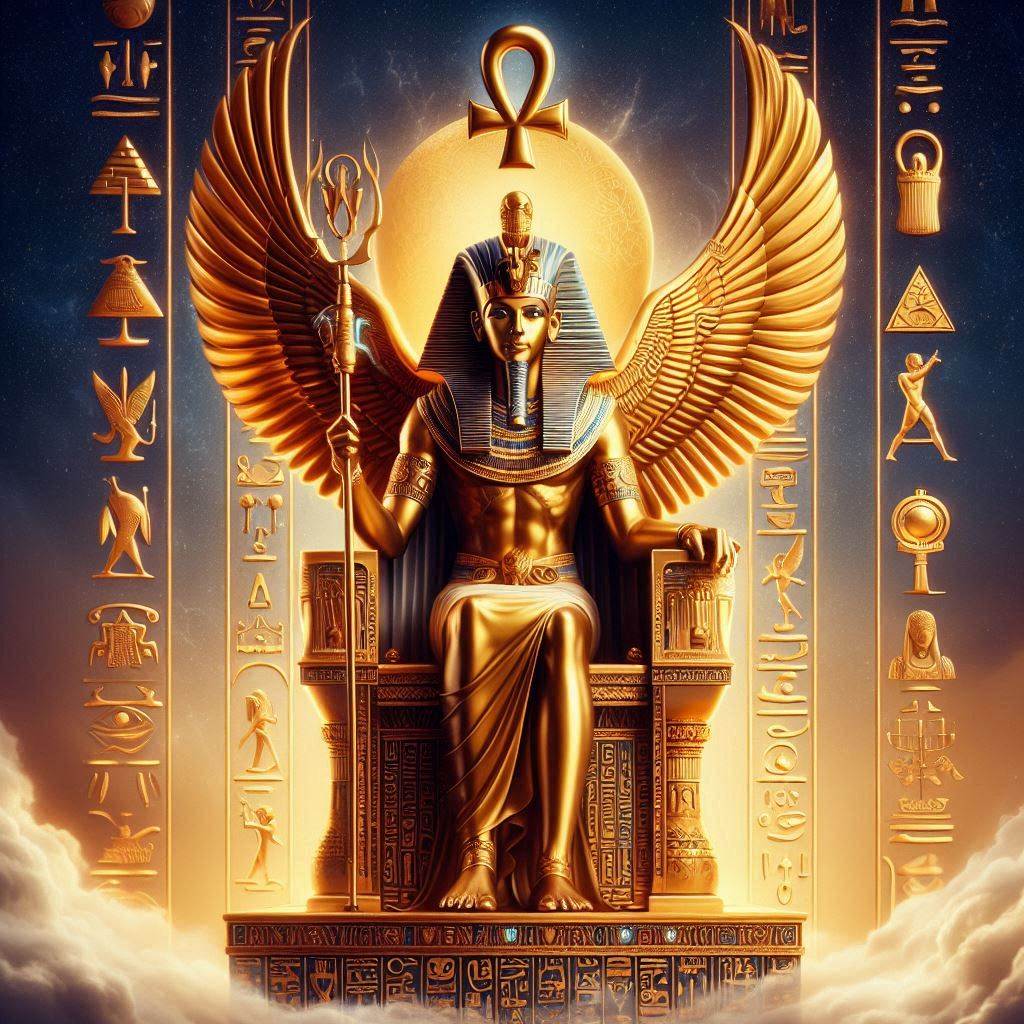
In the ancient land of Egypt, where the Nile’s life-giving waters flowed and the pyramids touched the sky, there lived a god named Osiris. Osiris, son of the earth god Geb and the sky goddess Nut, brought civilization and prosperity to Egypt. As the benevolent ruler, he taught the people the arts of agriculture and the cycles of the seasons. Under his reign, the land flourished, and peace and prosperity spread throughout the kingdom. Osiris’s wife, the goddess Isis, was his steadfast companion, embodying magic, motherhood, and fertility.
His brother Seth, the god of chaos, storms, and deserts, looked upon Osiris’s success with envious eyes. Seth coveted the throne and the power that came with it. He hatched a wicked plan to overthrow his brother and claim the kingdom for himself.
The treachery
Seth’s opportunity came during a grand banquet he hosted in Osiris’s honor. In the midst of the celebrations, Seth presented a beautifully ornate chest, declaring that he would gift it to whoever could perfectly fit inside. Intrigued and unsuspecting, Osiris lay down inside it to test the fit. Seizing the moment, Seth and his conspirators slammed the lid shut and sealed it tight with molten lead. They threw the chest into the Nile, leaving Osiris to drift away, trapped and helpless.
The chest carrying Osiris’s body eventually washed ashore near Byblos, where it became entwined in the branches of a tamarisk tree. Refusing to accept his death, she embarked on a perilous journey to find him. With her sister Nephthys and the jackal-headed god Anubis, Isis searched far and wide, following the whispers of the wind and the murmurs of the waters.
After many trials, Isis discovered the chest and retrieved Osiris’s body. Upon discovering that Osiris had been found Seth flew into a rage. In a fit of malevolent fury, cut it into fourteen pieces, scattering them across the length and breadth of Egypt. Each piece was hidden in a different location to ensure that Osiris could never regain his initial form and power.
The resurrection
Undeterred by Seth’s savagery, Isis set out on an arduous quest to recover the scattered pieces of her husband. With the help of Nephthys and Anubis, she traversed the land, searching every corner of Egypt. One by one, they found the pieces, and Isis, with her powerful magic, began to reassemble Osiris’s body. Only one piece, his phallus, was missing, swallowed by a fish in the Nile. Despite this, Isis fashioned a replacement and performed rituals to resurrect Osiris.
Osiris came back to life, but he could no longer dwell among the living. Instead, he descended to the underworld, where he became the judge of the dead and the ruler of the afterlife. There, he presided over the Hall of Ma’at, where he judged the souls of the deceased.
The resurrection of Osiris did not mark the end of Seth’s malevolence. Knowing that Osiris’s legacy could not die, Seth turned his wrath upon Horus, the falcon-headed son of Osiris and Isis. Horus grew up with a single purpose: to avenge his father and reclaim the throne. The conflict between Horus and Seth was fierce and unrelenting, a battle of epic proportions that raged across the heavens and the earth.
Their struggle was a cosmic drama, symbolizing the eternal battle between order and chaos, good and evil. After many trials and tribulations, Horus ultimately triumphed over Seth. He ascended the throne, bringing stability and justice back to Egypt. Horus’s victory ensured that the legacy of Osiris would endure, and Seth was banished to the barren deserts, his power diminished.
Interpretation of the legend
Osiris’s story became a cornerstone of Egyptian mythology, a tale of death and resurrection, justice and retribution. His journey from life to death to rebirth symbolized the eternal cycle of nature and the hope of life beyond death.
The rituals and beliefs surrounding Osiris shaped the religious practices of ancient Egypt, as the people looked to him for guidance in the afterlife and inspiration in their daily lives.
The Jungian interpretation of the legend
Jung believed that myths of death and resurrection, like that of Osiris, represent the death of the ego and the rebirth of a more integrated and whole self. This symbolic death signifies the shedding of old, outworn aspects of the personality and the emergence of new, more authentic ways of being. Such myths resonate deeply within the human psyche, offering a blueprint for personal growth and the journey towards self-realization.
The dismemberment of Osiris is a profound symbol of fragmentation within the human psyche. This process of fragmentation can be seen as the breaking apart of the ego, where different parts of the self become scattered and disconnected. However, this dismemberment also holds the promise of eventual reintegration and wholeness.
Isis is an embodiment of the anima that facilitates the healing and integration of the fragmented ego. Isis’s search for Osiris’s scattered pieces symbolizes the anima’s role in guiding the individual through the process of psychological healing. By confronting and embracing these fragmented parts, Isis (as the anima) helps to restore wholeness and balance. This process is leading to the rebirth of a more integrated and complete self.
Thus, this myth reflects the transformative power of the anima archetype in the journey toward individuation and self-realization.






Leave a Reply