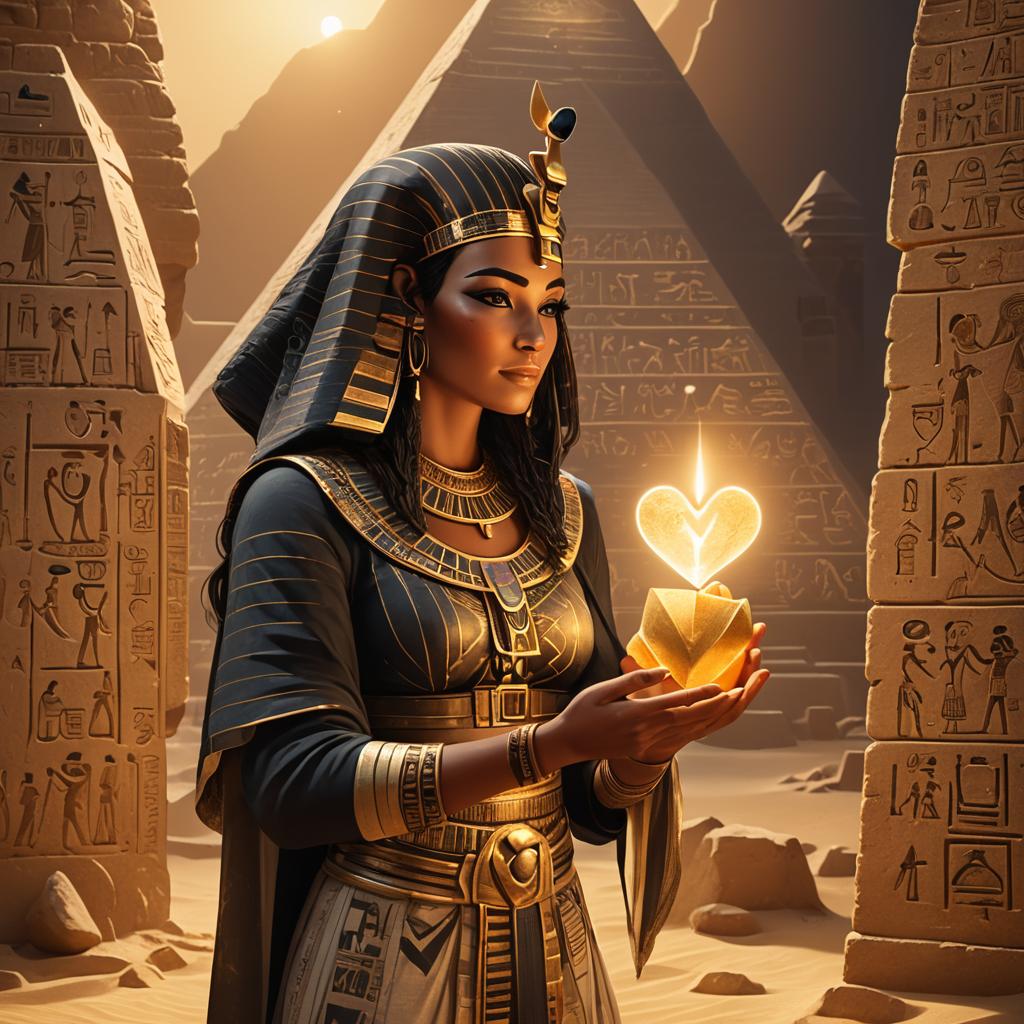
The heart was of paramount importance in ancient Egyptian culture, both biologically and spiritually. It was considered the seat of emotion, thought, will, and even moral judgment, far surpassing the brain’s role in modern understanding.
Center of life
In ancient Egypt, the heart, known as “ib” or “jb” in the Egyptian language, was considered the center of a person’s being. It was believed to be the source of emotions, thoughts, intentions, and personality. The Egyptians regarded the heart as the core of an individual’s physical and spiritual existence, often referring to it as the “house of intelligence.” Unlike modern science, which attributes cognitive functions to the brain, the ancient Egyptians believed that the heart was the organ responsible for consciousness and reasoning.
The heart was so central to an individual’s life that it was often mentioned in texts as the source of wisdom and understanding. In this sense, the heart was not just a physical organ but a symbol of the individual’s essence and identity. This belief influenced various aspects of Egyptian culture, including their approach to medicine, rituals, and legal practices.
The heart in Egyptian medicine
The ancient Egyptians were among the pioneers of early medicine, and their understanding of the human body was advanced for its time. Medical papyri, such as the Edwin Smith Papyrus and the Ebers Papyrus, contain references to the heart and its functions. The Egyptians recognized the heart’s role in circulating blood, and they understood that the heart was connected to the body through a network of vessels, which they called “metu.”
The metu were believed to carry not only blood but also air, water, and vital energy throughout the body. This understanding was crucial in their medical practices, where treatments often aimed to ensure the proper flow of these substances to maintain health. The heart was considered the control center for these vital processes, and many treatments focused on maintaining or restoring the heart’s function.
For example, when treating patients, Egyptian physicians might prescribe remedies intended to “open the vessels of the heart” or to strengthen it. They believed that disturbances in the heart could lead to various physical and emotional ailments. Thus, maintaining the health of the heart was of utmost importance in their medical practices.
The heart in afterlife
The heart’s significance extended far beyond physical life, playing a crucial role in the Egyptian understanding of the afterlife. The Egyptians believed in a complex afterlife where the soul, or “ka,” would live on after death. The journey to the afterlife involved several stages, including judgment, where the heart played a central role.
One of the most important religious texts in ancient Egypt is the “Book of the Dead,” a collection of spells and prayers intended to guide the deceased through the dangers of the afterlife. In these texts, the heart is depicted as a critical element in the judgment of the dead, known as the “Weighing of the Heart” ceremony. This ceremony was presided over by Anubis, the god of mummification and the afterlife, and involved the weighing of the deceased’s heart against the feather of Ma’at, the goddess of truth and justice.
If the heart was lighter than the feather, it meant that the deceased had lived a righteous life, and they were allowed to proceed to the afterlife. However, if the heart was heavier due to a life of sin and wrongdoing, it would be devoured by Ammit, a fearsome creature with the head of a crocodile, the body of a lion, and the hindquarters of a hippopotamus. This finality of judgment underscored the heart’s role as the arbiter of moral integrity.
Mummification
The Egyptians believed that the heart contained all the thoughts, intentions, and actions of a person’s life. Therefore, it was the heart, not the brain, that would testify to the individual’s morality during the judgment. This belief was so strong that in mummification, the heart was one of the few organs left inside the body, as it was deemed essential for the afterlife. Other organs were removed and placed in canopic jars, but the heart remained in place, often protected by amulets and spells to ensure its safe passage through the afterlife.
Amulets
To protect the heart in the afterlife, the ancient Egyptians used various amulets, the most important of which was the heart scarab. These scarabs, typically inscribed with a spell from the “Book of the Dead,” were placed over the heart during mummification. The spell, often from Chapter 30B of the “Book of the Dead,” was intended to silence the heart so that it would not betray the deceased during the weighing ceremony. This reflects the belief that the heart could either speak in favor of or against the deceased, impacting their chances of a favorable judgment.
The heart scarab was usually made of stone and shaped like a beetle, symbolizing regeneration and rebirth. It was often inscribed with the name of the deceased and prayers to the gods, asking them to protect the heart and ensure the deceased’s successful journey to the afterlife. The scarab served both as a protective charm and as a reminder of the importance of living a just life.
The ethical dimensions of the heart
In addition to its role in the afterlife, the heart was also central to the Egyptian understanding of ethics and morality. The Egyptians believed that living in accordance with Ma’at, the divine order of truth and justice, was essential for maintaining cosmic balance. The heart was seen as the internal compass guiding an individual’s actions in life.
Texts such as the “Instructions of Ptahhotep” and the “Maxims of Ani” offer insights into the ethical teachings of ancient Egypt, where the heart is frequently mentioned as the source of moral discernment. These texts advised individuals to listen to their hearts, as it would lead them to act justly and righteously. A “good heart” was synonymous with a virtuous life, while a “heavy heart” was associated with guilt and wrongdoing.
In the context of legal and social norms, the heart was considered the ultimate judge of a person’s intentions and actions. It was believed that the heart could not lie, and thus, it served as the ultimate witness to a person’s true character. This belief influenced not only religious practices but also the administration of justice in society, where oaths were often taken “by the heart” to ensure their sincerity.
Conclusion
In ancient Egyptian culture, the heart was far more than just a vital organ; it was the essence of life, the seat of thought and emotion, and the key to moral judgment in both life and death. Its centrality in Egyptian medicine, religion, ethics, and art underscores its profound significance in shaping the civilization’s worldview.
The heart’s dual role as a physical organ and a spiritual symbol reflects the Egyptian understanding of the interconnectedness of body and soul. By examining how the heart was perceived in ancient Egypt, we gain insight into a culture that viewed life and the afterlife as deeply intertwined, with the heart at the very core of this relationship. The ancient Egyptians’ reverence for the heart continues to fascinate scholars and laypeople alike, offering a window into the values and beliefs of one of history’s most enduring civilizations.








Leave a Reply