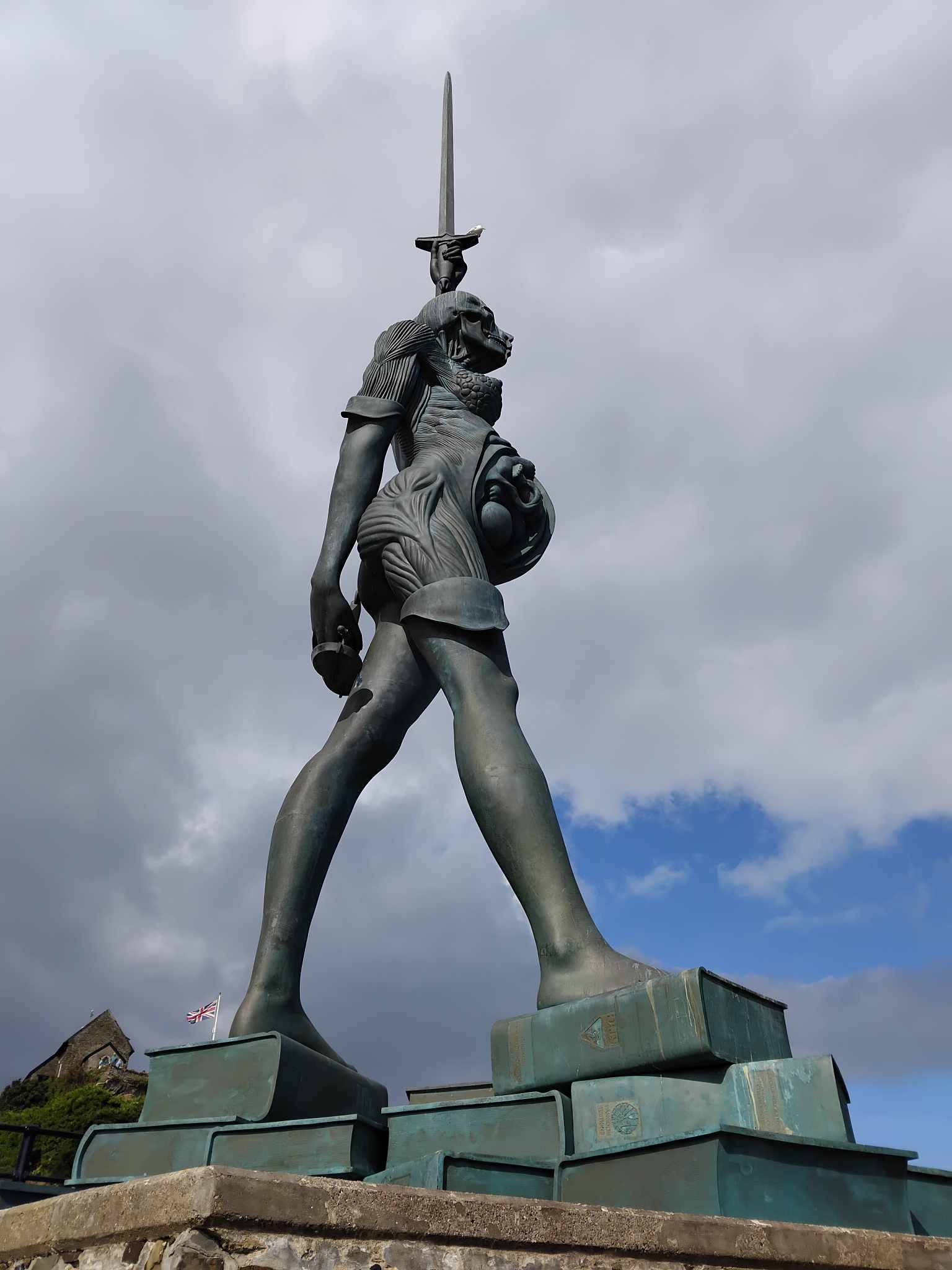
A bold symbol of strength and contradiction in Ilfracombe
The statue of Verity stands tall on the edge of Ilfracombe’s harbor, drawing eyes and sparking emotions from locals and visitors alike. This towering statue, created by artist Damien Hirst, commands attention with its raw combination of beauty and unsettling imagery. Unveiled in 2012, Verity represents a pregnant woman, sword raised in one hand, scales of justice in the other. But it’s not the mere depiction of a pregnant figure that has made her so iconic. The striking contrast between the exposed anatomy on one side and smooth, unbroken skin on the other invites deeper reflection on life, struggle, and truth.
The duality of Verity’s design
What makes Verity truly compelling is her duality. The statue, nearly 20 meters high, presents two contrasting sides. One side reveals a detailed, anatomical view of muscles, tissues, and the unborn child within her womb. The other side shows a smooth, elegant figure, offering a more conventional depiction of feminine strength. This visual contradiction creates tension and intrigue, pushing the observer to confront both the raw realities of life and the serene idealizations of motherhood. Verity’s unapologetic form becomes an emblem of honesty and vulnerability, stripped bare in the most literal and metaphorical senses.
The role of Verity in Ilfracombe’s identity
Verity has come to symbolize much more than just art in Ilfracombe. Her towering presence has reshaped the town’s identity, becoming a focal point for both controversy and admiration. Some residents embrace her as a bold statement of courage and truth, while others find her disturbing or even grotesque. This tension mirrors the complex layers of Verity herself—striking, divisive, and unforgettable. Her presence has undeniably added to the town’s tourism, making Ilfracombe a destination not just for its natural beauty, but also for the profound, provocative statement Verity makes about human existence.
Hirst’s intention behind Verity
Damien Hirst has always been known for his confrontational approach to art, and Verity fits squarely within his larger body of work. Hirst designed the statue as a representation of justice, fertility, and truth. With Verity holding a sword aloft, she embodies a sense of defiance, as though preparing to face any challenge. Yet the exposed internal anatomy suggests vulnerability, a reminder of the fragility of human life. The scales of justice, hidden behind her back, imply a balance that isn’t immediately visible but is central to the concept of fairness and morality. This complexity encapsulates Hirst’s ongoing fascination with the dualities of existence.
Note that when creating Verity, Damien Hirst was inspired by Degas.
A lasting conversation piece
Verity continues to evoke strong reactions. Whether seen as grotesque or a masterpiece, she provokes thought, serving as a reminder that life, in all its beauty and discomfort, is never as simple as it seems. The statue has cemented its place as a powerful symbol in Ilfracombe, blending art, humanity, and the stark realities we often shy away from. As time passes, Verity’s meaning continues to evolve, and her role in Ilfracombe remains as dynamic as the town itself.





Leave a Reply