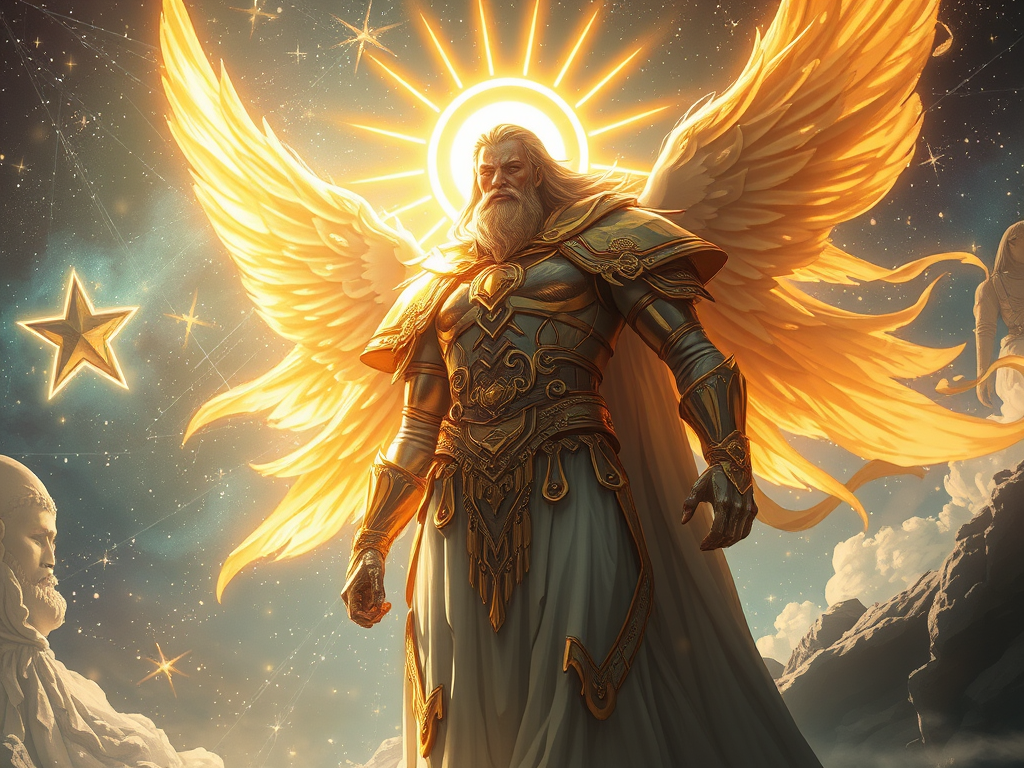
The myth of Hyperion, one of the Titans in Greek mythology, is layered with intricate symbolism. Hyperion represents the force of the sun, light, and illumination, but also stands as a figure of resistance and cosmic conflict. His story intertwines with the narratives of gods, fate, and the struggle for supremacy. To truly appreciate his role in mythology, one must examine the tensions between the Titans and the Olympian gods, and how Hyperion fits into this larger divine drama.
Hyperion: the Titan of light
Hyperion was a member of the first generation of Titans, children of Gaia and Uranus. As solar god he personified the sun, or the light that illuminated the heavens. Along with his siblings, he stood as a primal force before the Olympian gods began their rise. His domain, however, wasn’t solely the physical sun; it symbolized the light, enlightenment and knowledge in a broader sense. His name itself means “the one who goes above” or “the high one,” reflecting his connection to the heavens and his elevated status in the cosmic order.
Hyperion’s marriage to Theia
Hyperion’s marriage to Theia, the Titaness of sight and the shining light of the sky, was central to his mythological identity. Together, they had three important offspring: Helios, Selene, and Eos. Helios took on the role of the sun god, driving the chariot of the sun across the sky. Selene, the moon goddess, and Eos, the goddess of the dawn, also inherited the radiant qualities of their parents. Their births signify the continuity of light, but also the power of familial ties within the mythological hierarchy.
The Titanomachy and Hyperion’s role
The story of the Titanomachy, the great war between the Titans and the Olympian gods, brings us to a crucial moment in Hyperion’s life. The Olympians, led by Zeus, sought to overthrow the older generation of gods. Hyperion, loyal to the Titan cause, fought against Zeus and his siblings. However, the Titans were ultimately defeated, and the Olympians took control of the heavens. Hyperion’s resistance to the Olympians symbolizes the age-old conflict between old and new orders, and the inevitability of cosmic change.
Hyperion’s punishment and his enduring influence
After the defeat, many Titans, including Hyperion, faced punishment. While some were imprisoned in Tartarus, others were left in a state of exile or limbo. Despite his defeat, Hyperion’s influence did not fade entirely. His essence lingered in the sun, the source of both light and heat, representing both knowledge and the harshness of reality. The myth speaks to the cyclical nature of power: even in defeat, Hyperion’s presence endures in the natural world, reminding us of the lasting impact of those who came before.
Symbolism in Hyperion’s myth
Hyperion’s myth contains profound symbolism. The sun, as a symbol of enlightenment, represents both illumination and blindness. While it brings knowledge, it also burns and destroys. Hyperion’s connection to the sun reflects the duality of truth—its power to reveal and its capacity to overwhelm. The story of his struggle and eventual defeat is a metaphor for the limitations of even the greatest forces in the universe. It reminds us that no matter how high one might rise, forces beyond our control can always bring about change.
Truth, in its purest form, carries both a liberating and a destructive force. In Hyperion’s myth, his connection to the sun symbolizes this duality—just as the sun can illuminate and bring life, it can also scorch and blind. The sun reveals everything, leaving no shadows, and so does truth. However, the revealing nature of truth can be overwhelming for those who aren’t ready to face it.
Humans, by nature, struggle to handle truth
While truth has the potential to liberate, it can often disrupt the comfort of illusion and challenge deeply held beliefs. When we confront truth, we may feel exposed, vulnerable, or unprepared for its weight. The intensity of truth can be blinding, much like the sun’s rays can burn the unshielded eyes. It is not the knowledge itself that is the problem, but our capacity to accept and process it.
Hyperion, as a figure of light and knowledge, represents the pursuit of truth—a pursuit that often comes with great cost. His resistance to the Olympians, and his eventual fall, serves as a powerful metaphor for the human experience in dealing with truth. Just as Hyperion’s light could not withstand the forces that sought to replace him, the human psyche often cannot maintain the purity of truth without being altered in profound ways. The struggle to bear such a burden reflects the inherent difficulty in reconciling with absolute truth, which forces us to question our assumptions, our past, and our place in the world.
When we are not prepared, truth can destroy the very foundations upon which we build our identities. This is why, in many stories and philosophies, truth is often concealed or slowly revealed, as the mind may not always be ready to embrace its full force. Hyperion’s story suggests that while truth can set us free, we must first acknowledge the limits of our own resilience. To handle truth requires strength and transformation. It requires the readiness to confront not just the knowledge itself, but also the repercussions that come with it.
Concluding remarks
Thus, truth—like the sun—offers clarity, but also demands caution. When we seek truth, we are not just seeking information, but a deeper understanding that can alter our worldview. The process of handling truth is a journey, and much like the sun that rises and sets, it comes in phases. Too much light too soon can overwhelm, but in the right measure, truth can guide us toward greater freedom.







Leave a Reply