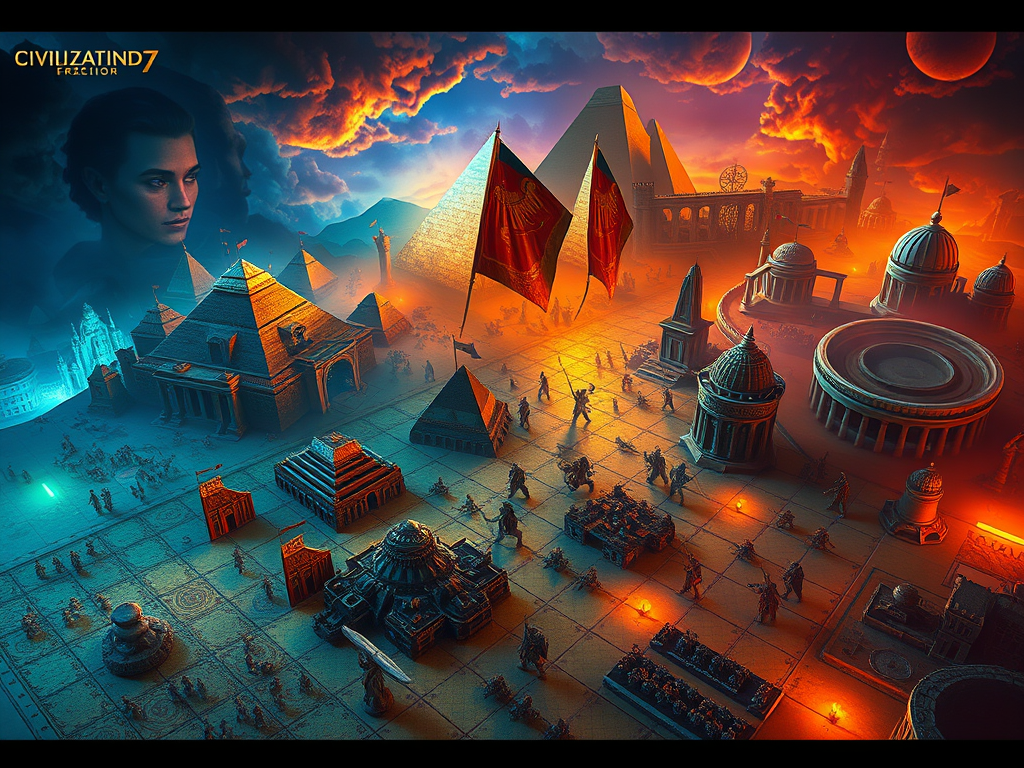
I started playing Civilisation 7 as soon as it was launched in February 2025. I noted that this game is quite similar to another game called Humankind.
Let’s provide some context:
Humankind is a turn-based strategy game developed by Amplitude Studios and published by Sega. Released on August 17, 2021, for Windows and macOS, the game is often compared to Sid Meier’s Civilization series due to its 4X (explore, expand, exploit, and exterminate) mechanics. However, it introduces distinct gameplay elements that set it apart, emphasizing cultural evolution, historical adaptability, and player-driven narratives.
Core Gameplay and Features
1. Cultural Evolution and Hybrid Civilizations
Unlike Civilization, where players choose a fixed civilization at the start, Humankind allows players to evolve through different cultures as they progress through the game’s six historical eras:
- Each era offers a choice of 10 cultures, from ancient to modern times (e.g., Egyptians, Romans, Mongols, French, etc.).
- Instead of sticking with one civilization, players can blend cultural traits from different societies, creating a unique hybrid civilization.
2. Fame as the Victory Condition
Instead of focusing purely on military conquest or scientific progress, the main objective is to accumulate “Fame.” This score represents achievements across various domains, including:
- Military success
- Cultural influence
- Scientific discoveries
- Economic prosperity
- Territory expansion
At the end of the game, the civilization with the highest Fame score wins.
3. Tactical Turn-Based Battles
Unlike Civilization, Humankind introduces tactical battles on separate, grid-based maps when armies clash:
- Battles are fought over multiple turns with terrain and unit positioning playing a crucial role.
- Players control their military units directly rather than letting combat be auto-resolved.
4. City-Building and Districts
Cities in Humankind grow dynamically, and districts influence resource production, population growth, and stability.
- Players must balance city expansion with stability, as over-expansion can lead to revolts.
- Some cultures provide unique districts that grant special bonuses.
5. Diplomacy and Ideological Choices
The diplomacy system allows for:
- Alliances, trade agreements, and wars
- Shifting diplomatic relations based on grievances and treaties
- Ideological choices that shape government policies (e.g., individualism vs. collectivism)
6. Customizable Avatars and AI Personalities
Players can create a custom avatar that represents their leader throughout history. Avatars evolve based on in-game decisions and can be shared online as AI-controlled opponents.
Expansions and Updates
Amplitude Studios has continued to support Humankind with DLCs and free updates, introducing:
- New cultures, events, and mechanics (e.g., the Cultures of Africa and Cultures of Latin America DLCs)
- Improved AI and diplomacy mechanics
- New scenarios and challenges
How Does Humankind Compare to Civilization?
While Humankind shares similarities with Civilization, it distinguishes itself by:
- Evolving cultures instead of fixed civilizations
- Tactical battle control rather than automated combat
- Fame-based victory, rewarding well-rounded playstyles
- More dynamic diplomacy and ideology systems
So what are the major differences?
Humankind appeals to fans of strategy games looking for a fresh take on historical 4X gameplay. Its cultural evolution system and tactical depth offer a new way to shape history, making each playthrough unique. However, some players have critiqued its AI behavior, pacing, and balance issues, especially compared to Civilization VI. Despite this, with ongoing updates, it continues to refine its mechanics and remains a strong contender in the strategy genre.







Leave a Reply