
Impressionism began in France in the 1860s as a reaction to the rigid rules of academic painting. Painters like Claude Monet, Pierre-Auguste Renoir, and Camille Pissarro chose to break away from historical and mythological themes and focus instead on scenes from modern life. They worked outdoors, capturing how light and color changed throughout the day. Brushstrokes became visible and spontaneous, color palettes lighter and more vibrant. Critics initially dismissed their works, but the movement gradually reshaped how people viewed art and reality.
Unlike the formal compositions favored by institutions, Impressionist paintings depicted fleeting impressions of real-world moments. Their approach aligned with growing interest in sensory experience, perception, and the psychological understanding of sight. Rather than idealizing subjects, artists portrayed urban crowds, leisure activities, and nature as they appeared in real time. Painting became less about representation and more about visual sensation.
Art that mirrored a changing world
Impressionism emerged during rapid urbanization, industrial progress, and shifting social structures in Europe. Paris was modernizing, with new boulevards, railways, and public parks altering how people lived and interacted. Artists responded by turning their attention to the everyday—cafés, gardens, train stations, and city streets. Their work captured the new rhythm of life that defined the late 19th century.
Public exhibitions outside the Salon system gave these painters more control over how they presented their work. As a result, they created a more direct relationship between artist and viewer. Impressionism challenged established values not just in art but also in cultural authority and taste.
While Impressionism itself was short-lived, its impact remained significant. It influenced Post-Impressionists like Vincent van Gogh and Paul Cézanne, who carried forward its principles while developing their own directions. The movement also laid the groundwork for modernism, shifting focus from imitation to interpretation. Its emphasis on perception, atmosphere, and individual vision continues to shape how art is created and understood.
How did impressionism influence literature?
Impressionism moved beyond the canvas and began to shape the way writers approached language, structure, and perception. Just as painters emphasized fleeting light and shifting moods, authors started to prioritize sensation, atmosphere, and inner experience over linear plots or objective descriptions. Literature began reflecting moments as they were felt rather than explaining them with fixed meaning.
Writers influenced by Impressionism focused on subjectivity. Instead of presenting events in clear chronological order, they explored fragmented impressions and emotional nuance. The aim was to make the reader feel what the character felt in that exact moment, without stepping outside the experience to interpret it. Language became less about precision and more about evoking sensations.
A shift in narrative technique
Authors like Virginia Woolf, Marcel Proust, and Anton Chekhov adopted techniques that mirrored the visual strategies of Impressionist painters. They used stream of consciousness, indirect speech, and suggestive imagery to convey shifting psychological states. Scenes often blurred into one another, not through abrupt action but through associations, memory, and mood. This style encouraged readers to engage with a character’s perception rather than rely on a clear external narrator.
Descriptions of setting or characters became more fragmented, filtered through personal impression rather than objective detail. A face might be described by the light reflecting off it or by the emotional reaction it triggered rather than its physical features.
Cultural context and intellectual currents
The influence of Impressionism on literature came during a period when psychology, particularly through thinkers like William James and later Freud, began to reshape how people understood the mind. Writers became more interested in inner life, subjective truth, and the instability of memory. Impressionist literature reflected that shift by challenging the idea that reality could be fully known or described.
The change also corresponded with a growing disillusionment with certainty in the wake of industrialization and societal upheaval. Rather than presenting fixed truths, literature began exploring the fractured and uncertain nature of experience.
Did impressionist ideas influence politics?
Impressionism did not directly shape political ideologies or legislative agendas, but its influence on culture created a ripple effect that extended into the political atmosphere. The movement reflected a deeper shift in how people saw reality, individuality, and society. As Impressionist artists and writers prioritized perception over rigid structure and embraced ambiguity over control, the broader culture began to absorb those values. Politicians operate within cultural frameworks, not outside them. So while few adopted Impressionist ideas openly, the mindset that Impressionism encouraged gradually affected political life.
The most visible impact was indirect, through the erosion of fixed narratives and the growing emphasis on personal experience. In the late 19th and early 20th centuries, political movements started incorporating emotion, mood, and identity into their public messaging. Nationalist rhetoric, revolutionary propaganda, and even liberal democratic appeals began drawing from the same modern cultural forces that Impressionism helped accelerate. People started resisting abstract doctrines or rational programs alone—they responded to mood, imagery, and the evocation of shared feeling.
Public places
Public space also changed under the influence of Impressionist thinking. Urban design, parks, and civic aesthetics began to consider how people felt in an environment. Politicians and urban planners in cities like Paris or Vienna responded to this shift, creating spaces that meant to be experienced emotionally, not only functionally. Georges-Eugène Haussmann’s earlier transformation of Paris already hinted at this, but the cultural momentum carried it further. Artistic and atmospheric considerations started informing public policy—especially in how cities presented themselves and how politicians staged their appearances.
Moreover, as mass politics grew, the public became more attuned to symbolism, appearances, and surface impressions. Impressionism made surface meaningful—not shallow, but rich with emotional content. Politicians had to adapt, learning to appeal visually and emotionally as much as intellectually. Public speeches and campaign images began to resemble performances more than lectures. The mood of the people mattered, not just their needs or interests.
Concluding remarks
While Impressionism didn’t produce manifestos or direct political movements, it helped dissolve the boundaries between inner life and public expression. That shift contributed to a new kind of political engagement—less about logic, more about how things appeared, felt, and resonated in the moment. It set the stage for the 20th century, where perception, mood, and psychological framing would become crucial tools in political life.
PS
Impressionist painters aimed to capture the fleeting qualities of light, atmosphere, and perception rather than precise, static details. They often worked quickly, using short brushstrokes, dabs, and dots instead of carefully blended tones. Color became a way to express how a moment felt, not just how it looked. Impressionist painters aimed to capture the fleeting qualities of light, atmosphere, and perception rather than precise, static details. They often painted outdoors and worked quickly, using short brushstrokes, dabs, and dots instead of carefully blended tones. Color became a way to express how a moment felt, not just how it looked. By layering pure pigments and letting the eye interpret the mix, they created images that felt alive and in motion.
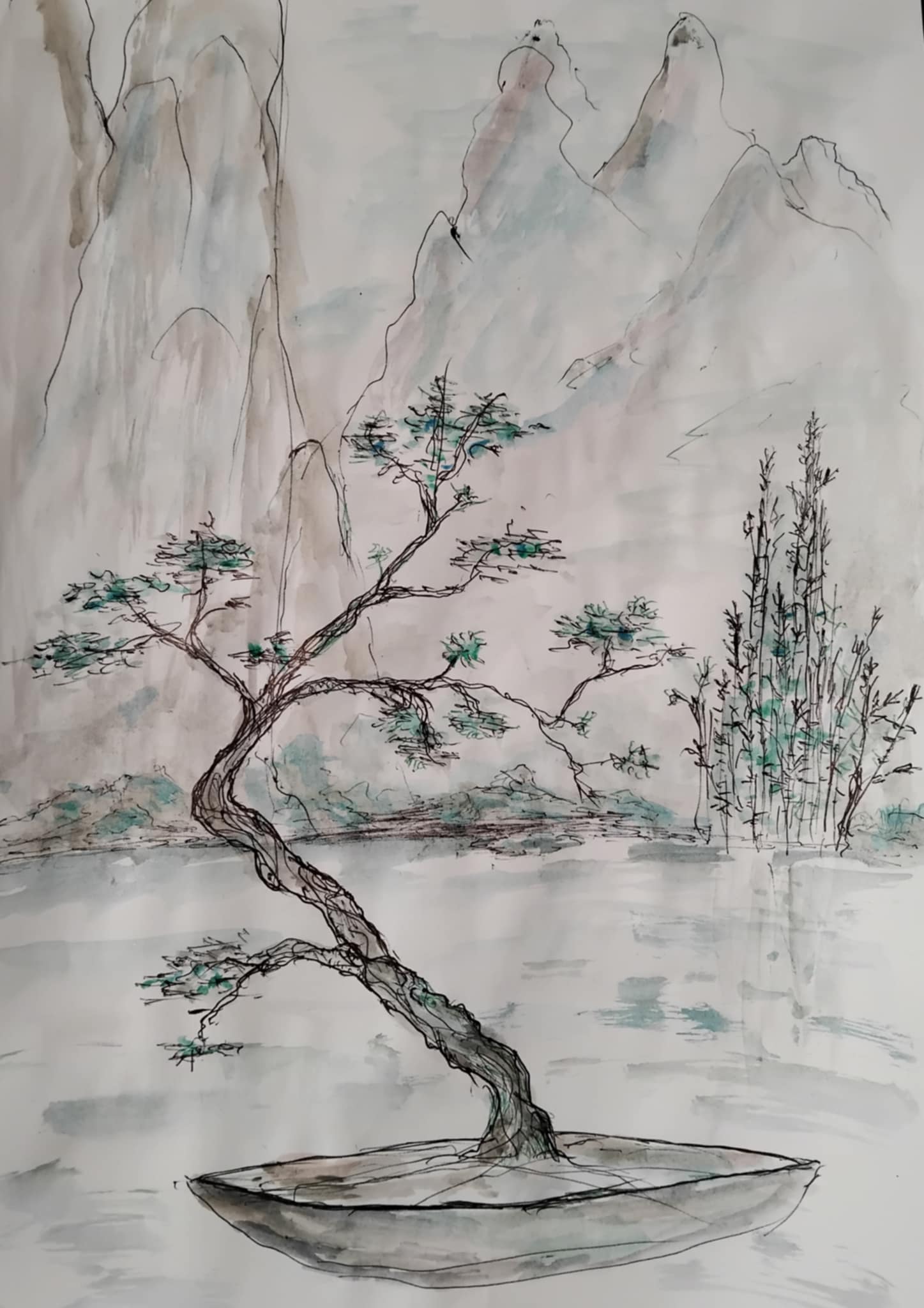
In the painting attached to the article, I followed the same approach. I painted fir trees using blue and green dots to evoke their form and texture, focusing on contrast and rhythm instead of contours. For the sky, I used short strokes in varied colors to suggest movement and changing light.
For the cover picture I followed the same approach. I painted fir trees using blue and green dots to evoke their form and texture, focusing on contrast and rhythm instead of contours. For the sky, I used short strokes in varied colors to suggest movement and changing light.
Like any form of art Impressionism can foster wellbeing – I can vouch for this.



Leave a Reply