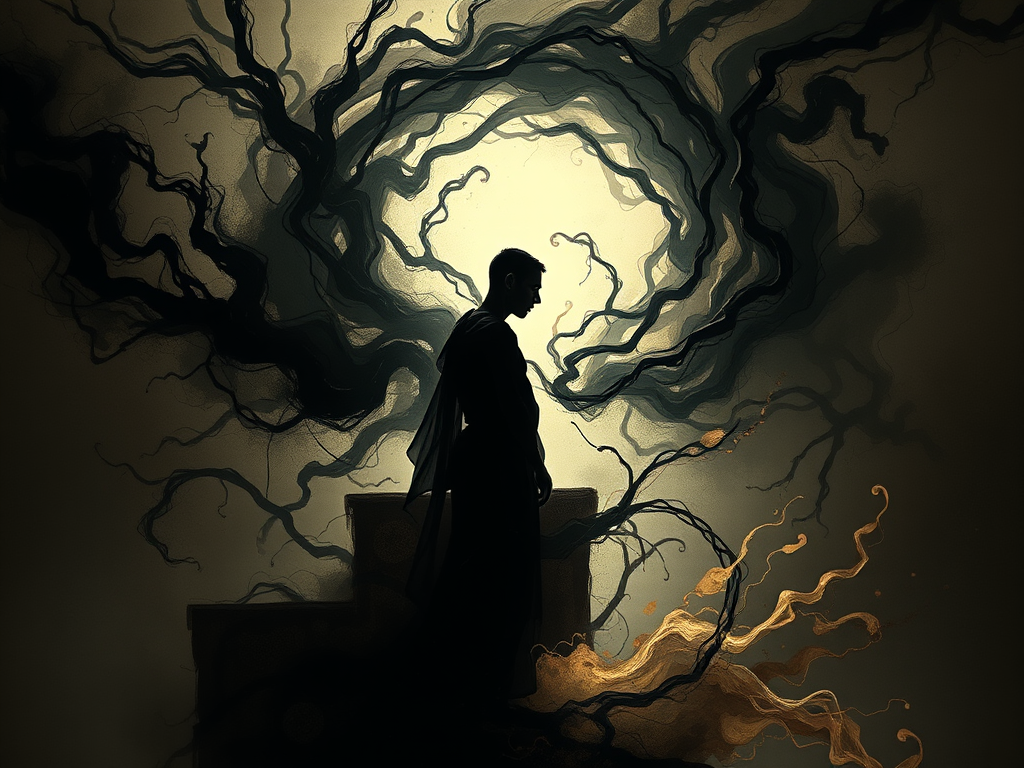
Arthur Schopenhauer developed one of the most unflinching views of human existence in modern philosophy. Born in 1788 in Danzig, he studied under the influence of Kant but moved in a different direction. Where Kant emphasized reason and the structures of knowledge, Schopenhauer turned attention toward irrational forces at work in the human mind.
Will and representation
His main work, The World as Will and Representation, presents a dual understanding of reality. The world appears to us through mental representations shaped by perception and thought. Yet behind those representations lies the Will, which Schopenhauer saw as the underlying force of existence. It is not personal or goal-directed, but blind, automatic, and ever-persistent.
The Will, for Schopenhauer, is a universal force that constantly pushes us to want and act. Because the Will always demands more, it creates a cycle of wanting, getting, and wanting again. When we want something and don’t get it, we feel pain, frustration, or suffering. Even when we do get what we want, the relief lasts only a short time. Soon after, a new desire appears, and the cycle continues. Desire never ends.
Schopenhauer believed human beings suffer more than other animals because of self-awareness. Unlike animals, humans reflect on their lives, recall the past, and anticipate the future. This mental capacity allows for regret, anxiety, boredom, and dissatisfaction. He saw boredom as proof that life lacks inherent meaning. Without the distraction of tasks or goals, humans feel the weight of existence.
How to deal with suffering?
Although Schopenhauer viewed life as filled with suffering, he did not advocate despair. He promoted ethical behavior based on compassion. Because all beings share the same Will, they share the same pain. To cause harm to another is to ignore the reality that others suffer in the same way we do. He believed true morality begins when a person recognizes the suffering of others as equal to their own.
Schopenhauer rejected theories that rooted ethics in reason or divine law. For him, moral action comes from a direct awareness of another’s pain. He saw this awareness as a kind of breakthrough from the ego’s grip, allowing for genuine connection.
He valued art as one of the few paths out of the cycle of desire. Music, especially, revealed the structure of the Will more directly than other forms. Art allows temporary escape from the Will’s demands. While absorbed in a work of art, the observer does not think of personal needs or plans. Instead, attention turns toward the object, freeing the mind from striving.
This freedom is temporary, but meaningful. It gives a glimpse of what existence might be like without constant pressure. For Schopenhauer, this experience held philosophical value. It allowed a different mode of being, if only briefly.
Similarities with other concepts
Schopenhauer’s Will belongs to a larger group of ideas that try to explain what lies beneath everything we see—what drives change, movement, and existence itself.
The Tao, in Chinese philosophy, is the natural order of the universe. It flows through everything and guides the way things happen, without effort or control. Like the Will, it is not a god or a plan. It is a constant force that moves all things, without asking or thinking.
In ancient Greek and early Christian thought, the concept of Logos refers to the rational principle that structures the universe. It implies order, meaning, and a pattern that can be understood. However, the Logos means mainly harmony, while Schopenhauer’s Will speaks to restless movement. Still, both are seen as underlying forces that shape our existence.
When people speak of God in philosophical terms, they often mean a first cause or a source of being. Schopenhauer did not believe in a personal God, but his Will fills a similar space—it explains why things exist and act, even if the Will does not offer comfort or care.
Panpsychism suggests that mind or experience is present in all matter, even at the smallest level. Schopenhauer’s idea also gives inner life to all things, not as thought, but as urge or drive. In that sense, his Will feels close to a panpsychic view, but without assuming awareness in things.
At the quantum level, modern physics reveals a world of constant fluctuation and energy exchange. Some thinkers try to draw links between quantum activity and philosophical ideas of a deep life-force. Schopenhauer did not speak about physics, but the Will resembles a constant field of energy that never stands still.
Similarities with Buddhism
Arthur Schopenhauer studied Buddhism, although not in a formal or extensive way as we might expect today. He encountered Buddhist ideas mainly through secondary sources that were available in Europe during his time, particularly early translations of Eastern texts and academic commentaries.
Schopenhauer’s idea of the Will aligns closely with core Buddhist teachings about desire and suffering. Buddhism teaches that craving and attachment cause suffering because they keep the mind restless and unsatisfied. Similarly, Schopenhauer sees the Will as the source of endless wanting, which leads directly to pain.
Both philosophies point out that peace comes from reducing or overcoming desire. Buddhism offers a path to end suffering through practices like meditation and ethical living. Schopenhauer also suggests ways to escape the Will’s grip—through art, compassion, or asceticism—but his view is more pessimistic overall.
Asceticism and the path to relief
Like in Buddhism, Schopenhauer’s asceticism plays a key role in his philosophy as a method to lessen suffering caused by the Will. Since the Will drives constant desire and craving, the only way to reduce suffering is to weaken or deny those urges. Asceticism means deliberately withdrawing from worldly pleasures and desires, refusing to feed the Will’s endless demands.
By practicing self-denial—such as limiting physical comforts, avoiding indulgence, or embracing simplicity—a person tries to calm the restless striving that the Will forces on us. This denial interrupts the cycle of wanting and temporarily frees the individual from its grip. The ascetic no longer acts to satisfy desires, reducing suffering tied to unmet wants or fleeting satisfaction.
For Schopenhauer, asceticism represents a kind of “will-less” state, where a person stands apart from the force driving most life. This detachment means they no longer identify with the Will’s desires as their own. It brings a level of inner peace and relief from pain because the endless craving fades.
Nietzsche on self-denial
Nietzsche strongly opposed the kind of self-denial that Schopenhauer praised. While Schopenhauer saw asceticism as a way to escape suffering by rejecting desires, Nietzsche viewed this rejection as life-denying and harmful.
Nietzsche believed that desire, struggle, and even suffering were essential parts of life’s strength and creativity. He saw the Will not as a blind force to escape from, but as a source of power to embrace and transform. For Nietzsche, denying life’s drives meant rejecting the very energy that fuels growth and greatness.
Instead of withdrawal or renunciation, Nietzsche celebrated affirming life in all its challenges. He promoted ideas like the “will to power,” which encourages embracing one’s desires and instincts to create meaning and overcome obstacles.
Nietzsche criticized Schopenhauer’s asceticism for weakening life’s vitality. He argued that real strength comes from engaging with the world fully, not escaping from desire or suffering. Their opposing views reveal deep tensions about how to live and what role desire plays in human existence.
Are his ideas pertinent to the 21st century?
Schopenhauer’s ideas remain surprisingly pertinent to the 21st century—perhaps even more so than in his own time—because they speak directly to the inner struggles of modern life.
The modern world fuels constant wanting. Advertising, social media, and productivity culture all reinforce the message that satisfaction lies just beyond the next achievement, purchase, or experience. This aligns precisely with Schopenhauer’s view of the Will: a blind, restless force that keeps us trapped in an endless cycle of craving. Even as technology promises comfort and ease, anxiety, depression, and burnout remain widespread—showing that fulfilling desires does not necessarily bring peace.
His concept of boredom as proof of life’s lack of inherent meaning also resonates today. Despite unprecedented entertainment and information, many people feel aimless or numb. In this light, Schopenhauer’s bleak but lucid account of human dissatisfaction seems prophetic.
Moreover, his emphasis on compassion as the foundation of ethics is increasingly relevant in a world fragmented by inequality and conflict. Rather than grounding morality in laws or abstract principles, he rooted it in a felt recognition of shared suffering—a view that aligns with modern psychological understandings of empathy and trauma.
Schopenhauer’s valuation of art and aesthetic experience as a reprieve from striving also anticipates contemporary discussions on mindfulness, presence, and the therapeutic power of beauty. When he described the way music bypasses the intellect and speaks directly to the Will, he captured something still deeply true about how humans seek meaning beyond language.
However, his pessimism and advocacy of asceticism can be harder to apply. In cultures that celebrate self-expression, ambition, and desire, rejecting the Will outright seems extreme or even pathological. Nietzsche’s critique still holds weight: denying life may reduce suffering, but it may also deaden vitality.
Still, in a world exhausted by its own appetites, Schopenhauer offers a mirror. His philosophy doesn’t provide easy answers, but it forces hard questions about what it means to live, desire, and suffer in an age of excess.






Leave a Reply