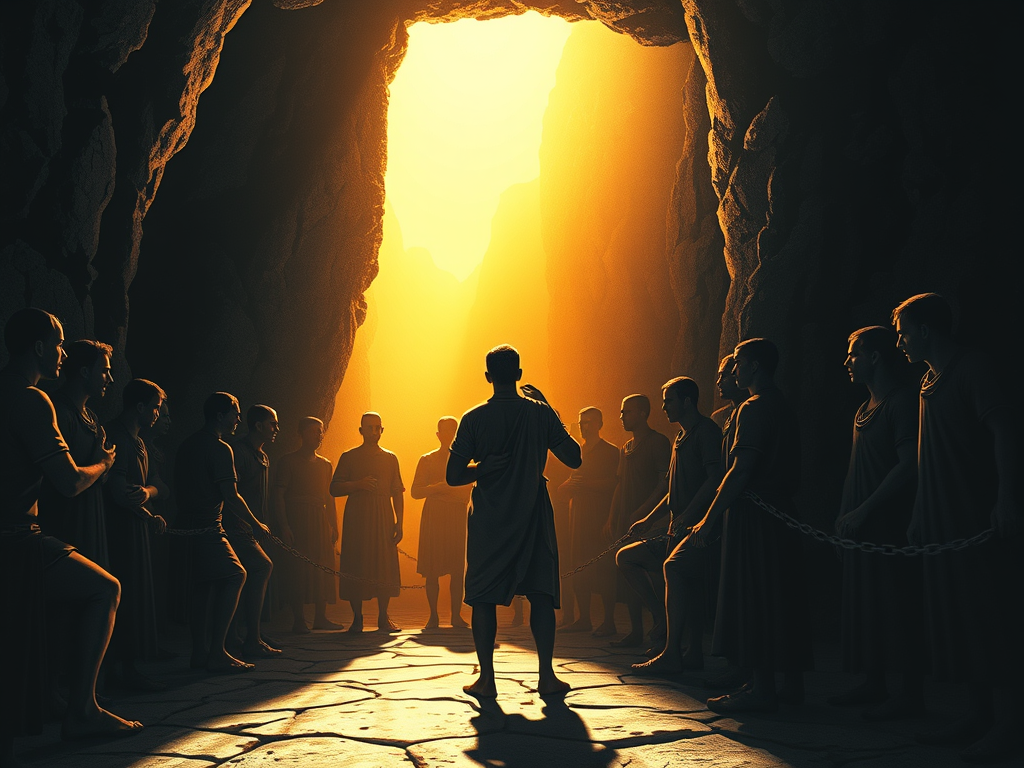
Plato’s Allegory of the Cave, found in Book VII of The Republic, remains one of philosophy’s most striking explorations of perception, knowledge, and human freedom. Written in the context of Plato’s broader investigation into justice and the ideal state, the allegory presents a vivid image of human beings confined by their own limited understanding. Plato imagines prisoners chained in a dark cave, facing a wall, seeing only shadows projected by objects behind them. Because these shadows constitute the entirety of their experience, the prisoners accept them as reality.
The allegory was intended not only as a critique of superficial perception but also as a reflection on the process of education, enlightenment, and the difficulties inherent in the pursuit of truth. In Plato’s vision, knowledge is not simply the accumulation of information; it is a profound transformation of perception, a liberation from the illusions that dominate ordinary consciousness. The cave functions as a metaphor for the human condition: we are often prisoners of appearances, mistaking partial or distorted impressions for ultimate reality. Understanding the allegory as a meditation on freedom reveals the deeper stakes of Plato’s philosophy. Freedom is not merely the absence of physical restraint, but the ability to perceive clearly, to act on insight rather than illusion. The prisoners’ confinement is therefore both literal and psychological, demonstrating how ignorance and deception impose real limitations on human autonomy.
The prisoners’ chains are crucial: they symbolize not just physical restraint, but the self-imposed limitations of perception. Their confinement is psychological, maintained by a lifetime of accepting shadows as truth. They don’t know anything beyond the cave; their understanding is limited to appearances, which they cannot question because the shadow-world defines the totality of their experience. In this sense, illusion becomes a form of tyranny. It restricts thought, narrows possibility, and creates a false sense of security. The prisoners are technically alive, capable of action, yet they are profoundly unfree because their cognition and imagination are shackled.
When a prisoner is freed and turns toward the light, the experience is painful and disorienting. The sunlight—the metaphor for truth, knowledge, and higher reality—initially blinds and overwhelms. This suggests that freedom is not a simple switch but a difficult process of awakening. True freedom requires confronting illusions that the mind may have clung to for decades. In other words, the mind itself can be a prison. The allegory implies that our subjective reality—our beliefs, biases, social conditioning, and attachment to comfort—can act like invisible chains, keeping us from perceiving what is real. Liberation, therefore, demands more than physical mobility; it requires the courage to question, to perceive beyond appearances, and to endure the discomfort of uncertainty.
From a philosophical perspective, Plato is making a radical claim: the more our understanding is limited to shadows, the less autonomous we are. We act under the influence of appearances, not knowledge. A society that thrives on illusions—whether through ideology, propaganda, or conventional wisdom—produces people who are outwardly free but inwardly imprisoned. The allegory, therefore, operates on a collective level: we are all susceptible to living in metaphorical caves if we accept simplified versions of reality without critical reflection.
Psychologically, the cave reflects the ego’s narrow identification with perception. The shadows represent projections, unexamined assumptions, and superficial attachments. Freedom emerges not simply by stepping into the light but by integrating the realization that much of what we believed about the world and ourselves was a distortion. This awakening is destabilizing. The freed prisoner faces the tension of knowing that the familiar world is largely an illusion, which creates a kind of existential vertigo. True freedom requires enduring this discomfort, accepting uncertainty, and cultivating discernment to navigate reality without relying on false images.
A Jungian perspective on the allegory
From a Jungian perspective, the Allegory of the Cave is fundamentally a map of the psyche, illustrating the dynamic between the ego and the unconscious. The prisoners are not just limited by ignorance—they are trapped in the ego’s narrow perspective, which interprets experience through habits, assumptions, and socially conditioned beliefs. The shadows on the wall represent projections: fragmented pieces of the unconscious that appear as external reality. These projections include both personal complexes—unresolved emotional patterns or internalized conflicts—and collective archetypal images embedded in cultural myths, symbols, and shared human experience. The prisoners’ acceptance of shadows as truth demonstrates how the ego can be dominated by forces outside its awareness, producing the illusion of freedom while constraining authentic choice.
The process of leaving the cave mirrors the Jungian path of individuation, the gradual integration of unconscious contents into consciousness. The initial blinding by sunlight reflects the disorientation encountered when confronting unconscious material. Here, the allegory captures the psychological tension that arises when the ego encounters truths it cannot immediately assimilate. Jung emphasizes that this confrontation is not merely intellectual; it is experiential and transformative. As the freed prisoner adjusts to the light, the ego begins to recognize the unconscious not as an external threat but as a source of vitality, creativity, and insight. The journey toward light is therefore also a journey toward wholeness—the Self, in Jungian terms—which transcends the ego while encompassing it.
The cave also highlights the collective dimension of the psyche. The prisoners’ shared illusion parallels the collective unconscious: inherited structures of experience that shape perception and behavior. Cultural narratives, societal norms, and myths operate like the cave itself, producing commonly accepted shadows that limit awareness. In this sense, Plato’s allegory anticipates Jung’s insight that psychological liberation is both an individual and collective challenge. Engaging the unconscious requires not only confronting personal shadows but also recognizing and navigating the shared illusions imposed by society.
An important Jungian insight emerges in the allegory’s tension between the return and the ascent. The freed prisoner’s journey does not end outside the cave; returning to the prisoners symbolizes the task of integrating awareness back into ordinary life and confronting the inertia of collective illusions. This stage mirrors the tension between consciousness and unconscious material: full engagement with reality requires negotiating both the inner and outer worlds, mediating between personal insight and societal norms, and resisting the pull of previously unquestioned assumptions.
Unlike a purely intellectual reading, the Jungian interpretation frames freedom as a psychic capacity rather than a physical or social condition. True freedom arises when the ego recognizes its projections, confronts the unconscious, and gradually aligns with the Self. The cave is not merely a metaphor for ignorance but a representation of the psychic structures that limit perception and autonomy. The allegory becomes a psychological map: shadows illustrate projections and unintegrated archetypes, the chains represent ego attachment and resistance, and the ascent toward light depicts the disciplined confrontation with unconscious forces necessary for authentic autonomy.
In this sense, Plato’s cave resonates with Jung’s insistence that liberation in the context of individuation is not merely external. The world of appearances continues to constrain perception until the ego undertakes the difficult work of self-knowledge, shadow integration, and conscious engagement with archetypal reality. Freedom, then, is existential and psychological: it is the capacity to act from awareness, to perceive beyond illusions, and to participate in life without being unconsciously dominated by projections—both personal and collective.






Leave a Reply