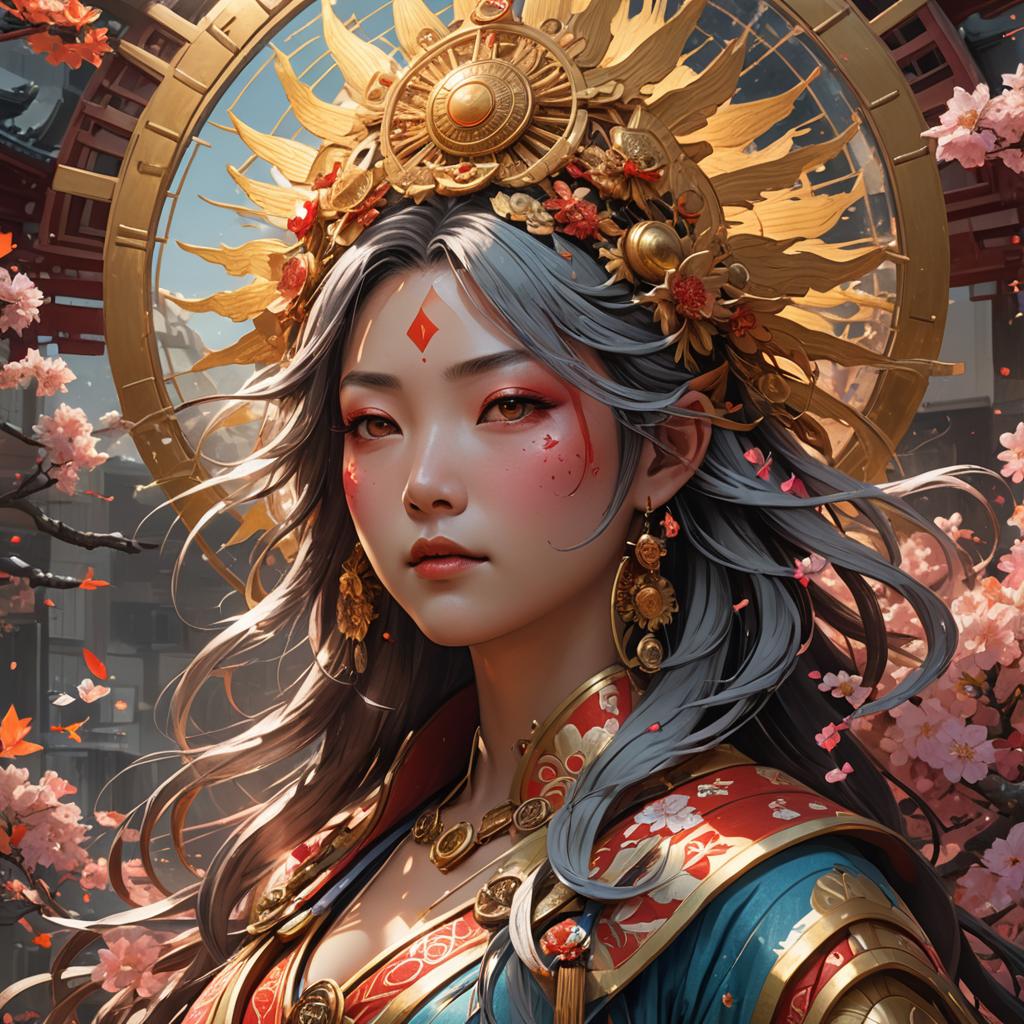
The legend of Amaterasu, the sun goddess, is one of the most prominent and revered myths in Shinto religion.
According to the legend, Amaterasu Omikami was born from the left eye of the first deity: Izanagi. She emerged as a radiant and powerful goddess of sun.
Amaterasu’s significance as a divine entity grew. Her warmth brought light to the world, making her an agricultural deity.
However, the harmony among the divine siblings—Amaterasu, Susanoo (the storm god), and Tsukuyomi (the moon god)— came to an end. Susanoo’s unruly behavior and jealousy led to a series of destructive acts. These culminated in his destruction of Amaterasu’s sacred rice fields.
Deeply offended by Susanoo’s actions, Amaterasu retreated to a cave called Ama-no-Iwato. There is sealed herself inside and plunging the world into darkness. Without her light, crops withered, and life on earth began to suffer.
The other gods and goddesses were distraught by Amaterasu’s withdrawal, realizing the negative consequences it would have for the world. They devised a plan to lure her out of the cave and restore light to the world.
A banquet was organized outside the cave, with festivities, music, and laughter. The goddess Ame-no-Uzume, known for her lively and playful nature, performed a provocative dance. This act of merriment drew the attention of the gods and causing them to laugh uproariously.
Curious about the commotion, Amaterasu peeked out of the cave to see what was happening. Seeing her radiant reflection in a mirror placed strategically outside the entrance, she was captivated by her own beauty. As she emerged from the cave, the other gods swiftly closed the entrance behind her, preventing her from retreating.
With Amaterasu’s return, light also came back to the world. Thus, life could flourish once again. The sun goddess resumed her rightful place in the celestial realm, bringing blessings and prosperity to humanity.
A Jungian interpretation of the legend
The Legend of Amaterasu, a cornerstone of Japanese mythology, presents a narrative rich in archetypal symbolism. At its core are three primary archetypes: the shadow, anima, and trickster. These archetypes interact throughout the tale, reflecting specific aspects of the human psyche.
The shadow archetype is embodied by Susano-o, the storm god whose rage lead to destructive behavior. His actions symbolize the darker aspects of the psyche, including envy, which can lead to the suppression of positive traits represented by the anima.
Amaterasu, the sun goddess, represents the anima archetype, embodying creativity, warmth, and vitality. When Susano-o’s shadow consumes him and plunges the world into darkness, Amaterasu retreats into a cave, symbolizing the repression of her creative energy in the face of adversity.
The destruction of the rice, a vital symbol of creativity, stresses the detrimental impact of unchecked shadow behavior on human creativity. Without the nurturing presence of the anima, represented by Amaterasu, the potential for growth and renewal is not possible.
Uzume, the goddess of mirth and revelry, embodies the trickster archetype in the tale. Through her playful antics, she disrupts the stagnant patterns of the shadow and coaxes Amaterasu out of her self-imposed exile. Uzume’s actions symbolize the role of the trickster in challenging established norms.
Through dance and revelry, Uzume invites the anima to infuse the psyche with renewed energy and vitality. This shows the importance of embracing joy as ways to healing and transformation.
Concluding reflections
The legend of Amaterasu thus offers a reminder of the resilience of the human spirit and the potential for growth and renewal, even in the face of adversity.
Just as Amaterasu emerges from the darkness of the cave, so too can we emerge from the depths of our own psyches through the power of playful expression and joy.






Leave a Reply