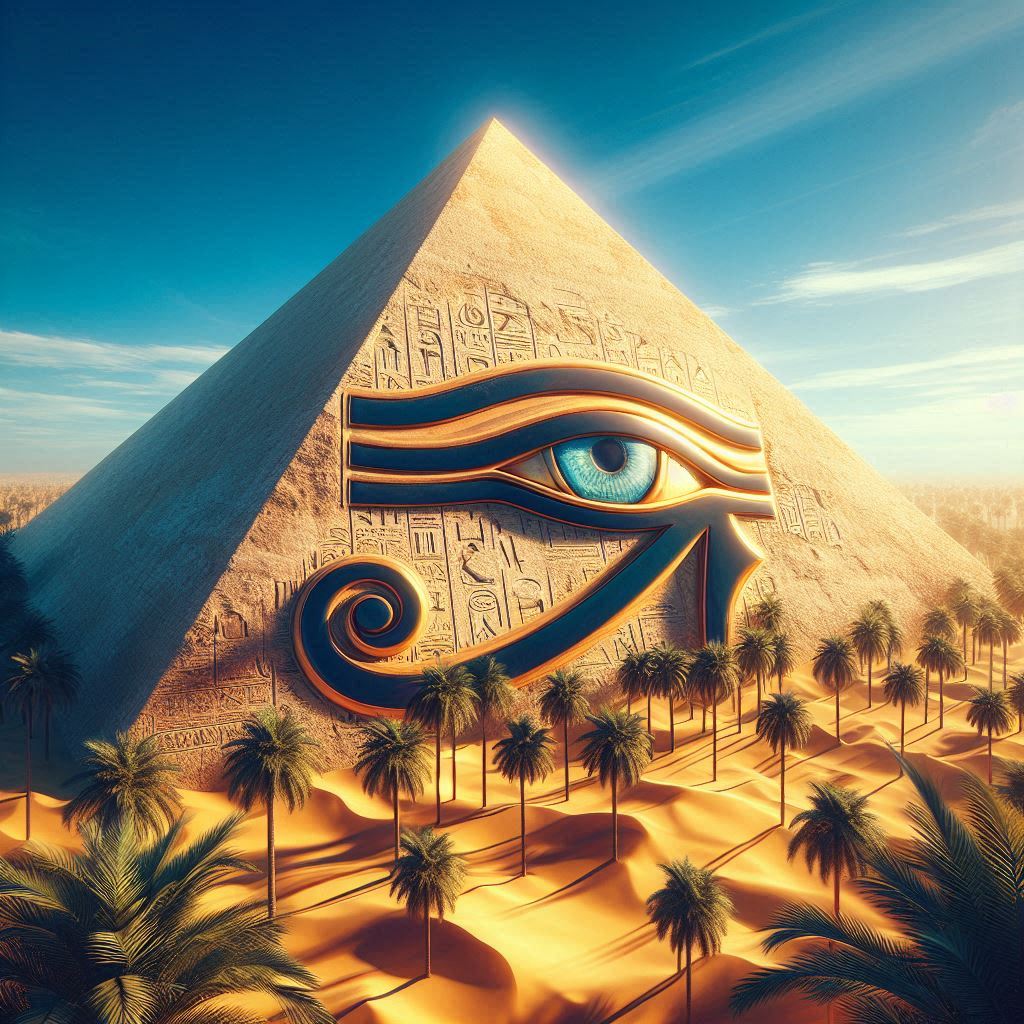
Horus, one of the most significant and complex deities in ancient Egyptian mythology, is often depicted as a falcon or as a man with a falcon’s head. His image and mythology have endured for millennia, symbolizing kingship, power, and protection. The legacy of Horus is vast, intertwined with the religious, political, and cultural fabric of ancient Egypt.
Origins
Horus is the son of Osiris, the god of the afterlife, and Isis, the goddess of magic and motherhood. His lineage places him at the heart of Egyptian mythology. Osiris, the benevolent ruler of Egypt, was murdered by his jealous brother Seth, who sought to usurp the throne. Seth’s act of fratricide was not only a crime against his family but also a disruption of Ma’at, the divine order.
Isis, devastated by her husband’s death, used her magical abilities to reassemble Osiris’s body and conceive a child. This child, Horus, was destined to avenge his father and restore harmony to Egypt. Isis hid in the marshes of the Nile Delta to protect Horus from Seth, who sought to eliminate any threat to his ill-gotten throne.
As Horus grew, Isis began to train him for the eventual confrontation with Seth. These lessons were both physical and mental. She taught him the arts of combat, the secrets of magic, and the wisdom needed to be a just ruler. Each day brought new challenges designed to hone his skills and fortify his spirit.
Seth
Seth, knowing that his nephew was alive and a threat to his rule, sent numerous minions to hunt down and kill Horus. Disguised as animals or even fellow gods, these assassins prowled the marshes, searching for any sign of the boy. Each encounter tested Isis’s ingenuity and Horus’s budding instincts.
One night, as they lay hidden among the reeds, a giant serpent sent by Seth slithered towards the infant Horus. Isis, sensing the danger, recited powerful incantations that paralyzed the serpent, saving her son from certain death. This constant vigilance was necessary to ensure that Horus could grow strong enough to eventually face Seth.
Seth also sent a band of malevolent spirits to locate Horus. Disguised as friendly travelers, these spirits approached the hiding place of Isis and Horus. Isis, however, recognized the deception. She used her magic to create illusions, leading the spirits astray and protecting her son from their clutches.
Disguised as a beggar, Seth approached Horus while he was alone. Sensing danger, Horus attempted to flee, but Seth pursued relentlessly. The chase led them through treacherous terrain, with Horus using his knowledge of the land to evade capture. At the critical moment, Isis intervened, summoning a storm that obscured their path and allowed Horus to escape. This narrow escape reinforced the ever-present danger and the necessity of remaining hidden until the right time.
The Formation of Alliances
Throughout his youth, Horus formed alliances with other deities who supported his claim to the throne. One notable ally was Hathor, the goddess of love and joy. In one story, Hathor found the young Horus wounded and weary from an encounter with Seth’s minions. She nursed him back to health, offering both physical healing and emotional support. This bond would prove invaluable in his later battles against Seth.
The Contests
One of the most famous aspects of their rivalry involved a series of contests designed by the gods to determine the rightful ruler. These challenges ranged from boat races on the Nile to more esoteric tests of endurance and wit. Throughout these trials, Horus demonstrated his courage, strength, and righteousness, while Seth relied on deceit and brute force.
One of the most famous contests between Horus and Seth was the boat race on the Nile. The gods decreed that the one who could sail a stone boat across the river would be declared the rightful king. Seth, confident in his strength, carved an enormous boat out of stone. However, when he tried to sail it, the boat sank under its weight. Horus, displaying both ingenuity and humility, crafted his boat from wood and covered it with gypsum to give it the appearance of stone. This race set a precedent for his eventual victory.
Another significant trial was the underwater battle, where Horus and Seth transformed into hippopotamuses and fought in the waters of the Nile. The gods set a time limit of three days for the battle. During this fierce contest, the river roiled with their struggle. Seth, using his brute strength, attempted to overpower Horus. However, Horus, with his agility and determination, managed to hold his own.
The final battle
The final showdown between Horus and Seth took place in the form of a physical combat trial.
During the battle, Seth managed to land a devastating blow, gouging out Horus’s left eye. This injury was not only a physical wound but also a symbolic assault on the cosmic order, as Horus’s eyes represented the sun and the moon. Despite the excruciating pain and the partial loss of vision, Horus fought on, driven by a sense of duty and justice.
The gods watched in awe as Horus, now partially blinded, continued to match Seth’s ferocity. Thoth, the god of wisdom and magic, eventually intervened, using his powers to restore Horus’s eye.
In the final moments of the battle, Horus managed to disarm Seth and pin him to the ground. With his strength and resolve, he bound Seth and presented him before the council of gods.
The council
The final judgment came in the form of a council convened by the gods. Here, Horus and Seth presented their cases before the divine assembly. Each god offered their opinion, with some supporting Seth due to his age and experience, and others backing Horus because of his righteousness and potential for bringing order to Egypt.
Ra, the sun god, initially supported Seth, but after witnessing Horus’s virtues and the deceitfulness of Seth, Ra eventually endorsed Horus. Thoth, the god of wisdom, played a crucial role in arguing for Horus’s rightful place as king, emphasizing his just nature and the restoration of Ma’at, the cosmic order.
Symbolism
The Eye of Horus, also known as the Wadjet, is one of the most recognizable symbols from ancient Egypt. It was believed to have protective and healing powers, often used in amulets and jewelry. The Eye of Horus was also thought to provide wisdom and prosperity, making it a ubiquitous emblem in Egyptian iconography.
Ma’at, the foundational element in Egyptian belief, essential for the proper functioning of the cosmos, society, and individual lives was also related to Horus. The Egyptians believed that Ma’at was established by the gods at the time of creation, and it was the duty of both the gods and humans to maintain it. Disruptions to Ma’at, whether through natural disasters, social upheavals, or moral failings, were seen as threats to the cosmic balance.
The goddess Ma’at, often depicted as a woman with an ostrich feather on her head, personified these principles. She was involved in the judgment of souls in the afterlife, where hearts were weighed against her feather to determine the righteousness of the deceased.
In the mythological narrative, Seth represents chaos, violence, and disorder—forces that threaten to destabilize Ma’at. His murder of Osiris, the god of the afterlife and order, is a profound disruption of cosmic balance. Horus, as the son of Osiris and Isis, is destined to confront Seth and restore Ma’at.
Horus as a King
Horus’s association with kingship is profound. Every reigning pharaoh was considered the earthly embodiment of Horus, legitimizing their rule and connecting them to the divine. This belief underscored the pharaoh’s role as the upholder of Ma’at, the cosmic order. Temples dedicated to Horus, such as the well-preserved Temple of Edfu, highlight his importance in state and religious ceremonies.
The worship of Horus was widespread, with numerous temples erected in his honor. The Temple of Edfu, located on the west bank of the Nile, is one of the most significant and well-preserved monuments dedicated to Horus. Built during the Ptolemaic period, this temple complex reflects the grandeur of Horus worship, featuring colossal statues, intricate reliefs, and inscriptions that celebrate his mythos and divine attributes.
Conclusion
The legend of Horus is a story of resilience, justice, and divine right. His trials and tribulations underscore the archetypal values of order, righteousness, and the eternal struggle against chaos.
Horus’s journey from a vulnerable child to the avenger of his father and ruler of Egypt embodies the triumph of good over evil and the enduring power of myth in human civilization. His legacy, enshrined in art, literature, and religious practice, continues to captivate and inspire.






Leave a Reply