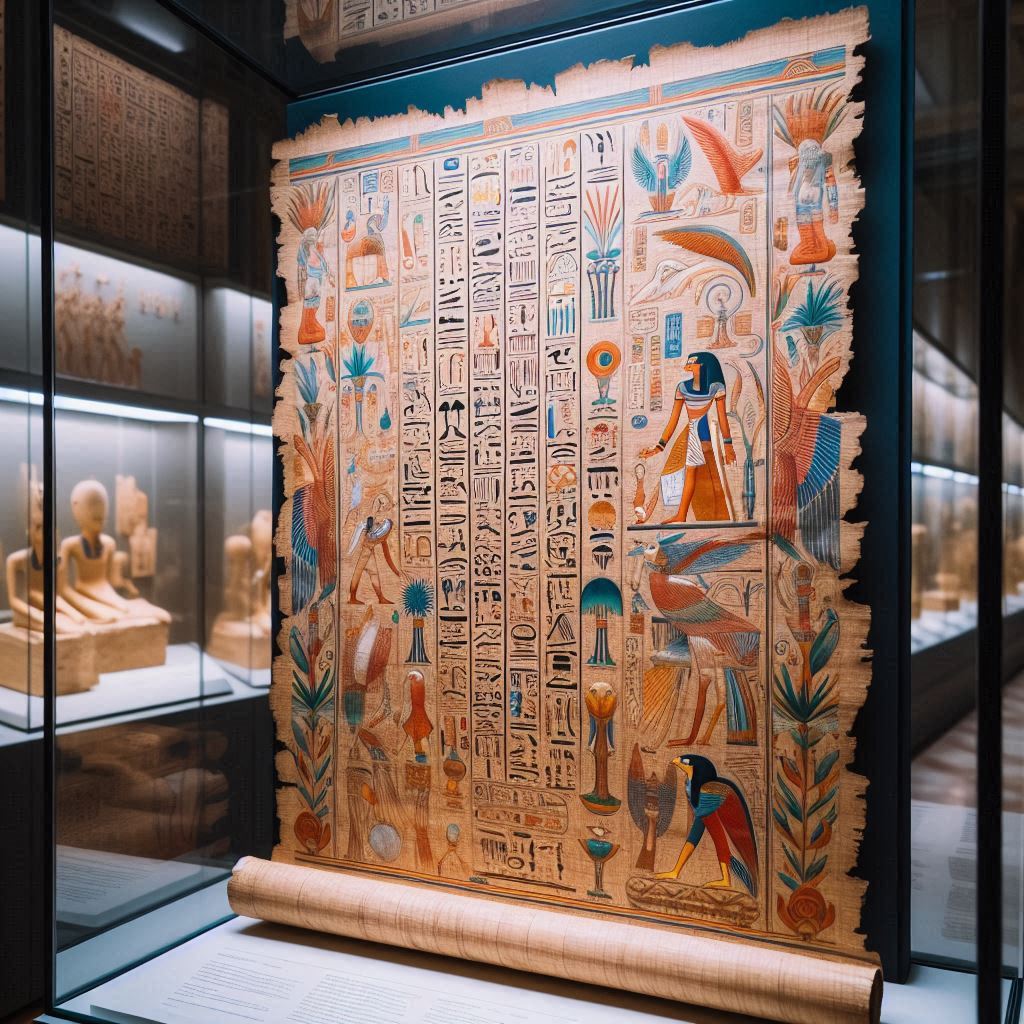
Ancient Egypt, with its rich cultural and intellectual history, left behind a treasure trove of knowledge inscribed on papyrus scrolls. These papyri, made from the papyrus plant native to the Nile Delta, served as the primary medium for writing in ancient Egypt. Over the millennia, many of these papyri have survived, providing us with invaluable insights into the ancient Egyptian world, including their religious practices, medical knowledge, and daily life. Here are some of the most famous Egyptian papyri and their descriptions.
1. The Edwin Smith Papyrus
The Edwin Smith Papyrus is the oldest known surgical treatise, dating back to around 1600 BCE. Named after the American Egyptologist Edwin Smith, who purchased it in 1862, this papyrus offers a unique insight into ancient Egyptian medicine. Unlike other medical texts of the time, which often relied on magical spells, the Edwin Smith Papyrus is rational and practical in its approach. It describes 48 cases of injuries, fractures, wounds, dislocations, and tumors, providing detailed observations and treatments. The document demonstrates a remarkable understanding of anatomy and surgical techniques, emphasizing the Egyptians’ empirical approach to medicine.
2. The Ebers Papyrus
The Ebers Papyrus, dating to around 1550 BCE, is one of the most extensive and well-preserved medical documents from ancient Egypt. It is a comprehensive compilation of herbal knowledge and medical treatments, with over 700 remedies and formulas. The papyrus covers a wide range of ailments, from physical injuries and internal diseases to mental health issues. In addition to medical treatments, it includes incantations and prayers to ward off evil spirits believed to cause disease. This document highlights the dual nature of Egyptian medicine, combining practical remedies with spiritual practices.
3. The Book of the Dead
Perhaps the most famous of all Egyptian papyri, the Book of the Dead is a collection of funerary texts from around 1550 BCE to 50 BCE. The title “Book of the Dead” is a modern term; the ancient Egyptians referred to these texts as the “Spells for Going Forth by Day.” The papyrus scrolls, often buried with the deceased, contained spells, prayers, and incantations intended to guide the dead through the underworld and ensure their safe passage to the afterlife. These texts were personalized for the individual, with specific spells selected based on their beliefs and needs. The Book of the Dead provides profound insight into Egyptian religious beliefs, their views on death, and their hopes for the afterlife.
4. The Rhind Mathematical Papyrus
Named after Alexander Henry Rhind, the Scottish antiquarian who acquired it in 1858, the Rhind Mathematical Papyrus dates back to around 1650 BCE. This papyrus is one of the most important sources of knowledge about ancient Egyptian mathematics. It contains 84 mathematical problems, ranging from simple arithmetic to geometry and algebraic equations. The text illustrates how the Egyptians calculated areas, volumes, and proportions, showcasing their practical use of mathematics in fields like architecture and engineering. The Rhind Papyrus is a testament to the Egyptians’ advanced mathematical understanding, particularly in solving practical problems related to construction and land measurement.
5. The Harris Papyrus
The Great Harris Papyrus, also known simply as the Harris Papyrus is measuring over 40 meters in length. Dating to the reign of Ramses IV (circa 1150 BCE), it is a detailed record of the reign of Ramses III, one of Egypt’s most powerful pharaohs. The papyrus documents the king’s achievements, including his construction projects, donations to temples, and military victories. It also provides an account of the state administration and the distribution of wealth among the temples. The Harris Papyrus is a crucial historical document, offering a comprehensive overview of the political, religious, and economic landscape of Egypt during the New Kingdom period.
6. The Westcar Papyrus
The Westcar Papyrus is a collection of five stories, written during the Middle Kingdom (circa 1800 BCE), that are set in the court of Pharaoh Khufu (Cheops), the builder of the Great Pyramid. These tales, often referred to as “The Tales of the Magicians,” involve miraculous events and magical feats performed by priests and magicians. The stories provide a fascinating glimpse into the world of ancient Egyptian mythology and royal court life. They also reflect the Egyptians’ belief in the supernatural and their fascination with the mystical powers attributed to their religious figures.
7. The Turin King List
The Turin King List, or the Turin Royal Canon, is a papyrus dating back to the 19th Dynasty (circa 1300 BCE). Unlike other king lists that glorify the reigns of specific pharaohs, the Turin King List attempts to provide a complete and accurate chronological record of all the kings of Egypt from the earliest times up to the reign of Ramses II. Although the papyrus is fragmentary, it is an invaluable resource for Egyptologists, as it lists many otherwise obscure or little-known kings and provides information on the lengths of their reigns. The document underscores the Egyptians’ strong sense of history and their efforts to preserve the memory of their rulers.
8. The Hunefer Papyrus
The Hunefer Papyrus is one of the most beautifully illustrated copies of the Book of the Dead. Created for Hunefer, a scribe during the 19th Dynasty (around 1300 BCE). This papyrus presents detailed and vibrant depictions of the journey to the afterlife. The most famous scene from this papyrus is the Weighing of the Heart ceremony, where the deceased’s heart is weighed against the feather of Ma’at, the goddess of truth and justice. The richly decorated papyrus provides not only religious texts but also a visual narrative of the afterlife, making it a masterpiece of ancient Egyptian art and religious thought.
Conclusion
These papyri reveal the complexities of Egyptian society, their beliefs, and their intellectual achievements. Each papyrus offers a unique perspective on the ancient world, preserving the knowledge and traditions of one of history’s most remarkable civilizations.







Leave a Reply