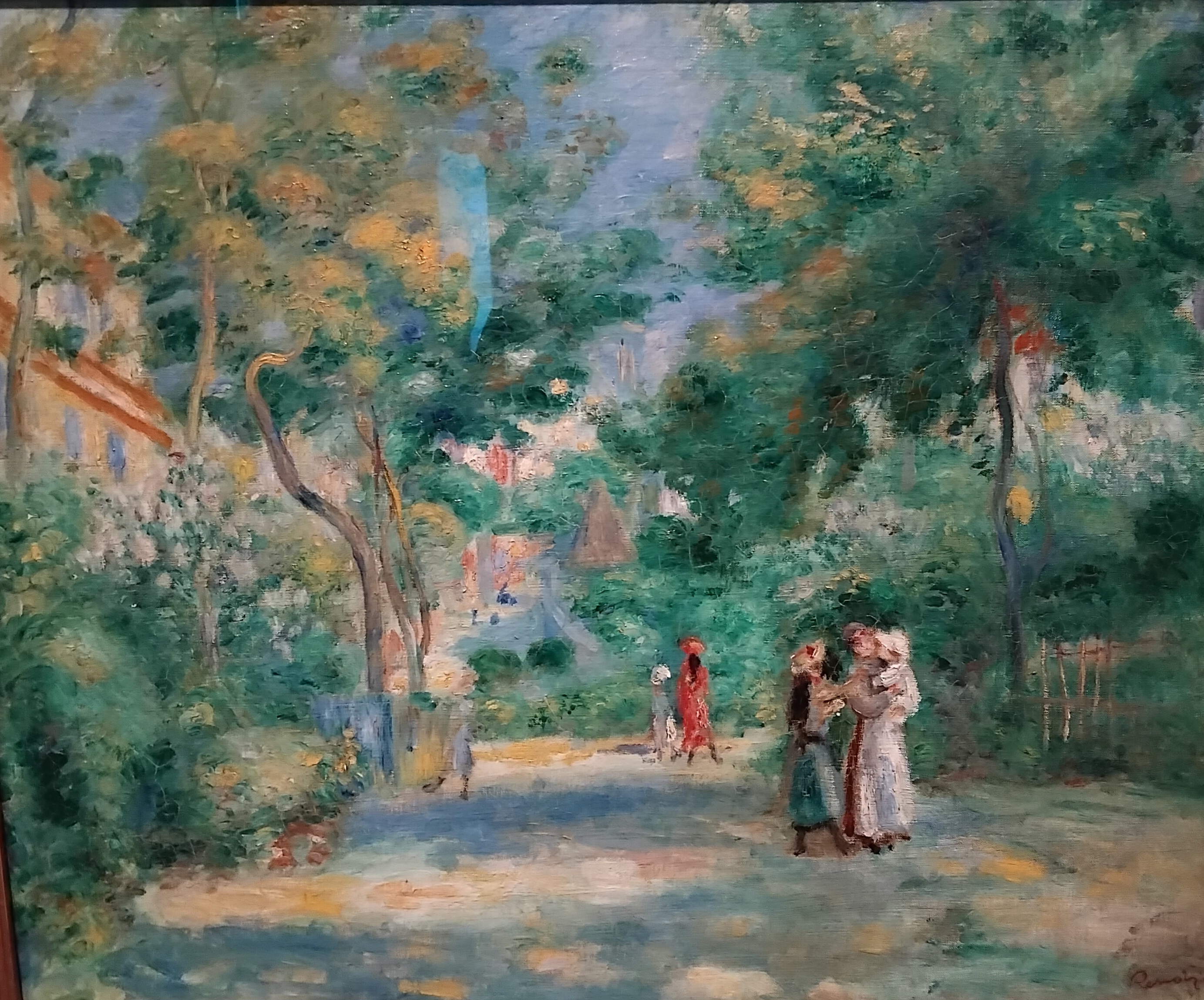
When we think of Pierre-Auguste Renoir, we think of vibrant color, light that plays across a canvas, and moments of life frozen in time. But to understand his art is to explore the inner landscape of his personality and how he perceived the world. For Renoir, life seemed to be a celebration of beauty, and his personality absorbed the pleasures of the everyday. His world brimmed with sensuality, joy, and a deep appreciation for human intimacy. His eyes never rested on a surface for long, always seeking the warmth in the scene, the grace in human forms, and the subtle glow of color in the most unexpected places.
I used as cover text for this article one of this paintings – A garden at Montmartre. I made the picture at the Ashmolean museum, with permission.
This being said, in order to imagine how Renoir experienced the world, we need to attempt to see life through his eyes when watching his creations. While we cannot know for certain what his internal world was like, we can explore his personality through the art he left behind. Using imagination, tied to the theory of mind, allows us to make presumptions about his sensitivity and self-expression. Renoir’s works reflect not only joyful people but also vibrant landscapes and flowers, revealing the depth of his connection to the world around him.
Why did he paint?
As so many artists it is likely that Renoir painted because he had an emotional need to express what he saw and felt. His sensitivity to the world around him, both to people and nature, was deeply personal. Painting allowed him to project his inner joy and appreciation for beauty into the canvas. He painted not to challenge or provoke, but to capture and celebrate the things he found beautiful. For Renoir, art wasn’t about intellectual expression; it was about sharing his sense of wonder and happiness. His work allowed him to communicate his personality—someone who valued connection, warmth, and beauty in the simplest moments of life.
His message was simple yet profound: life is full of beauty and joy, if we know how to see it. Through his paintings, he communicated a deep appreciation for the ordinary moments that make up everyday life. Whether it was a gathering of friends, a quiet landscape, or the vibrant bloom of flowers, Renoir’s art conveyed a celebration of life’s pleasures. He wasn’t interested in making grand philosophical statements or exploring social critique. Instead, he used his art to remind us that happiness can be found in the present, in the colors, light, and warmth of the world around us.
I just wander when was he happy?
It occurs to me that Renoir found happiness in both human connection and nature. His art reflects a man who felt most alive in the company of others, whether it was friends enjoying a lively meal together or people engaged in quiet moments. At the same time, nature provided him with a sense of peace and fulfillment. His paintings of flowers and landscapes suggest that Renoir felt a deep joy in the natural world’s beauty. He didn’t seek out happiness in grand gestures but found it in the simple, everyday experiences that he painted with such care and affection.
What was beauty from his perspective?
Probably beauty, for him, existed in the fleeting experiences of life—moments that others might overlook. He had an extraordinary sensitivity to how color, texture, and light could evoke emotion. Renoir’s art shows that beauty, from his perspective, didn’t need to be idealized; it could be found in the natural, imperfect, and transient moments that made life so rich.
How did he deal with hardship?
Even when faced with severe arthritis that crippled his hands, Renoir didn’t stop painting. His determination to continue, even when it meant tying brushes to his hands, shows his resilience and dedication. Renoir’s response to hardship was not to retreat but to push forward, using art as a way to overcome the challenges he faced. His physical limitations didn’t dampen his spirit or his desire to project his personality into his work. Instead, they seemed to strengthen his connection to his art, allowing him to find joy and purpose even in difficult circumstances.
What can we learn from Renoir?
Renoir’s life and art teach us the importance of seeing beauty in the everyday and projecting our own personality into our work. His ability to find joy in both people and nature, even in the face of personal hardship, offers a valuable lesson in resilience and optimism. By focusing on the richness of life’s simple moments, Renoir reminds us to slow down and appreciate the world around us. His art encourages us to cultivate sensitivity, to look for beauty in the ordinary, and to express our own unique vision of the world through whatever medium we choose.






Leave a Reply