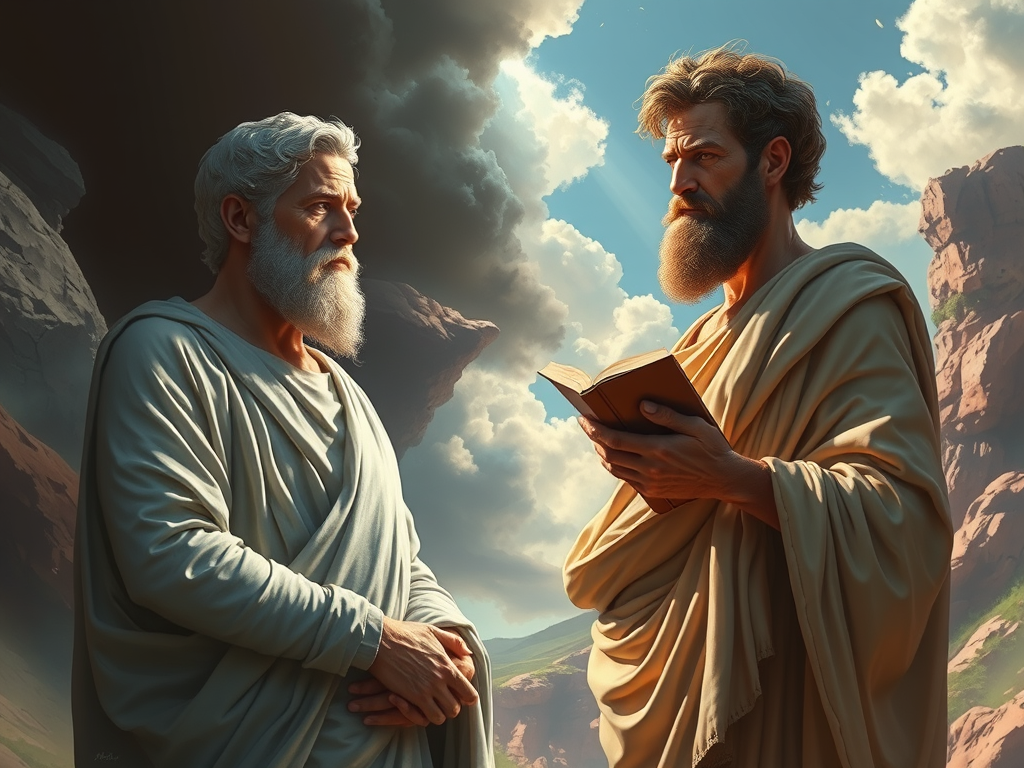
Plato and Aristotle represent two of the most influential yet contrasting perspectives in Western philosophy. Their fundamental differences shape the way we understand metaphysics, ethics, politics, and the nature of knowledge. Plato, as an idealist, viewed reality as rooted in eternal, unchanging Forms, while Aristotle, as an empiricist, emphasized the importance of direct observation and experience.
The reality
Plato saw the world as a pale shadow of a higher, eternal realm. He believed in unchanging Forms (eide), pure archetypes that shape everything we see. What the senses perceive is unreliable, a fleeting imitation of a greater reality. Knowledge (episteme) emerges not from experience but from intellectual insight into these Forms. The physical world is deception; truth lies beyond it.
Dismantling Plato’s view, Aristotle rejected the notion of separate, immaterial Forms. He argued that reality consists of substances (ousiai) made of both matter (hyle) and form (morphe). Forms do not float in some higher realm—they exist within the things themselves. Knowledge is built from experience (empeiria), observation, and logical analysis (logos). The world is not an illusion; it is the very foundation of truth.
Knowledge: Innate ideas or empirical discovery?
According to Plato learning is an act of remembering (anamnesis). Before birth, the soul (psyche) knew the Forms, but earthly existence makes it forget. Knowledge is not acquired but recollected. The philosopher, through dialectic (dialektike), moves beyond opinion (doxa) toward wisdom (sophia), peeling away illusions to grasp eternal truths.
Aristotle overturned this idea. The mind is not born with knowledge but gains it through experience. He developed a systematic approach (organon) to reasoning, relying on induction (epagoge) and deduction (syllogismos). The intellect (nous) extracts universals from particulars, constructing understanding through empirical study. Truth does not preexist in the mind; it must be uncovered.
Ethics: A life of reason or a life of balance?
Moral excellence from Plato’s perspective referred to the alignment of the soul’s three parts—reason, spirit, and desire. Justice (dikaiosyne) arises when reason rules, guiding the individual and the state. The highest pursuit is the Form of the Good (to agathon), the ultimate source of virtue. Philosophy leads the soul toward this perfect ideal.
Aristotle also grounded his ethics on virtues, but he promoted the idea of human flourishing (eudaimonia). He rejected abstract ideals and focused on practical virtue (arete). A person becomes virtuous through habit, choosing the golden mean (mesotes) between excess and deficiency. The wise person (phronimos) cultivates reason and action in harmony. Ethics is not about reaching a distant Form but about living well in the real world.
Utopia or pragmatism?
A typical idealist, Plato crafted an ideal political vision where philosopher-kings rule with wisdom. The state mirrors the tripartite soul: rulers embody reason, guardians represent spirit, and producers serve desire. Justice emerges when each class performs its role. His Republic is rigid, hierarchical, and bound to the vision of the Good.
Being more pragmatic, Aristotle rejected utopian fantasies. He studied existing political systems, favoring a mixed government balancing monarchy, aristocracy, and democracy. Stability comes not from rigid hierarchy but from laws (nomoi) that cultivate virtue in citizens. Political systems must adapt to the needs of the people, not to an abstract ideal.
The arts – dangerous illusions or paths to truth?
Interestingly, Plato distrusted art (techne). He saw poetry and drama as deceptive imitations (mimesis) that distort reality and corrupt the soul. Emotion clouds reason, and art inflames passion at the expense of wisdom. Philosophers seek truth, while artists mislead. His Republic has no place for poets.
Quite the contrary, Aristotle defended art as a vehicle of knowledge. He embraced mimesis as a means of revealing deeper truths about human nature. Tragedy, through catharsis, purifies the emotions and fosters moral understanding. Art does not deceive; it illuminates. It refines thought rather than obscuring it.
A rivalry that never ends
Plato and Aristotle stood at the heart of Western thought, locked in an eternal argument. One sought perfection beyond the physical world; the other found truth within it. One saw knowledge as recollection; the other as discovery. Their debate continues, shaping philosophy, politics, ethics, and art. To choose between them is to choose between two visions of reality itself.
But do we really need to chose between the two philosophies? Why not see their perspectives as rather complementary?





Leave a Reply