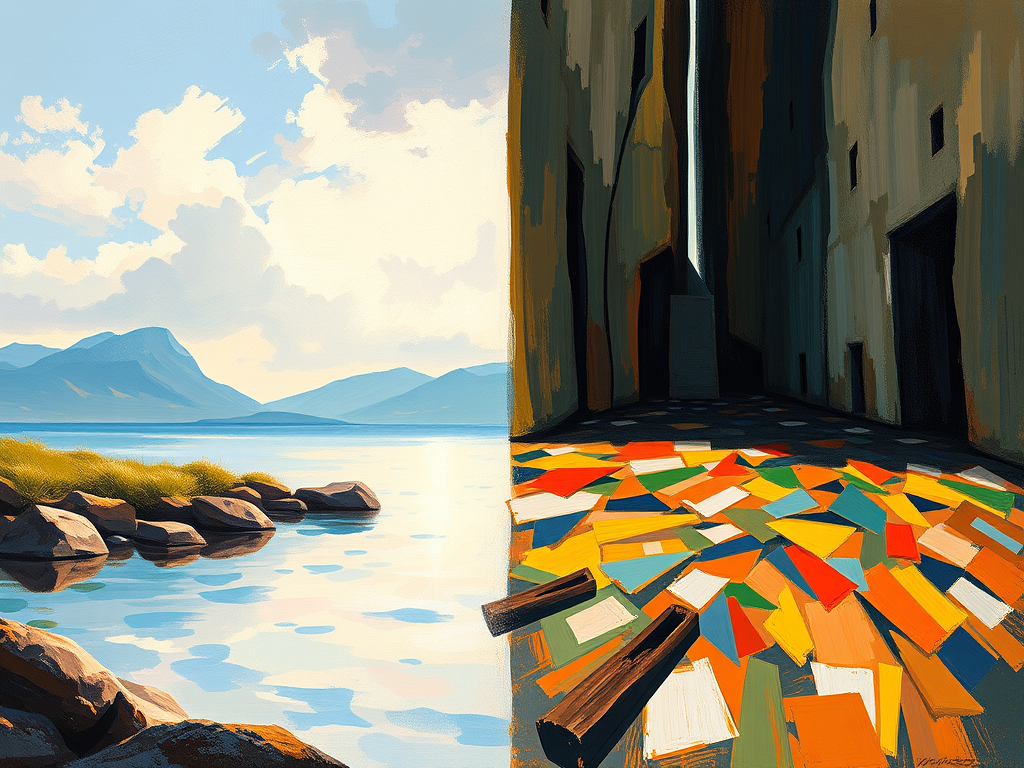
The transition from Impressionism to Expressionism marks a significant shift in the evolution of modern art. While both movements emerged in the late 19th and early 20th centuries, they diverged in their approach to the representation of reality. Impressionism, grounded in the depiction of fleeting moments and sensory experiences, focused on capturing the play of light and color.
Expressionism, however, sought to reveal the inner emotional states of the artist, often through distorted forms and intense color contrasts. Understanding this separation requires exploring the historical context and philosophical shifts that guided these movements.
The roots of impressionism
Impressionism originated in France in the 1860s as a reaction against the rigid academic art traditions that dominated the time. Artists like Claude Monet, Pierre-Auguste Renoir, and Edgar Degas rejected detailed realism in favor of capturing the atmosphere of a scene. They painted landscapes, urban settings, and everyday life, often working outdoors to capture natural light and the transient effects of weather. Impressionism emphasized the visual impression rather than accurate representation, focusing on how light and color changed a scene.
The philosophical shift towards expressionism
While Impressionism sought to capture the external world, Expressionism emerged as a reaction to the emotional and psychological turbulence of the early 20th century. Expressionism focused on portraying the artist’s inner emotional world, often at the expense of realism. In the wake of industrialization, war, and social upheaval, artists began to confront deeper existential questions. Figures like Edvard Munch, Wassily Kandinsky, and Egon Schiele explored themes of anxiety, alienation, and the darker aspects of human experience.
The role of color and form
One of the most noticeable differences between Impressionism and Expressionism lies in their use of color and form. While Impressionist artists focused on subtle, delicate color palettes to depict the effects of light, Expressionists favored bold, often jarring colors. These colors were not intended to reflect the physical world accurately but to express emotional intensity. In Expressionism, forms were distorted, exaggerated, and deformed to amplify the psychological or emotional impact of a subject, creating a more subjective, sometimes unsettling, portrayal of reality.
A departure from naturalism
Impressionism remained tied to a sense of naturalism, as its goal was still rooted in representing the observable world, even though it often deviated from strict realism. Expressionism, however, embraced abstraction and subjectivity, moving further away from naturalism. This departure was influenced by a growing disillusionment with the industrial world and the mechanized nature of society. As artists grappled with the breakdown of traditional social structures, they sought new ways to communicate personal emotions and psychological states.
Expressionism’s impact on modern art
The influence of Expressionism reverberated through many art forms, including painting, literature, theater, and film. The movement birthed radical styles, such as German Expressionism in cinema, and inspired artists to explore surrealism, abstract art, and later movements like Abstract Expressionism. Figures like Jackson Pollock and Willem de Kooning were significantly impacted by Expressionism’s focus on personal emotion and energetic brushwork.



Leave a Reply