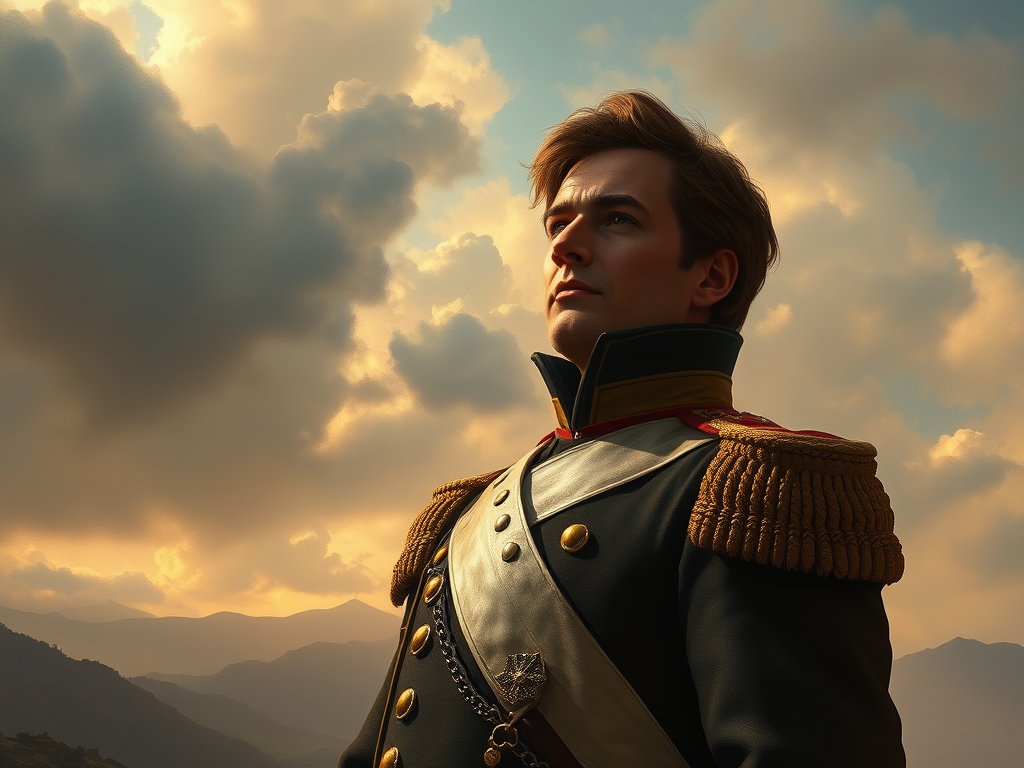
History often remembers Napoleon Bonaparte as a man of ambition, strategy, and ruthless command, but beneath the armor of the Emperor stirred the wounded heart of a dreamer. His life, framed by the Enlightenment yet shadowed by the Romantic age, bore the mark of a man caught between two worlds: the cold rationalism of order and the wild storm of emotion. The boy from Corsica who read The Sorrows of Young Werther with trembling hands did not forget how suffering becomes myth when a soul refuses to dull its ache. In that tension between longing and control, Napoleon found both his rise and his ruin.
Embodiment of Romanticism
Few have embodied the contradictions of Romanticism so fully. He adored clarity and adored chaos. He dreamed of symmetry in politics and was seduced by the asymmetry of passion. His letters to Joséphine, penned during military campaigns, carry the aroma of burning need, fragile pride, and tender resentment. “I awake consumed with you,” he wrote—not to the world, not to the public, but to her, the one he couldn’t quite possess. Behind the war drums echoed the quieter cadence of vulnerability, a rhythm he could never completely silence. He tried to sculpt his life like an epic, and yet, like all Romantics, he remained haunted by the fact that nothing gold ever truly stays.
The age he belonged to had shifted from salons to storms, from Voltaire’s wit to Byron’s thunder. France, drunk on revolution, began yearning not just for freedom, but for feeling—for myth. And Napoleon, both myth-maker and man, became the mirror for those desires. He crowned himself emperor with deliberate drama, not simply as an act of power but as a gesture of symbolism. In him, people saw the Promethean fire—defiant, sacred, tragic. And as Goethe observed, he moved like fate itself. What could be more Romantic than trying to conquer the world with only the fragility of one’s ego to shield the heart?
The Heroica symphony
Beethoven understood this spirit, at least at first. He saw in Napoleon not just a military genius, but a new kind of hero: one who might fuse liberty with will, revolution with form. His Heroica Symphony, meant to capture that spirit, stood originally in Napoleon’s name. But then the man crowned himself, and Beethoven, disillusioned, tore his name from the score. Yet the music remained. Its chords still carry the echo of a fallen ideal—the sound of hope turned human. That gesture, both grand and intimate, speaks to the deeper truth: Romanticism does not forgive betrayal of soul.
The heroic traits of the Emperor
To understand Napoleon through the lens of Romanticism is not to excuse his failings or sanctify his ambitions. We need to see it as a way of recognizing that beneath the empire, there lay a restless inner empire: a longing to be more than flesh, to transcend the limits of mortality, to immortalize his name not just in marble but in memory. That desire, far from being unique, made him deeply human. And perhaps more than anything, it is that humanity—flawed, luminous, self-destructive—that continues to seduce and trouble us.
He wandered through the Alps with books of philosophy, seeking clarity from the peaks. He built his legend not only with cannons but with ideals, some sincere, some staged. He exiled monarchs and was exiled in turn, a fitting symmetry for a man who dreamed in revolutions but lived in spirals. The loneliness of Saint Helena felt less like a punishment and more like a mirror—too honest, too late.
Romanticism aches for the impossible, longing to turn history into poetry, pain into grandeur. Napoleon understood that. He did not just ride into battle; he rode into myth. And whether he rose or fell, he always knew he was being watched by time, judged not only by those he conquered but by the future itself.
A paradoxical heroic legacy
And that is why he still matters. Not as a cautionary tale, not as a monument, but as a symbol of our own contradictions. In Napoleon, Romanticism found both its champion and its warning. He lived as if the soul could shape the world. But the soul, when stretched too far, eventually shatters.



Leave a Reply