Motto: “The exploration of ancient and modern narrative aims to promote Jungian psychology. Like dreams, myths offer profound insights into our subconscious. By analysing symbols from narratives and our experiences, we deepen our self-understanding, embodying the timeless wisdom of ‘Know Thyself.‘ Engaging in this art of reflection, amidst today’s consumerist culture, serves as a shield against social conditioning. Such an approach to life empowers an authentic self-discovery and helps to reclaim personal narratives.”
Friedrich Nietzsche and Sigmund Freud are two towering figures in the realms of psychology. Nietzsche’s Apollonian and Dionysian dichotomy finds intriguing parallels with Freud’s Eros and Thanatos duality. In this post we will explore the interplay between these concepts, shedding light on how they converge and diverge.
In “The Birth of Tragedy,” Nietzsche introduced the concepts of the Apollonian and the Dionysian as forces shaping human culture. The Apollonian represents order, rationality, and artistic expression. The Dionysian force embodies chaos, emotion, and instinctual urges. This dichotomy reveals the struggle between the forces that seek harmony and those that yearn for unrestrained creativity and passion.
Sigmund Freud presented the idea of Eros as the constructive life force of the psyche. Conversely, Thanatos is the destructive force withing all of us. Both are elemental drives that shape human behavior. Eros, the life instinct, represents love, creation, and the preservation of life. Thanatos, on the other hand, signifies the death instinct, embodying aggression, destruction, and chaos.
Eros versus Dionysian
Freud’s Eros and Nietzsche’s Dionysian reveals an intriguing overlap. As archetypes both Eros and Dionysus are associated with life-affirming and creative energies. Eros, as the force of love and connection, shares common ground with Dionysus.
While both concepts involve energies that affirm life, they differ in their expressions and manifestations. Eros tends to be more focused on interpersonal relationships and the preservation of life. Dionysian force has a preference for the transcendence of individuality and rationality through ecstatic experiences.
While both may involve a sense of liberation and vitality, the Dionysian emphasizes a more intense, primal, and often irrational form of expression compared to the more structured and relational nature of Eros.
Eros often aligns with societal norms and values that promote cooperation, family structures, and social cohesion. In contrast, the Dionysian, with its emphasis on ecstatic experiences and a dissolution of boundaries. Thus, the Dionysian may challenge conventional social norms and structures.
Dionysos versus Thanatos
The parallels between Nietzsche’s Dionysian and Freud’s Thanatos become apparent in the shared theme of chaos. Nietzsche associates chaos with the unrestrained creativity of Dionysus. Freud’s Thanatos is a destructive chaos that seeks to dismantle order. Both thinkers recognize the inherent tension between the forces of creation and destruction within the human psyche.
Nietzsche’s Dionysian chaos is associated with uninhibited creativity, primal instincts, and a dissolution of boundaries. Freud’s Thanatos, represents a destructive chaos that seeks to dismantle order and disrupt life.
Thanatos manifests as a counterforce to Eros, the life instinct. This force can lead to behaviours such as aggression, self-destructive tendencies, and the compulsion to repeat traumatic experiences.
The Dionysian, with its emphasis on creative chaos and ecstatic experiences, can inspire a sense of liberation, renewal, and authenticity. It may challenge established norms and values, fostering cultural innovation and artistic expression.
On the contrary, Thanatos finds expression in destructive behaviours, such as violence, self-harm, and the pursuit of death, operating as a disruptive force that undermines individual and social order, leading to conflict, suffering, and the breakdown of relationships. Thanatos, poses a threat to individual and social stability.
Apollo versus Thanatos
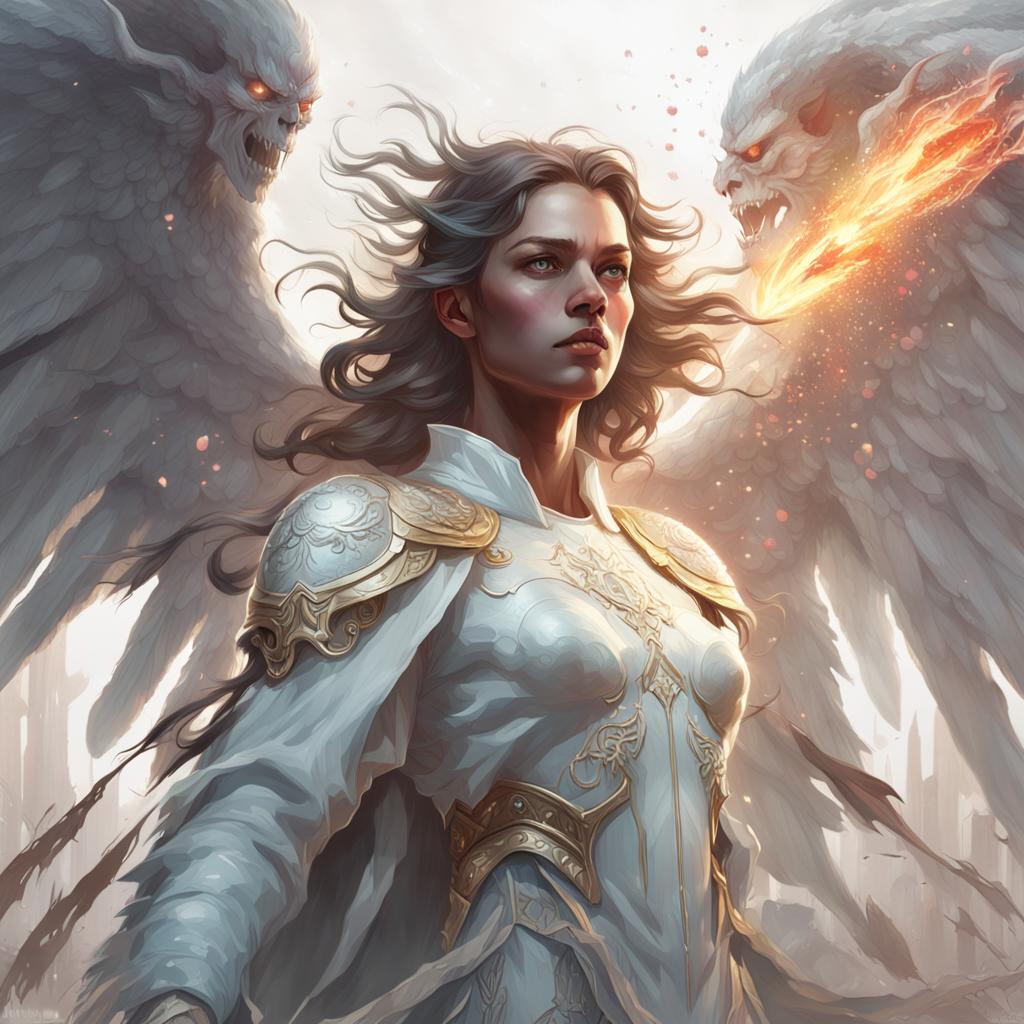
In Nietzsche’s philosophical framework, the conflict between Apollo and Dionysus represents a tension between rational order and creative chaos. While Dionysus challenges Apollo’s structured world with his unbridled creativity and primal instincts, his influence ultimately contributes to the richness and diversity of human culture.
However, the ultimate adversary for Apollo is Thanatos, representing the destructive chaos of the death instinct. Unlike Dionysus, whose creative chaos enriches human experience, Thanatos embodies a threat to both Apollo’s ordered society and Dionysus’s creative fervour. The destructive nature of Thanatos jeopardizes the very fabric of existence, extending beyond cultural tensions to pose an existential threat to humanity’s ability to maintain coherence and meaning in the face of ultimate decay.
The victory of Thanatos would lead to the collapse of both Apollo’s structured world and Dionysus’s creative vitality, plunging humanity into a state of existential despair. Thus, while the conflict between Apollo and Dionysus pertains to differing vital tendencies the threat posed by Thanatos extends to the very essence of life and death, making it a more formidable adversary in Nietzsche’s philosophical narrative.
What are the empowering lessons we can learn from these dichotomies?
- Recognizing the tensions between creative and destructive impulses within ourselves, we can gain insight into our inner conflicts. This awareness allows for introspection and self-reflection, leading to a deeper understanding of our authentic personal motivations and behaviours.
- Acknowledging both the Dionysian/Eros urge for liberation and the Thanatos drive for destruction, we can develop strategies to channel these energies wisely and avoid harmful coping mechanisms.
- Embracing the Dionysian aspect of creativity can inspire us to explore new ideas, experiences.
- Recognizing the presence of destructive impulses associated with Thanatos allows us to address underlying issues and seek support when needed.
- Gaining insight into the inherent chaos of existence, we can adopt a flexible mindset and embrace change, ultimately leading to greater spiritual growth and well-being.





Leave a Reply