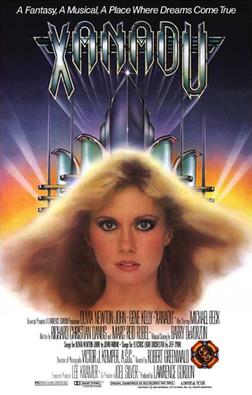
Xanadu, the 1980 musical fantasy film, drew its inspiration from a combination of historical, cultural, and artistic sources. At its core, the movie attempted to reimagine the legendary paradise of Xanadu, as famously depicted in Samuel Taylor Coleridge’s poem “Kubla Khan.” In the film, Xanadu represents more than just a nightclub; it symbolizes the fusion of past and future, an idealized vision of creativity, joy, and human potential. The creators aimed to capture this mystical essence through the use of vibrant music, striking visual aesthetics, and a magical narrative.
The fusion of classic Hollywood and modern pop culture
The decision to cast Gene Kelly, one of the most iconic stars of Hollywood’s golden era, alongside Olivia Newton-John, a beloved pop singer of the 1980s, speaks to the film’s ambition to merge two distinct periods in entertainment history. Gene Kelly’s presence evoked memories of the grand Hollywood musicals of the 1940s and 1950s, while Newton-John embodied the youthful energy and optimism of the 1980s. This fusion was intended to represent a bridging of generations, where old and new could come together in harmony, much like the mythical city of Xanadu represented an earthly paradise where different worlds collided.
Musically, Xanadu featured a soundtrack that combined the orchestral rock of Electric Light Orchestra (ELO) with Newton-John’s pop vocals, blending genres in a way that reflected the film’s desire to unify artistic styles. The goal was to create a soundtrack that would transcend time, much like the film’s themes, and represent a meeting point between tradition and modernity.
The mystical and artistic vision of Xanadu
In the film, Xanadu represents more than just a physical space. It serves as a metaphor for a place where dreams manifest, where the boundaries between reality and fantasy blur. This idea closely ties to the mythical representation of the original Xanadu in “Kubla Khan,” where Coleridge described a paradise of pleasure-domes and sacred rivers. The movie intended to capture this ethereal quality by presenting Xanadu as a realm of endless possibilities, where art, music, and creativity thrive without restriction.
Olivia Newton-John’s character, Kira, embodies the role of a muse, an ancient Greek figure who inspires artists to achieve greatness. Her presence reflects the mystical dimension of the film, where she not only guides the protagonist but also represents the power of imagination and the transcendence of human limitations. Through Kira, Xanadu intended to communicate the notion that creativity flows from a divine source, one that connects both the artist and the audience to something larger than themselves.
The nightclub Xanadu
The nightclub Xanadu, the film’s central symbol, was not meant to simply represent a place for entertainment. It stood for the ideal creative space, a utopian vision where the artist’s dreams take shape and flourish. The film’s creators sought to show how a collaboration between the old and the new, the traditional and the contemporary, could result in something timeless and magical. This idea is echoed in the film’s narrative arc, where the protagonists work together to create a space that embodies beauty, joy, and freedom—a reflection of humanity’s collective creative potential.
In this sense, Xanadu taps into the mystical idea that inspiration comes from an otherworldly place. Just as the mythical Xanadu was a paradise on earth, the film’s Xanadu becomes a symbol of artistic and spiritual fulfillment. It presents creativity as a process that transcends the limitations of time, place, and even genre, allowing people to reach for something higher.
The legacy of Xanadu as a mystical journey
Though Xanadu initially faced criticism, its enduring appeal lies in its exploration of the mystical connection between art, music, and human imagination. By drawing on the legend of Xanadu, the film tried to transport audiences into a dreamlike world where anything seemed possible. It represented a longing for a space where individuals could express their creativity freely, unburdened by the constraints of reality.
Ultimately, Xanadu serves as a reflection of the desire to tap into a deeper, more mystical aspect of human existence. Its vision of a world where art, inspiration, and joy reign reminds audiences of the limitless potential within themselves. The film continues to resonate as a metaphor for the pursuit of creative transcendence, making it a cult classic that speaks to the power of imagination and the timeless allure of the mystical.







Leave a Reply