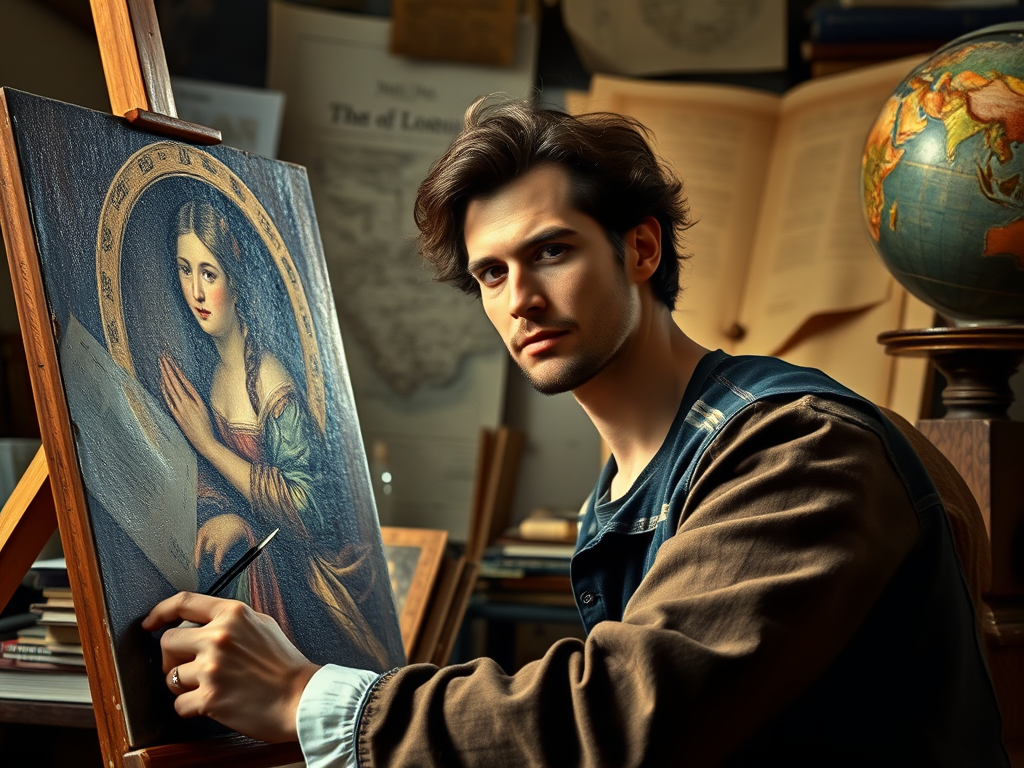
The Enlightenment, a period stretching from the late 17th century to the early 19th century, marked a significant intellectual shift. Philosophers, writers, and artists sought to emphasize reason, individualism, and the importance of scientific inquiry. This transformation was reflected in various facets of culture, including art. The movement challenged long-standing religious doctrines and traditions, propelling people toward a more rational, secular view of the world. Artists began to explore new techniques, themes, and concepts, breaking away from centuries-old conventions.
The shift toward reason and individualism
As Enlightenment thinkers rejected blind obedience to authority and tradition, art mirrored these shifts in profound ways. The era introduced an intellectual environment that valued personal expression over religious or mythological narratives. Artists, rather than following prescribed formats or depicting solely religious themes, began to explore more human-centered subjects. Portraiture, for example, became a prominent genre, reflecting the rising value placed on individual identity and autonomy. Instead of idealized, saintly figures, artists portrayed everyday people with greater psychological depth.
While Renaissance art emphasized divine order and harmony, Enlightenment artists focused on capturing human emotions, reason, and experiences in their works. This period marked a departure from the religious iconography that had dominated the previous centuries. Artists began embracing the idea that human beings were capable of understanding the world through reason and personal inquiry. The human form, often depicted in its most natural state, became a subject of great interest. Artists like Francisco Goya and Jacques-Louis David infused their works with an unprecedented level of realism and emotional expression.
The impact of scientific exploration on art
The Enlightenment brought with it an insatiable curiosity about the natural world. Scientific discoveries reshaped how people viewed the universe and human existence within it. In art, this influence manifested in a heightened focus on observation and detail. Artists took inspiration from the principles of empirical science and sought to portray the world with more precision. The exploration of light, shadow, and anatomical accuracy became central in the work of painters like Leonardo da Vinci and Rembrandt, whose techniques emphasized a realistic portrayal of human figures.
Artists also began experimenting with new perspectives, reflecting the evolving understanding of space and perspective in the physical world. The linear perspective that had dominated Renaissance art was further developed during the Enlightenment, as artists like David used geometrically precise methods to create a sense of depth and structure. With the increasing availability of scientific knowledge, art transformed from mere decoration to a method of inquiry into the human experience and the natural world.
Political and social themes in art
The Enlightenment also encouraged critical reflection on social and political structures. The era’s values of liberty, equality, and fraternity found expression in the works of artists who sought to comment on contemporary political issues. Revolutionary movements across Europe, particularly in France, influenced artists to depict themes of freedom, revolution, and social justice. Jacques-Louis David’s iconic painting The Death of Marat symbolizes the revolutionary spirit of the time, elevating a political martyr to the status of a saint. The work’s stark realism and emotional intensity suggest a deep connection between art and political action, illustrating the potential for art to shape public perception and influence societal change.
Artists not only addressed political subjects but also examined social issues such as the role of women, poverty, and the class divide. The pursuit of individual freedom and social reform found representation in works that called attention to injustice or celebrated personal achievement. Art, in this context, became a tool for societal critique, giving voice to the marginalized and challenging entrenched norms.
The birth of Romanticism
As the Enlightenment gave way to the 19th century, a new movement emerged: Romanticism. While the Enlightenment emphasized reason, order, and objectivity, Romanticism placed a greater emphasis on emotion, imagination, and the sublime. Artists rejected the calculated precision of Enlightenment-era art in favor of a more expressive and subjective approach. Romantic painters such as J.M.W. Turner and Francisco Goya embraced the power of nature, emotion, and individual experience.
Romanticism’s focus on the individual, the dramatic, and the irrational can be seen as a response to the rationalism of the Enlightenment. While Enlightenment thinkers sought to define the world through reason and logic, Romantics acknowledged the complexity and unpredictability of human emotion and the natural world. Art during this period began to evoke a sense of mystery, danger, and transcendence, exploring the depths of the human psyche and the unknown forces that shaped existence.
Psychological depth in art
The Enlightenment’s emphasis on the individual also had profound implications for the psychological depth of art. Artists no longer simply depicted the external world; they also sought to convey internal states, such as joy, sorrow, anxiety, and contemplation. This shift towards exploring the mind and emotions foreshadowed later developments in psychology and art. The rise of portraiture and genre painting allowed artists to delve deeper into the psychological complexity of their subjects, offering a window into the human soul.
Portraiture, in particular, became an avenue for the exploration of identity. Rather than merely creating flattering depictions of their sitters, artists began to represent individuals in a more introspective and often more vulnerable light. In works like Thomas Gainsborough’s The Blue Boy, the subject is not only an aristocrat but an individual, conveying a range of human emotions beneath the surface of social status.
The Enlightenment gave birth to a new understanding of the self, and art became a medium for exploring the complexity of human consciousness. The psychological depth that emerged during this time would set the stage for later artistic movements and psychological theories, particularly in the 20th century.
Lasting influence on modern art
The ideas cultivated during the Enlightenment continue to influence art today. The emphasis on reason, individualism, and critical thought laid the foundation for many artistic movements in the 19th and 20th centuries. From realism and romanticism to the abstract expressions of modernism, Enlightenment values of freedom, personal expression, and the quest for knowledge resonate deeply in the evolution of artistic styles.
In many ways, the Enlightenment marked the beginning of art as an intellectual pursuit. It connected deeply to philosophical and psychological thought, and artists began using their work as a way to comment on, question, and challenge societal norms. The blending of art with reason, science, and politics during this period established a rich foundation for artists to reflect on the world and their place within it.
As art continued to evolve, the Enlightenment’s influence remained a powerful undercurrent, driving artists to explore the complexities of the human condition and the vastness of the natural world. It was a time when the boundaries between art, science, and philosophy became increasingly blurred, forever changing the landscape of creativity.

Leave a Reply