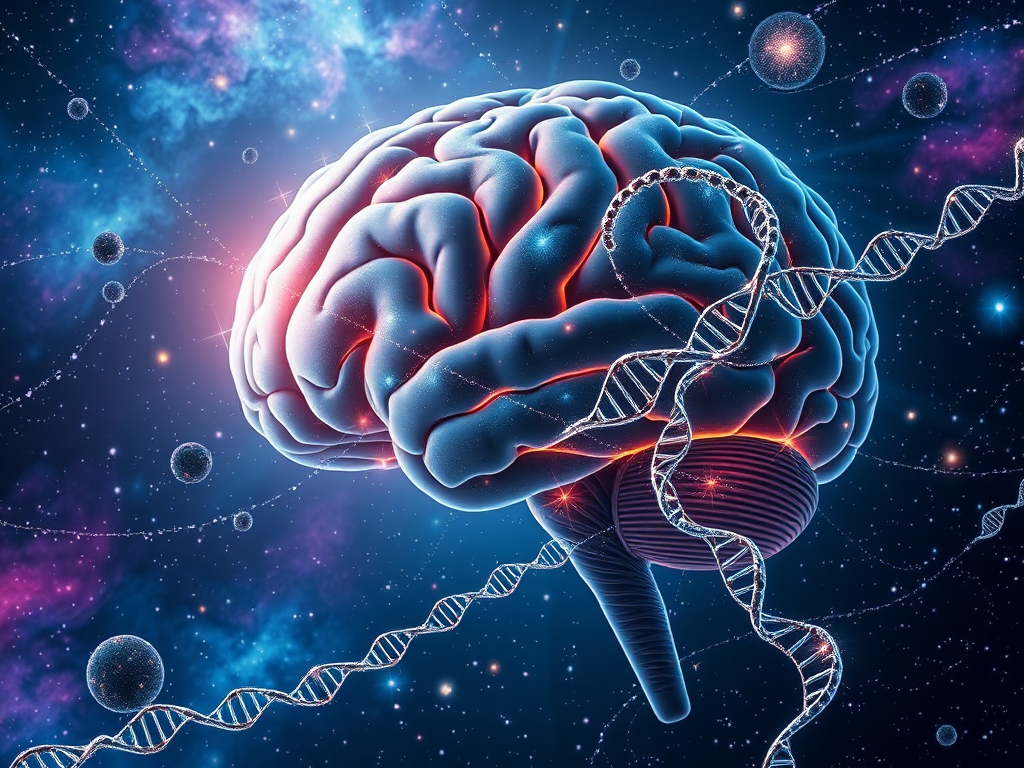
Panpsychism is the philosophical theory that consciousness is a fundamental feature of all matter. According to this idea, even the smallest particles and simplest forms of matter may possess some form of experience or awareness. This concept stands in contrast to the mainstream view that consciousness emerges only from complex biological systems, such as the brain. If panpsychism is true, we would live in a world where consciousness exists throughout, from atoms to galaxies, making reality itself a web of interconnected, conscious entities.
This philosophical perspective, while often seen as unconventional, has a long history. Ancient thinkers like the Stoics believed in a form of universal consciousness, and even Spinoza proposed that all of reality is imbued with a divine substance. In the 20th century, philosophers such as Alfred North Whitehead and Galen Strawson reignited panpsychism, proposing that the universe is composed of experiences at every level, not simply mechanical interactions. If these ideas are correct, the implications would reach beyond philosophy and into the realms of physics, ethics, and even spirituality.
What quantum theory might reveal about consciousness
Quantum theory, particularly the work of figures like David Bohm and Roger Penrose, opens new dimensions to this conversation. Bohm’s holistic view of the universe suggests that everything in existence interconnecs through an invisible implicate order. This perspective aligns closely with panpsychism’s notion that consciousness permeates all levels of reality. If quantum phenomena underlie consciousness, as Penrose speculates in his theory of orchestrated objective reduction (Orch-OR), we might unlock the mysteries of how consciousness exists in the quantum realm.
Quantum theory already challenges the classical understanding of reality, showing that particles behave in unpredictable, non-local ways. The idea that consciousness could be a quantum phenomenon opens the door to exploring how these quantum processes might govern even the most basic elements of matter.
Knowledge would begin to include first-person perspectives
Galileo famously removed qualities from the study of matter. He claimed science must exclude color, taste, and feeling to achieve clarity. That move gave rise to physics as we know it, but at a cost. Panpsychism restores interiority to the world without discarding reason. Thinkers like Alfred North Whitehead argue that every actual occasion includes feeling, even without thought. A shift would occur in epistemology: not only facts, but perspectives would count as knowledge.
Modern science often separates the knower from the known, measuring objects through neutral instruments. A panpsychist universe would not behave like a machine waiting to be examined. William James imagined consciousness not as an on-off switch, but as something diffuse and layered throughout reality. If even matter contains some degree of subjectivity, then to know becomes to relate, to feel across boundaries. Science would expand not by eliminating subjectivity, but by taking its hidden presence seriously.
Death would transform but not erase awareness
The usual model treats death as the final blackout, where the self vanishes because the brain stops working. In a panpsychist view, consciousness never appears out of nowhere and never disappears into nothing. The structure that held personal awareness might dissolve, but the underlying field of experience remains. The philosopher David Chalmers speculates that we might one day model consciousness like electromagnetism—a basic force, not a late effect. Nothing would return to unconscious matter because no matter was ever unconscious.
The world would appear less silent and more alive
Trees would not simply photosynthesize, and rocks would not merely sit in fields without stories. Their experience would differ radically from ours—slower, simpler, without self-awareness—but still real in their own way. Neuroscientist Thomas Nagel asked, “What is it like to be a bat?” and in doing so reminded us that subjective experience escapes direct description.
Shifting our relationship with nature
With panpsychism, nature would no longer be seen merely as a resource for us to exploit but as a conscious participant in existence. If the trees, rocks, and rivers possess awareness, our relationship with nature could take on a deeper, more respectful tone. We would need to reconsider the ethics of how we interact with the environment. The way we treat the planet might no longer feel like a human-centered obligation but a responsibility toward conscious entities with their own experiences and rights. This could inspire a new level of environmental stewardship, with human actions aligned not just with preserving nature for our benefit but in respect for its intrinsic value as conscious matter.
Our sense of identity would change
Right now, we imagine the self as enclosed within the skull, defined by thoughts that occur inside our heads. If experience flows through every particle, then our selfhood may include the air we breathe, the chair we touch, or the light on the floor. The boundary between subject and object would no longer hold its sharpness. We would begin to sense ourselves as constellations within a wider field of sentience that never really excludes anything.
Art, myth, and ritual would reclaim intellectual authority
For too long, we dismissed non-rational ways of knowing as primitive, sentimental, or pre-scientific. In a panpsychist world, we would return to practices that once honored the inner life of all things. Indigenous cosmologies often treat nature as conscious not metaphorically, but literally. By aligning with that view, we would not regress into superstition but recover a sense of relational depth that modern science stripped away. The arts would no longer decorate understanding—they would reveal its unspoken side.
The universe would feel less mechanical and more relational
When everything thinks in its own way, reality stops being an impersonal stage. We would no longer feel like minds looking at matter but as minds moving within other minds. Panpsychism does not offer comfort or certainty—it asks us to give up the illusion of isolation. We would become aware that every gesture sends ripples across a field of sentience far older than we are. The cosmos would not be empty space—it would be a shared interior.
Impact on our perception of reality
Consciousness would no longer be confined to humans or even animals; instead, we would recognize that everything in the universe participates in the creation of reality. Our perception of the world around us would change dramatically. What once seemed like inanimate objects would be revealed as active participants in shaping the world. The observer, no longer distinct from the observed, would create reality in a shared experience with the universe itself. Reality might not be an objective, static construct but a dynamic, interactive process where consciousness continuously emerges and shapes our experience.
This change in perspective could radically alter not only how we understand consciousness but how we interact with the world around us. Every action, no matter how small, might be seen as having the potential to influence a conscious universe, creating a deeper sense of responsibility toward the world and everything in it.
A new understanding of reality construction
The implications of panpsychism extend into how we construct reality itself. If consciousness permeates all matter, then reality is not just something we passively observe. Rather, we actively participate in the creation of our surroundings. Every thought, every interaction, could affect the conscious entities that make up the world. Reality would no longer be fixed or solely the product of our minds. Instead, it would be a shared creation between us and the conscious world around us.
If we begin to see consciousness as a fundamental force that shapes reality at every level, we would understand that we are not isolated from the world. Our minds do not just interpret the world; they help to create it. This perspective could change how we view the universe—from a cold, indifferent place to a vibrant, conscious entity that we are deeply connected with.
In this new understanding, reality is no longer an external object we study, but an interactive process we co-create. This shift in thinking could redefine not only science but also how we live, work, and relate to the universe. If consciousness exists in all things, we might find that our lives are not just part of a grand narrative but also contributors to that narrative, shaping existence with every action, thought, and connection.



Leave a Reply