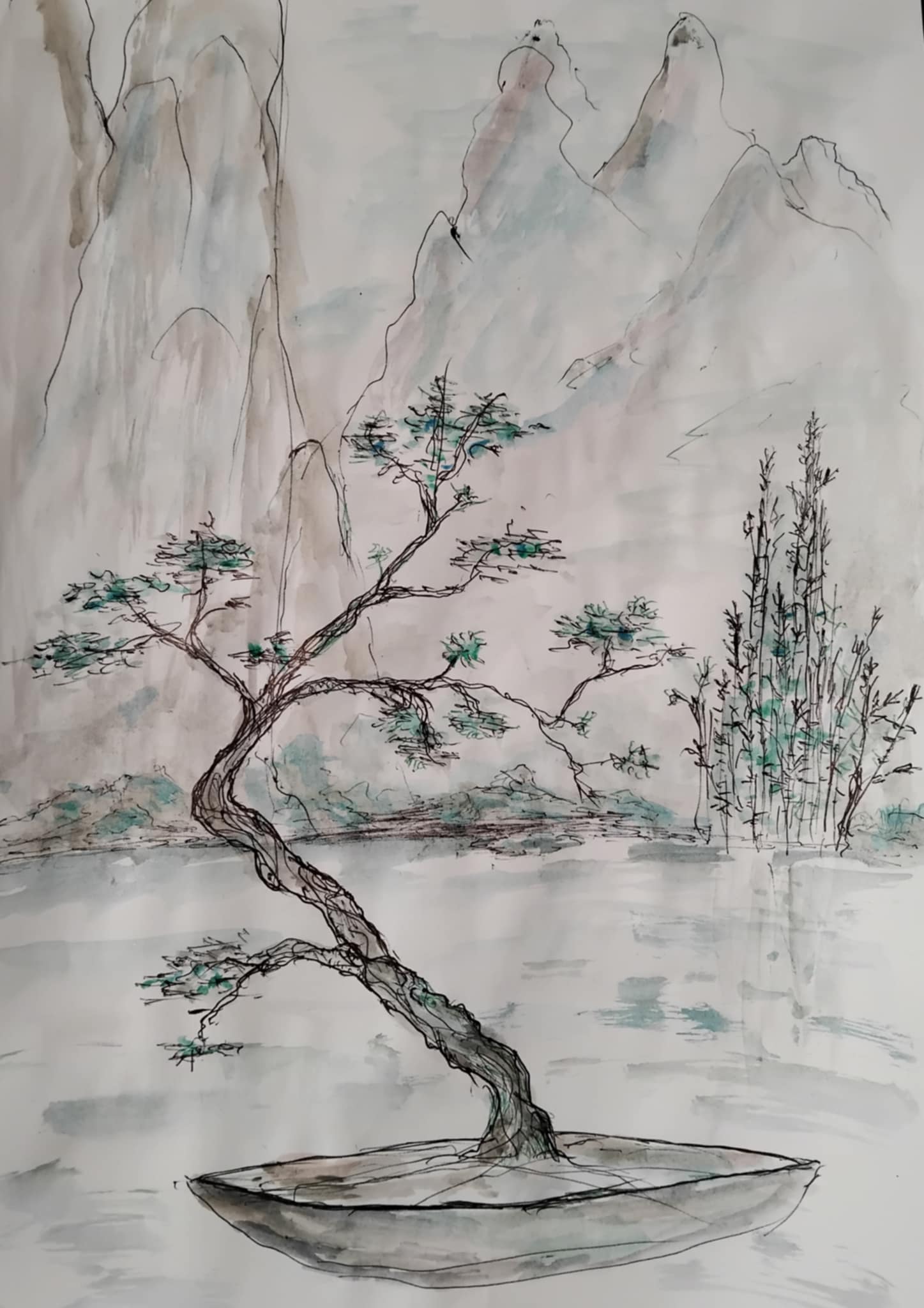
I sat down with a quiet intention: to paint something simple, inspired by the spirit of Chinese art. A pine tree took shape in the centre. Behind it, a lake, a bamboo bush, and distant mountains emerged in soft tones—just enough to suggest a world, nothing more. I wanted it to breathe, to hold emptiness.
But emptiness quickly began to feel like absence. The composition seemed too bare. I kept adding—small details, soft shadows, subtle layers. Every time I looked at it, it felt like something was still missing. The balance between simplicity and incompleteness became harder to hold.
The more I worked on it, the more I was drawn into the details. It stopped being a meditative flow and became something else: a tension between finishing and overworking. At some point, I said enough. I accepted the image as it was, knowing that chasing perfection would only strip it of its honesty. I put the brush down. When to stop is an art in itself—whether in painting, thought, or life.
And then I began reflecting. What would I do differently next time? That reflection turned out to be as rewarding as the painting itself. I tried not to be judgmental, but I didn’t avoid judgment. Judgment gives valuable feedback. Being judgmental kills the fun.
What stayed with me wasn’t the result, but the atmosphere. Somehow—though not entirely—I stepped into that Oriental landscape. And that, for me, was enough.





Leave a Reply