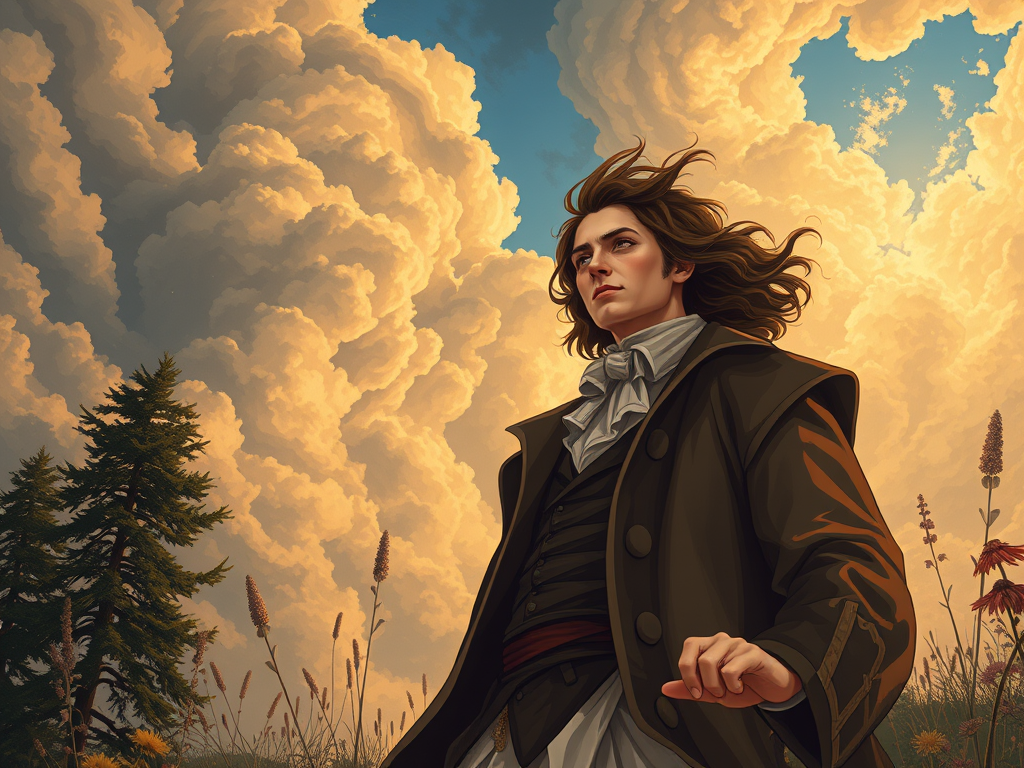
Percy Bysshe Shelley was one of the central figures of Romanticism, a movement that reshaped literature, art, and thought in the late 18th and early 19th centuries. Romanticism emphasized emotion over reason, imagination over strict logic, and the individual’s deep connection to nature and the sublime. It rebelled against industrialization, rigid social structures, and the constraints of Enlightenment rationality, celebrating creativity, personal freedom, and the pursuit of idealism. The movement often explored intense feelings, revolutionary ideas, and the human spirit’s capacity to transcend the ordinary.
Shelley was born on August 4, 1792, in Sussex, England, into a wealthy, aristocratic family. He attended Eton College, where he developed a strong sense of justice and a distrust of authority, which later shaped his radical political and social views. Shelley studied briefly at Oxford University but was expelled for publishing a pamphlet titled The Necessity of Atheism, reflecting his unflinching commitment to questioning established norms. He married Mary Wollstonecraft Godwin, who would later write Frankenstein, and they moved among the circle of radical writers, thinkers, and poets that defined the early 19th-century intellectual scene.
Shelley’s life mirrored the principles of Romanticism in profound ways. His poetry, including works like Ozymandias, To a Skylark, and Prometheus Unbound, celebrated imagination, the beauty and power of nature, and the ideal of human liberation. He championed personal and political freedom, challenging societal conventions, the monarchy, and organized religion. Shelley’s life was marked by personal rebellion—against family expectations, social conventions, and literary traditions. He embraced intense emotional experiences, including passion, grief, and love, often transforming them into poetic insight.
Romanticism’s emphasis on the individual and the sublime aligned closely with Shelley’s restless spirit. He lived largely on the fringes of society, often financially unstable, traveling in Italy and other parts of Europe in search of intellectual and emotional inspiration. His pursuit of idealism, both politically and personally, and his willingness to defy convention at great personal cost, embody the Romantic ideal of a life lived in harmony with imagination, emotion, and conscience rather than conformity.
Shelley died tragically young at 29, drowning in a storm off the Italian coast in 1822, but his life and work remain quintessential examples of Romanticism: passionate, visionary, and defiantly unbound by the limits of his society.






Leave a Reply