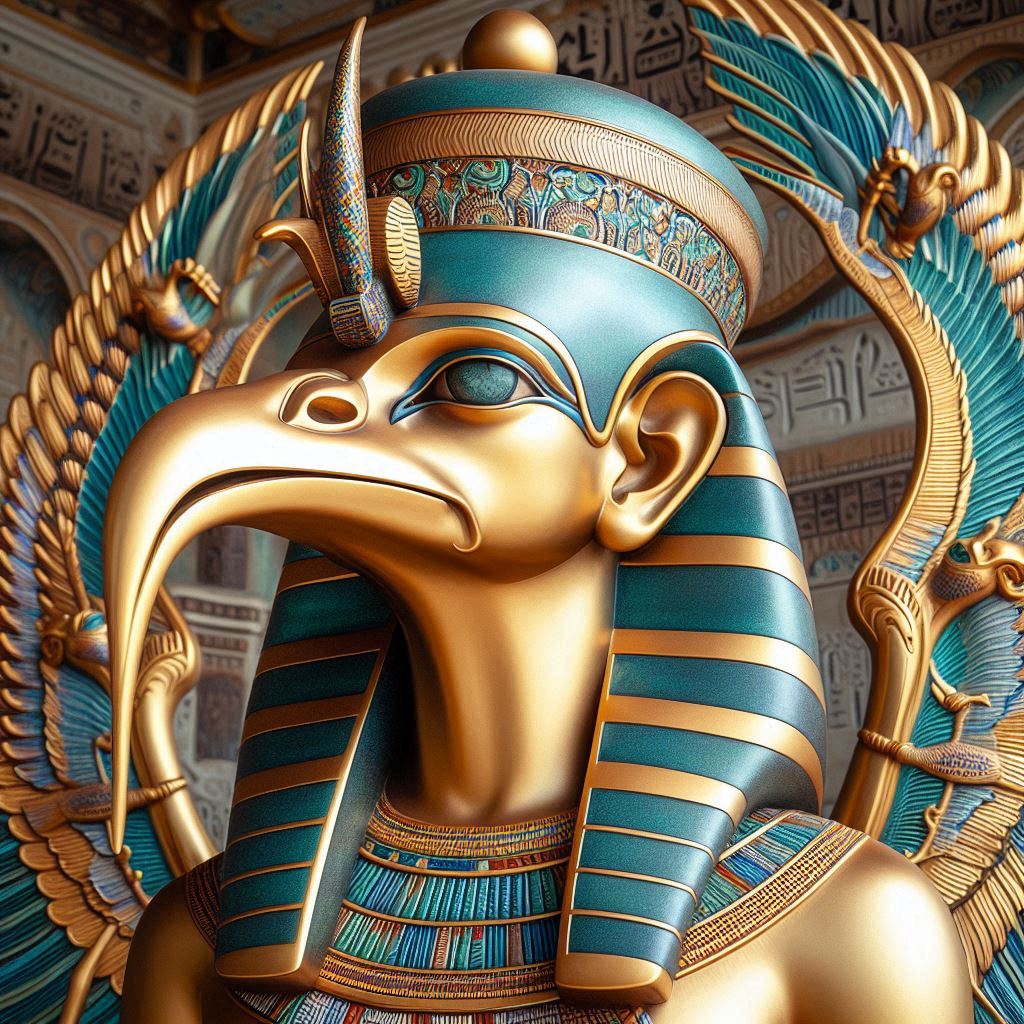
Thoth is a fascinating deity in ancient Egyptian mythology, often depicted with the head of an ibis or sometimes a baboon, and associated with wisdom, writing, and magic. He played a crucial role in many myths and was revered as a divine scribe and mediator.
Weighing of the heart
Thoth is often depicted as a deity who records the deeds of both gods and humans. One of his key roles is as a divine scribe and keeper of records, particularly during the “Weighing of the Heart” ceremony in the afterlife.
In this ceremony, god Anubis weigh the heart of the deceased against the feather of Ma’at, the goddess of truth and cosmic order. If the heart is lighter than the feather, the soul is deemed pure and allowed to enter the afterlife. If it is heavier, it is devoured by the demon Ammit, leading to the soul’s annihilation. Thoth is responsible for recording the results of this judgment, meticulously noting the outcome and ensuring that justice is served.
This role as a recorder of deeds aligns with his broader function as a god of wisdom, writing, and knowledge. Thoth’s role in recording the deeds of the dead underscores the Egyptian belief that all actions are observed, judged, and preserved in the cosmic order, with Thoth serving as the divine keeper of this universal memory.
Thoth and Osiris
In the central Osiris myth, Thoth plays a vital role in the resurrection and continuation of the divine lineage. When Osiris is murdered by his brother Set, his wife Isis, with the help of her sister Nephthys, seeks to bring him back to life. Thoth, as the god of wisdom and magic, provides Isis with the powerful words and spells needed to restore Osiris. Through this divine knowledge, Isis is able to reanimate Osiris just long enough to conceive their son, Horus.
Later in the myth, when Horus grows up and battles Set to avenge his father and claim his rightful throne, Thoth again plays a crucial role. He offers counsel and wisdom to Horus, guiding him through the trials and conflicts with Set. Thoth’s involvement in both the resurrection of Osiris and the guidance of Horus underscores his role as a mediator and protector of cosmic order, using his wisdom to ensure the continuation of the divine lineage and the restoration of balance in the universe.
Thoth as universal memory
Toth’s significance extends beyond mere divinity. Symbolically, he embodies the concept of universal memory, where every action, thought, and event is meticulously recorded and preserved. This role makes him a profound symbol of the interconnectedness of all things and the perpetual nature of existence. Exploring Thoth’s role as a keeper of universal memory reveals intriguing parallels with concepts such as karma, Akasha, and similar ideas across various cultures.
His association with writing and knowledge further cements his role as the keeper of universal memory. Thoth was believed to have invented writing and maintained an extensive record of cosmic and human events. This aspect of Thoth aligns with the idea that every action is logged in the grand ledger of the universe, symbolizing a continuous and omnipresent consciousness that maintains the balance of existence.
Comparing Thoth with karma
The concept of karma, prevalent in Hinduism, Buddhism, and Jainism, shares similarities with Thoth’s role as the cosmic record-keeper. Karma posits that every action, whether good or bad, has consequences that will return to the individual in the future. This principle of cause and effect underscores the idea that the universe maintains a record of all deeds, influencing one’s future experiences and spiritual evolution.
Just as Thoth records the outcomes of the deceased’s actions and maintains cosmic order, karma represents the universe’s moral ledger, ensuring that every action is accounted for and affects future outcomes. Both concepts emphasize that the actions of individuals are not forgotten but are rather integral to the unfolding of life and the cosmos.
Thoth and Akasha
In contrast, the concept of Akasha, from Eastern traditions, represents a more metaphysical aspect of universal memory. Akasha is often described as the fifth element or the cosmic ether that records all events, thoughts, and experiences in the universe. This concept aligns closely with the idea of a cosmic archive where everything is imprinted in a vast, invisible field of consciousness.
Thoth’s role in recording and maintaining the balance of the universe mirrors the function of Akasha as a repository of all cosmic data. While Thoth is more focused on the tangible aspects of recording and writing, Akasha embodies a more abstract and pervasive form of universal memory. Both concepts suggest that the universe maintains a complete record of existence, whether through divine scribes like Thoth or through the ethereal Akasha.
Similar concepts
Thoth’s function as a keeper of universal memory also has parallels in other mythologies and philosophical traditions. For example, in Greek mythology, the goddess Mnemosyne represents memory and is associated with the recording of human experiences. Her role as a Titaness and the mother of the Muses highlights the significance of memory and knowledge in shaping human culture and divine order.
In the Chinese tradition, the concept of “Heavenly Stems and Earthly Branches” reflects a similar notion of recording and maintaining cosmic balance. This ancient system was used to track time and events, symbolizing a cosmic record-keeping system that ensured harmony between heaven and earth.
Concluding reflections
Thoth, as a symbol of universal memory, represents a profound aspect of ancient Egyptian spirituality where every action and thought is recorded in the cosmic ledger. This concept resonates with the principles of karma, where every deed has consequences, and Akasha, where all experiences are imprinted in a vast, invisible repository. The parallels found in other mythologies and philosophies further illustrate a shared understanding across cultures of the importance of recording and maintaining cosmic balance. Whether through divine scribes, cosmic records, or moral cause-and-effect, these concepts underscore the universal truth that nothing is ever truly forgotten, and every action is part of the grand tapestry of existence.







Leave a Reply