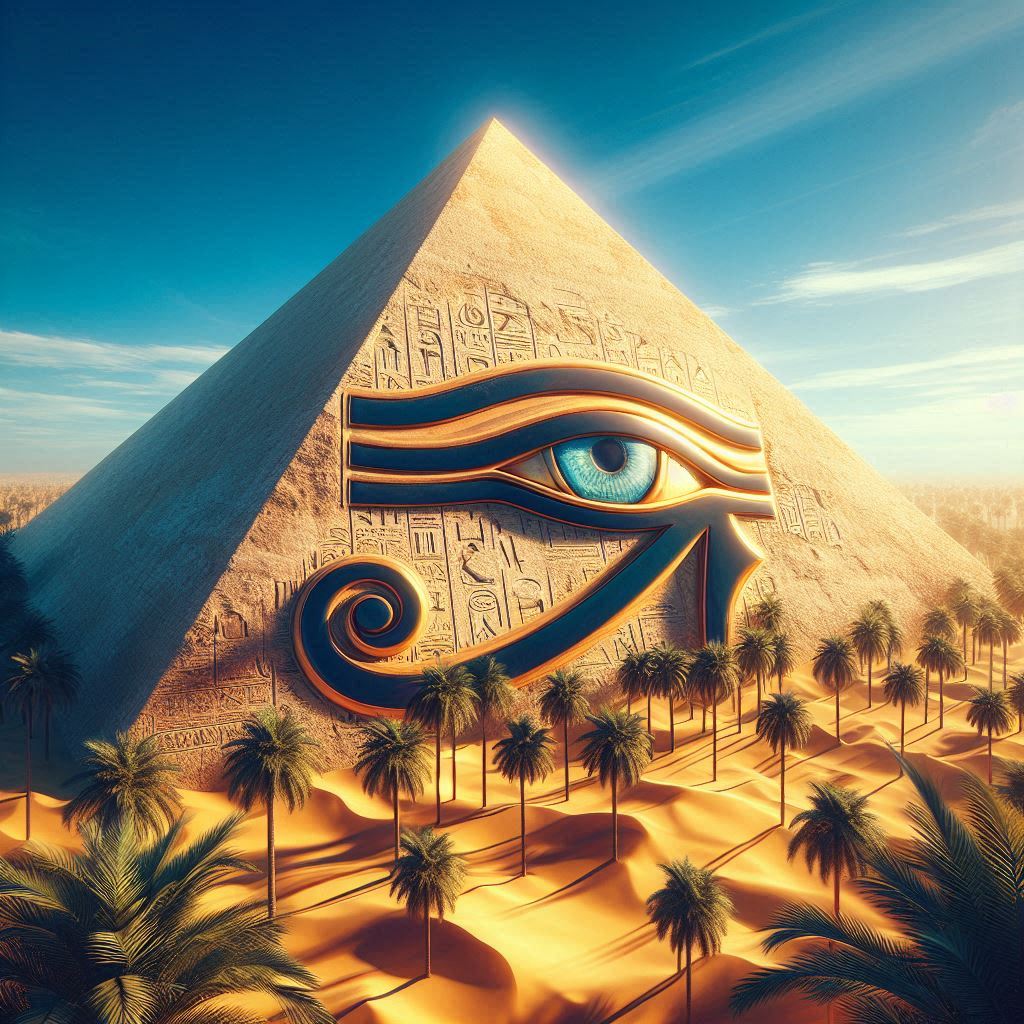
The Egyptian gods formed a complex and diverse pantheon integral to ancient Egyptian religion and culture. Central to their belief system, these deities were deeply interwoven with natural phenomena, daily life, and the afterlife. Each god or goddess embodied specific aspects of the world, such as creation, order, or chaos, and was often associated with particular elements of nature, social roles, or moral principles. Worship of these gods was a cornerstone of Egyptian spirituality, influencing everything from royal legitimacy to personal well-being and cosmic balance.
Ra
The sun god, often depicted with a falcon head and a sun disk, travels across the sky in his solar barque and battles the serpent Apophis in the underworld at night to ensure the sun’s rebirth each morning.
Osiris
The god of the afterlife and resurrection, shown as a mummified man with a white crown, governs the fertility of the Nile. Set, his brother, murders him, but his wife, Isis, revives him briefly to father Horus. Osiris then becomes the ruler of the underworld.
Isis
The goddess of magic, motherhood, and fertility, she is the sister and wife of Osiris and the mother of Horus. Known for her role in Osiris’s resurrection and her nurturing qualities, she uses her magic to protect and care for both the living and the dead.
Horus
The god of the sky and kingship, depicted with a falcon head, avenges his father Osiris’s death by defeating Set and reclaiming his rightful place as ruler. Horus also protects the pharaoh, seen as his earthly embodiment.
Set (Seth)
The god of chaos, violence, and the desert, shown with the head of a mysterious animal, is known for murdering Osiris and opposing Horus. Despite his chaotic nature, Set plays a role in maintaining cosmic balance.
Anubis
The god of mummification and the afterlife, depicted with a jackal’s head, oversees the embalming process and guides souls to the underworld. Anubis also protects graves and manages the judgment process.
Thoth
The god of wisdom, writing, and the moon, shown with an ibis head, is credited with inventing writing and serving as a scribe of the gods. The role of Thoth is to maintain the balance of the universe and assists in judging souls.
Hathor
The goddess of love, beauty, and motherhood, often represented with a cow’s head or cow horns and a sun disk. Hathor is also the goddess of music, dance, and fertility. She nurtures and protects women.
Sekhmet
The lioness-headed goddess of war and healing, known for her fierce nature, also has a role in curing diseases. She is a protector of the pharaoh and a warrior goddess.
Ma’at
The goddess of truth, justice, and cosmic order, depicted with an ostrich feather, ensures the balance and harmony of the universe. Her principles are central to Egyptian law and morality. The feather of Ma’at is used to weigh the hearts of the deceased during judgment.
Ptah
The creator god and patron of craftsmen, shown as a mummified man with a skullcap. Pthah has created the world through his thought and speech. He is the patron of the city of Memphis.
Geb
The god of the earth, depicted as a man lying on the ground with a goose (his symbol) on his head, rules the earth and is part of the Ennead, a group of nine deities worshipped in Heliopolis. He is also the god of fertility and agriculture.
Nut
The goddess of the sky, shown as a woman arched over the earth with stars on her body, swallows the sun each evening and gives birth to it each morning, symbolizing the cycle of day and night.
Tefnut
The goddess of moisture and rain, depicted with a lioness head. She is the goddess of water and moisture. Also she is the sister and wife of Shu, the god of air.
Shu
The god of air and supporter of the sky, depicted as a man with a feather on his head, separates the sky goddess Nut from the earth god Geb, maintaining their balance.
These gods and goddesses played crucial roles in ancient Egyptian religion, embodying the natural forces and societal values of their time.




Leave a Reply