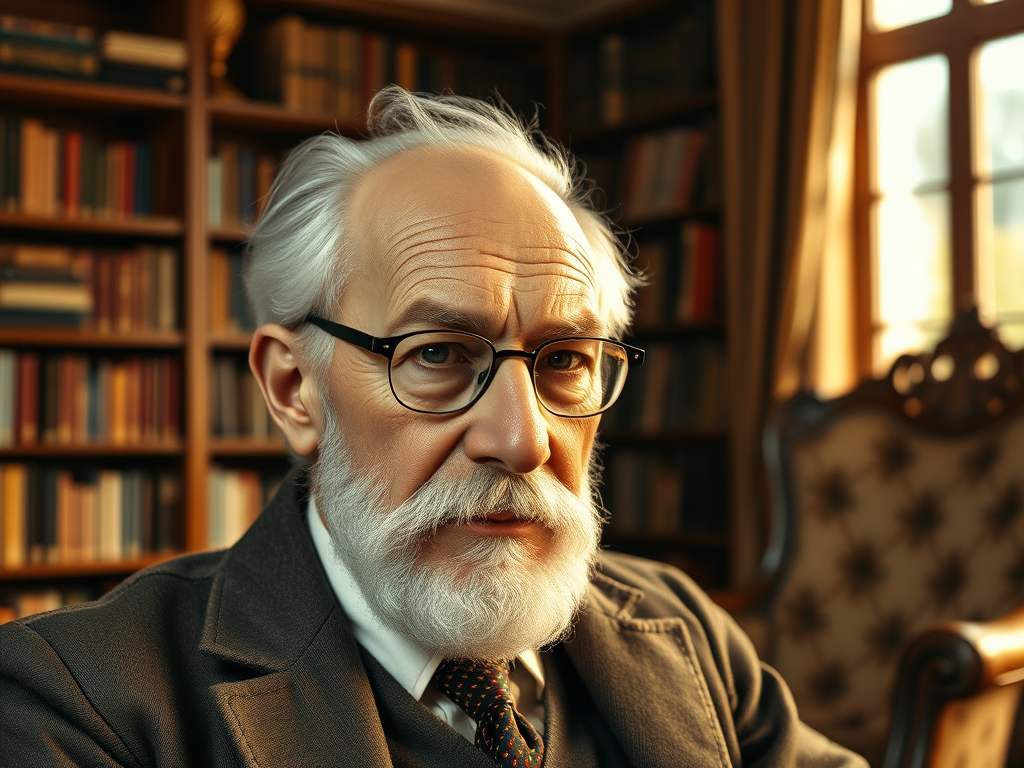
Sigmund Freud, the father of psychoanalysis transformed the way people understand the human mind. Born in 1856, he developed ground-breaking theories about the unconscious, repression, and dreams.
His views on religion sparked controversy, as he described faith as an illusion rooted in childhood dependency. Many assume this means he rejected all forms of spirituality. However, his emphasis on self-knowledge, authenticity, and deep inner exploration aligns with core spiritual values. Searching for truth within the unconscious, confronting repressed fears, and embracing authenticity formed the foundation of his work. These ideas mirror the spiritual pursuit of inner transformation, even though he never openly framed them as such.
He often stood at odds with religion, calling it an illusion born from human desires and anxieties. Inspired probably by Feuerbach, Freud argued that religious beliefs emerged from childhood needs, projecting authority figures onto an imagined divine presence. Many see this as evidence that Freud rejected all forms of spirituality. However, he valued self-knowledge, authenticity, and the deep exploration of the unconscious. These aspects align with spiritual traditions that emphasize inner transformation, even though Freud never openly embraced spirituality.
Jung and Freud on spirituality
During his early career, Carl Jung was a devoted disciple of Sigmund Freud and even appeared poised to succeed him in advancing psychoanalytic theory. At that time, Jung embraced many of Freud’s foundational ideas, particularly the significance of the unconscious in shaping human behavior. However, as Jung’s intellectual journey progressed, he began to question some of Freud’s core assumptions, leading to a gradual but profound divergence in their theories.
Freud’s approach to the unconscious was primarily centered on repressed sexual desires and impulses. He argued that neuroses and other psychological disturbances stemmed largely from unresolved conflicts related to these repressed drives. Jung, however, soon realized that this explanation did not fully account for the complexities of human experience. He introduced the concept of the collective unconscious—a deeper, shared layer of the mind populated by archetypes and universal symbols. This perspective not only broadened the scope of what constituted the unconscious but also infused it with a dimension that was both symbolic and spiritual.
The divergence between the two thinkers became most pronounced in their treatment of spirituality. Freud maintained a skeptical stance toward religious and spiritual phenomena, viewing them as illusory constructs or manifestations of neurotic processes. He believed that a scientific study of the psyche should be strictly confined to observable and physiological aspects of human behavior. In contrast, Jung saw spirituality as an indispensable element of psychological development. He argued that engaging with myths, symbols, and religious experiences was crucial for achieving individuation—a process of integrating the various facets of one’s self to attain wholeness. This broader interpretation of psychic energy, which Jung referred to as libido, was not limited to sexual drives but encompassed creative, intellectual, and spiritual energies as well.
The spiritual split
As Jung’s ideas evolved, the differences between his views and Freud’s became irreconcilable. Jung’s interest in mystical traditions, Eastern philosophies, and the symbolic dimensions of the human experience challenged the more rigid, reductionist framework that Freud had established. This fundamental disagreement over the nature of the unconscious, the interpretation of libido, and the role of spirituality in human psychology ultimately led to a personal and professional separation between the two men. Jung’s departure from Freud’s school of thought marked the beginning of analytical psychology—a discipline that continues to explore the integration of spirituality and myth into our understanding of the psyche.
The unconscious as the path to truth
We all know that Freud revolutionized psychology by uncovering the depths of the unconscious mind. He saw hidden desires, repressed memories, and unconscious conflicts shaping behavior and emotions. This exploration of the hidden self mirrors spiritual traditions that focus on inner awareness. Freud believed that understanding these unconscious forces led to greater authenticity. He urged people to confront their fears, desires, and inner contradictions rather than live in self-deception.
Mystical traditions also emphasize the journey inward. Buddhism speaks of confronting illusions, while Jung later expanded on the unconscious through archetypes and individuation. Freud never framed his work as spiritual, yet he provided tools for deep self-exploration. He encouraged people to question their motivations and uncover hidden truths, just as spiritual seekers aim for enlightenment.
Authenticity as a means of transformation
Despite his lack of open spiritual views , Freud saw authenticity as liberation from neurosis. He believed that psychological suffering stemmed from repression, hypocrisy, and self-deception. He urged people to face their true selves rather than conform to societal expectations. This idea resonates with spiritual teachings that stress inner truth over external validation.
Authenticity in Freud’s view required deep analysis. He believed that confronting repressed emotions, traumas, and desires would bring people closer to their real selves. This mirrors the way spiritual traditions emphasize shedding false identities. Existentialists later explored similar ideas, with figures like Sartre emphasizing self-definition and freedom. Freud’s insistence on truth-seeking placed him closer to spiritual traditions than many assume.
Desire, suffering, and liberation
Inspired probably by Nietzsche, Freud believed that human beings were torn between desires and the constraints of society. He saw suffering as inevitable because of this conflict. Religious traditions also address suffering, offering paths to transcendence. Freud never promised ultimate liberation, but he believed that self-awareness could ease suffering. He argued that confronting unconscious fears freed people from their grip. This resembles the way Buddhism speaks of overcoming attachments through awareness.
Despite his skepticism about religious beliefs, Freud understood the power of the mind to shape experience. He acknowledged that symbols, myths, and dreams carried deep psychological meaning. He analyzed dreams as gateways to the unconscious, a practice that resembles mystical traditions using visions and symbols for insight.
Freud’s unspoken spirituality
As seen above, Freud never identified as a spiritual thinker, yet his work aligned with many spiritual principles. He championed self-exploration, authenticity, and the search for deeper meaning. He rejected blind faith but encouraged confronting the unknown within. His work opened doors to understanding the mind in ways that went beyond materialism. Even though he dismissed religious doctrine, he valued the journey of self-discovery. His ideas laid the groundwork for psychological and spiritual discussions that continue today.






Leave a Reply